
A crochet frog is a round, grinning little toy that suits a new maker, and here you will find six frog ideas along with a complete written pattern for a chubby sitting frog about 3 inches tall. The body is one stuffed ball, the eyes are two little domes on top, and the legs are tiny flat tubes. No tricky shaping, no long limbs to stuff.
Frogs forgive a lot. A slightly lopsided body just looks like a frog that ate well. That makes this a good project when you know the magic ring and single crochet but have not finished a toy yet. When you want more critters after this one, the amigurumi patterns section has the full family.
At a glance
Skill level
BeginnerYarn
Worsted acrylic or cotton, about 40 yards greenHook
3.5 mm (E-4)Size
About 3 inches tallTime
2 to 3 hoursStitches used
MR, sc, inc, invisible dec
6 crochet frog designs to make
Every design lists the skill level, yarn and hook, with a note from the maker.
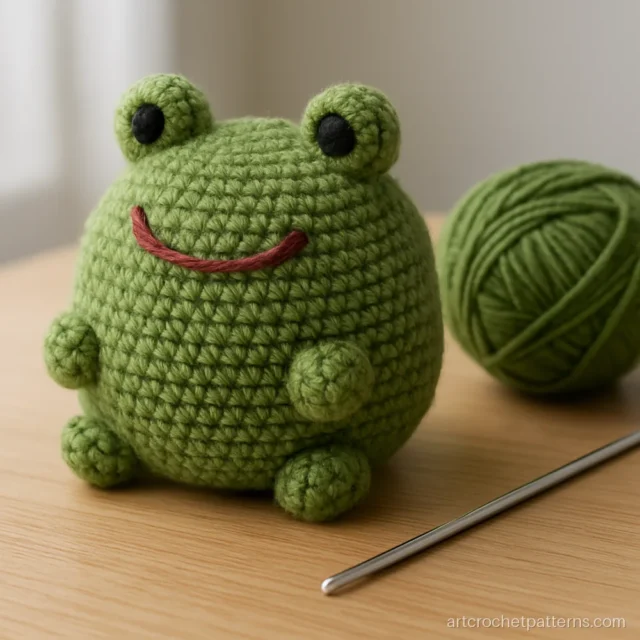 LevelBeginnerYarnWorsted acrylicHook3.5 mm (E-4)
Classic sitting frog in leaf green
This is the frog from the written pattern below. The wide body sits flat on a shelf without any weighting.
Maker note: Pin both eye domes before sewing. Set them close together on the crown so the frog looks up at you.
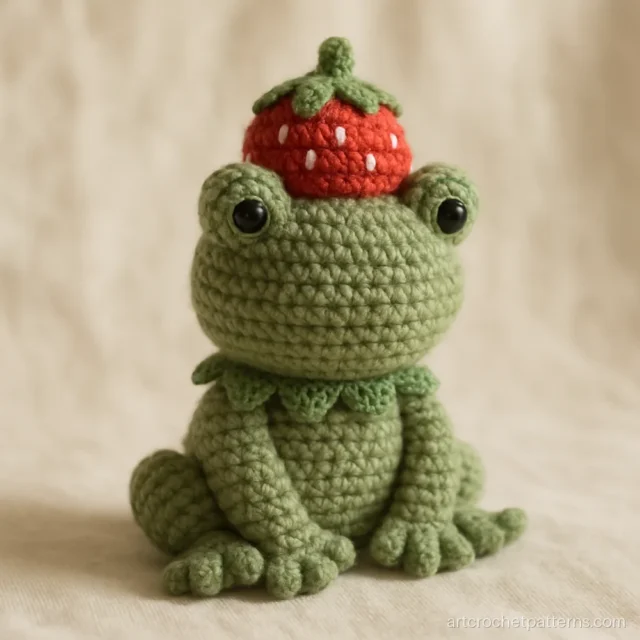 LevelEasyYarnWorsted cottonHook3.5 mm (E-4)
Frog wearing a strawberry hat
A small red cap with white seed stitches and a green leaf collar turns the basic frog into a gift. The hat is just the first six rounds of the body worked straight.
Maker note: Work the hat in back loops for its last round so the leaf collar has a ridge to grab.
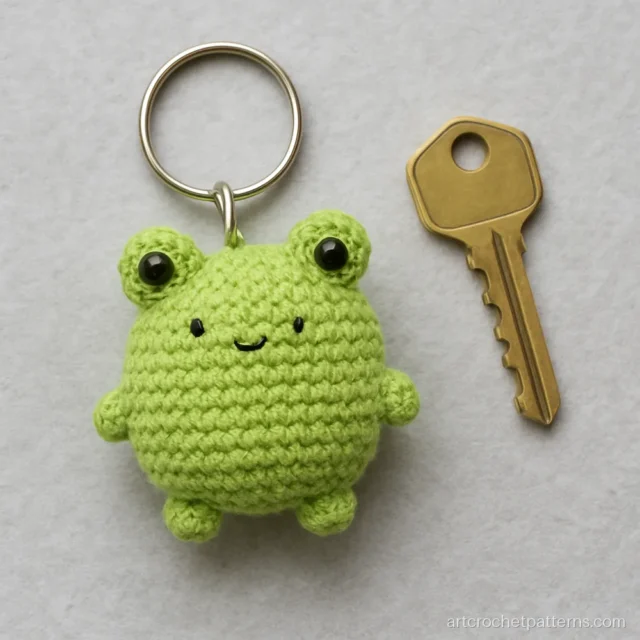 LevelBeginnerYarnDK acrylicHook2.75 mm (C-2)
Mini frog keychain in DK yarn
Same rounds, lighter yarn. In DK weight on a 2.75 mm hook the frog shrinks to about 2 inches and clips onto a bag zipper.
Maker note: Sew the key ring loop through several stitches at the crown, not one, so it cannot tear out.
 LevelEasyYarnBulky chenilleHook6 mm (J-10)
Big chenille frog plush
Chunky velvet chenille on a 6 mm hook makes a huggable frog close to 9 inches tall. It hides stitches, so count carefully as you go.
Maker note: Chenille is hard to undo. Mark every round with a contrasting marker and check the count before moving on.
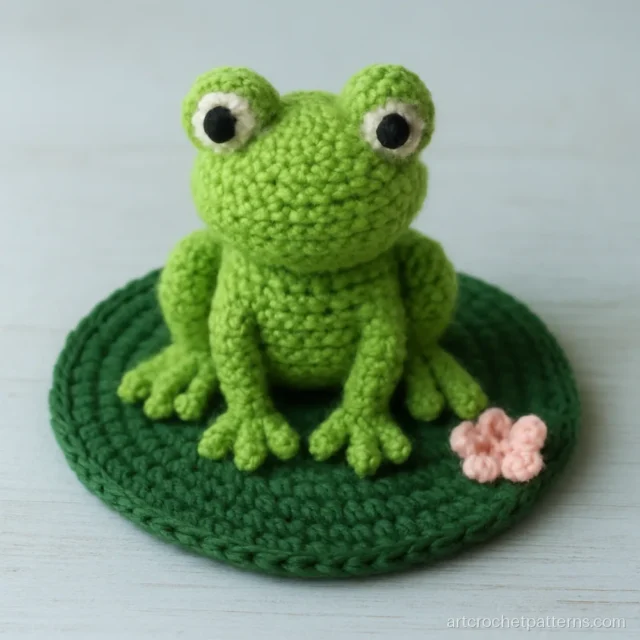 LevelEasyYarnWorsted acrylicHook3.5 mm (E-4)
Frog on a round pond pad base
The pond pad is a flat circle of 48 stitches with a wedge left open. Add a small pink flower and the frog becomes a desk ornament.
Maker note: Stop the pad two stitches short each round and turn, leaving the notch that real water plant leaves have.
 LevelIntermediateYarnSport cottonHook3 mm
Tree frog with long dangly legs
Longer legs with three little toes let this frog drape over a shelf edge. A good second frog once the round body feels easy.
Maker note: Work each toe as ch 3, sl st back down; three toes per foot keep the legs from looking like noodles.
Free crochet frog pattern: the sitting frog
You need about 40 yards of green worsted acrylic, a few yards of black and dark pink for the eyes and mouth, a 3.5 mm hook, a stitch marker, fiberfill and a tapestry needle. Work in a continuous spiral. Your marker rides up one lap at a time; clip it into the opening stitch of every round. Abbreviations are US: sc is single crochet (UK double crochet), inc is 2 sc in one stitch, dec is an invisible decrease.
Body
- Rnd 1: 6 sc in a magic ring (6)
- Rnd 2: inc in each st around (12)
- Rnd 3: (sc, inc) 6 times (18)
- Rnd 4: (2 sc, inc) 6 times (24)
- Rnd 5: (3 sc, inc) 6 times (30)
- Rnds 6 to 11: sc in each st around (30)
- Rnd 12: (3 sc, dec) 6 times (24)
- Rnds 13 to 14: sc in each st around (24)
- Rnd 15: (2 sc, dec) 6 times (18). Stuff firmly, pushing filling into the bottom so it sits flat.
- Rnd 16: (sc, dec) 6 times (12). Top up the stuffing.
- Rnd 17: dec 6 times (6). Fasten off, thread the tail through the front loops and pull closed.
Eye domes (make 2)
- Rnd 1: 6 sc in a magic ring (6)
- Rnd 2: inc in each st around (12)
- Rnds 3 to 4: sc in each st around (12). Fasten off with a long tail.
Legs (make 4)
- Rnd 1: 6 sc in a magic ring (6)
- Rnd 2: (sc, inc) 3 times (9)
- Rnds 3 to 6: sc in each st around (9). Fasten off, leave unstuffed and press flat.
The magic ring end of the body is the bottom. That flat base is what lets the frog sit.
Putting the frog together
- Stuff each eye dome lightly and pin both on top of the head, about two stitches apart, near Rnd 15.
- Whip stitch around the open edge of each dome. Small stitches through the outer loops vanish into the green.
- With black yarn, work a cluster of four or five straight stitches on the front of each dome for pupils. If the frog is going to anyone younger than three, stick with stitched pupils like these and skip plastic eyes and buttons.
- Embroider the mouth: one long stitch in dark pink from side to side across Rnd 10, then a tiny tacking stitch in the middle so it curves into a grin.
- Sew two legs low on the front so they poke forward, and two at the back sides angled out like folded hops.
- Weave every tail into the stuffed body and trim it flush.
For a cleaner closing at the top and bottom, our guide to the invisible decrease shows why those decrease rounds look smooth instead of bumpy.
Picking a yarn for your frog crochet
| Frog yarn | Hook to try | What you get |
|---|---|---|
| Fingering or sport cotton | 2.25 to 3 mm | Pocket frog, about 2 inches, crisp detail |
| Worsted acrylic | 3.5 mm | The 3 inch pattern frog, soft and washable |
| Worsted cotton | 3.5 mm | Firm frog with clear stitches, a little matte |
| Bulky chenille | 6 mm | Big squishy plush near 9 inches |
Greens vary more than you would think. Leaf and apple greens read as cheerful, olive and moss read as real pond frogs. A cream or pale yellow belly patch, sewn on as a flat circle of 18 stitches, adds a lot of charm for ten extra minutes.
When a frog goes wrong
| What the frog does | Cause | Cure |
|---|---|---|
| Frog rolls onto its back | Stuffing sits high, not in the base | Pack the bottom first; tuck a flat plastic disc inside for older kids' toys |
| White stuffing peeks through | Loose fabric from an oversized hook | Go down a size so the stitches close up |
| Eyes tilt different ways | Sewn without pinning | Pin both, step back, adjust, then sew |
| Body grows a cone shape | Increases stack in the same spot | Move the single increase in each repeat a stitch over every other round |
Ideas for your next frog crochet pattern
Once the plain frog works, try a set. Make a mama frog in worsted and a baby in DK, or a whole pond with a pond pad and a crochet turtle neighbor. Frogs also pair well with a crochet mushroom for a woodland shelf. For a frog bag charm, swap to cotton DK so the toy keeps its shape after months of being squeezed in a pocket.
A seasonal twist works too: a tiny scarf for winter, a flower crown in spring. Each one is just a strip or a little circle sewn on, so the frog stays a two hour project.
Questions makers ask
Can a brand new maker handle a crochet frog?
It is a kind choice. The body is a single stuffed ball with no neck joint, and the legs need no stuffing. If you can work a magic ring and count to 30, you can finish it.
How much yarn does the frog crochet pattern use?
About 40 yards of worsted green covers the body, eyes and legs. You need only a yard or two of black and pink for the details.
Can I make the frog without a magic ring?
You can chain 2 and put all 6 sc of Rnd 1 into that first chain you made. The center hole will be slightly bigger, so pull the tail snug before stuffing.
Why does my frog look more like a ball than a frog?
Placement does the work. Set the eye domes high and close together, sew the legs low, and stretch the mouth wide across the front. A wide grin reads as frog right away.
How do I wash a crochet frog?
Check the band on your yarn first. Acrylic frogs usually survive a delicate machine wash inside a zipped mesh pouch, followed by air drying. Squeeze them back into shape while damp.