
Crochet blanket sizes are the first decision in any blanket, and this page gives you the common measurements from lovey to king along with a planner that does the math. Pick a size above, type in your gauge from a real swatch, and the planner tells you how many chains to start with, about how many rows to work, and a rough yardage range.
The numbers below are planning sizes, not rules. Patterns vary by a few inches, and a blanket for a tall teen or a deep mattress may need more. Treat the charts as a starting point you adjust to the bed, couch or stroller in front of you.
At a glance
Use it for
Planning width, length and yarn before you chainYou need
A 6 inch swatch in your pattern stitchGives you
Foundation chain, row count, yarn rangeSmallest size
Lovey, 10 to 14 inches squareLargest size
King, about 108 by 100 inchesSkill level
Any; basic counting only
How to use the planner above
- Choose a size. The planner fills in a standard width and length, or you can type your own.
- Enter stitches per 4 inches. Count across the middle of a washed swatch made in the stitch you will really use.
- Enter rows per 4 inches. Count up the same swatch. For tall stitches like double crochet, rows matter as much as stitches.
- Read the results. You get a foundation chain (with the turning chain added for your stitch), a target row count, and a yardage range for weights 3 to 5.
This crochet calculator rounds to whole stitches. If your pattern works in a repeat, such as a multiple of 3 plus 2, nudge the chain to the nearest number that fits.
Crochet baby blanket sizes
| Type | Size | Best use |
|---|---|---|
| Lovey or security | 10 to 14 square | A comfort square to hold, often with a toy head |
| Stroller or car seat | 30 by 35 | Covering legs in a stroller; stays out of wheels |
| Receiving | 40 by 40 | Wrapping and swaddling a newborn |
| Crib | 45 by 60 | Covering a standard crib mattress for play time |
| Toddler | 42 by 52 | Toddler bed or nap mat |
The crochet baby blanket size most people make for a shower gift is the stroller blanket. It works up in a couple of weekends and stays useful for years. For more on stitches and styles, see the baby blanket gallery. Keep loose blankets out of the crib while a baby sleeps; they are for supervised cuddles and outings.
In pictures
What the work should look like, with the yarn and hook used for each sample.
 LevelBeginnerYarnWorsted acrylicHook5.5 mm (I-9)
Measuring a gauge swatch
A 6 inch swatch measured across the middle 4 inches gives an honest count. The edges of a swatch are always a little off.
Maker note: Wash and dry the swatch the way you will wash the blanket before you count; acrylic relaxes and cotton shrinks.
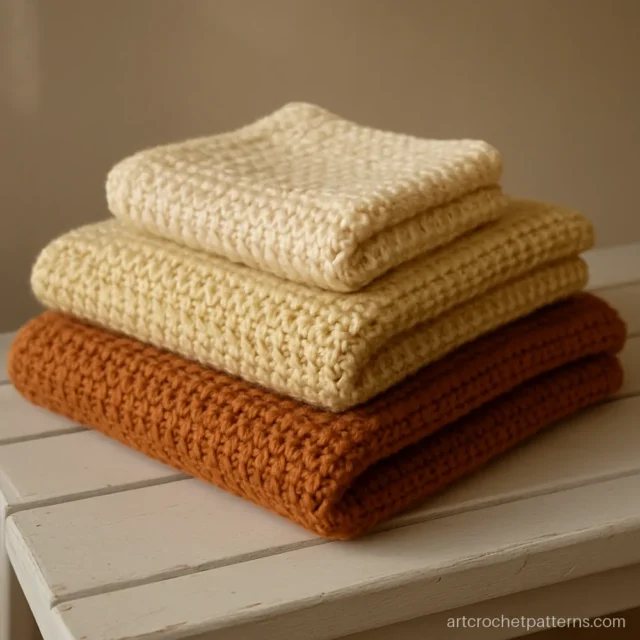 LevelEasyYarnWorsted cotton blendHook5 mm (H-8)
Lovey, baby and throw side by side
A lovey, a stroller blanket and a throw folded on top of one another show how fast yardage grows with each step up in size.
Maker note: Doubling both width and length uses about four times the yarn, so check yardage before you size up.
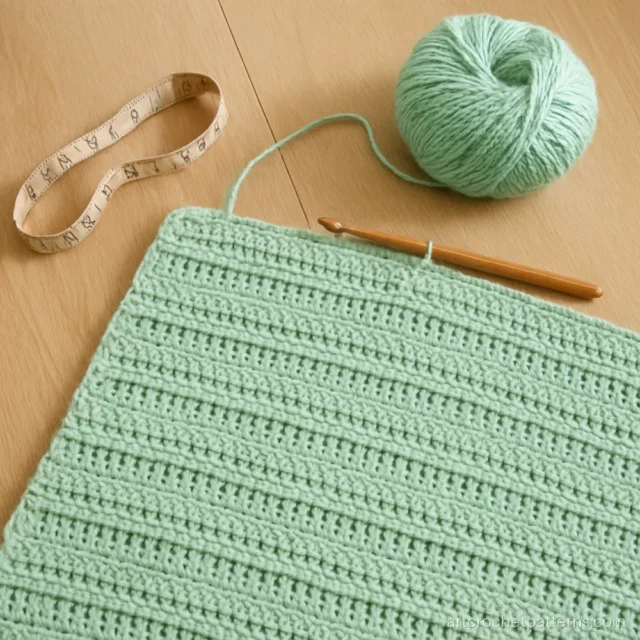 LevelBeginnerYarnWorsted acrylicHook6 mm (J-10)
Crib blanket in progress
Lay the work flat and measure the length every 10 rows. It is easy to stop at the right size this way instead of guessing.
Maker note: Measure with the blanket relaxed on a table, never hanging from the hook; the weight stretches the rows.
Crochet blanket sizes for beds and couches
| Type | Size | Covers |
|---|---|---|
| Lapghan | 36 by 48 | The lap of one seated adult |
| Throw | 50 by 60 | A couch nap, draped over a sofa arm |
| Twin | 65 by 90 | Top of a twin mattress with some side drop |
| Full | 80 by 90 | Top of a full mattress with some side drop |
| Queen | 90 by 100 | Top of a queen mattress with side drop |
| King | 108 by 100 | Top of a king mattress with side drop |
To check a bed size, measure the mattress top, then add the drop you want on each side and at the foot. A 12 inch drop on both sides adds 24 inches to the width. Big blankets are often easier as joined squares; the granny square blanket page shows that route.
Turning gauge into a foundation chain
Here is the math the planner does, so you can check it by hand.
- Divide stitches per 4 inches by 4 to get stitches per inch. Example: 14 dc per 4 inches is 3.5 per inch.
- Multiply by the width you want. A 30 inch stroller blanket needs 3.5 times 30, which is 105 stitches.
- Add the turning chain. When the skipped ch 3 stands in for a dc and your first real dc goes in the 4th ch from the hook, chain 107 to end with 105 dc.
- For length, divide rows per 4 inches by 4 and multiply by the length. At 8 rows per 4 inches, 35 inches needs 70 rows.
Yarn calculator crochet estimates
The planner gives a range because stitch pattern changes yardage a lot. Single crochet and dense textures eat yarn; open lace and granny clusters use less. These rough totals are for worsted weight in half double or double crochet.
| Size | Worsted yardage |
|---|---|
| Lovey | 150 to 250 |
| Stroller | 800 to 1,000 |
| Receiving | 1,100 to 1,400 |
| Crib | 1,800 to 2,300 |
| Lapghan | 1,200 to 1,500 |
| Throw | 2,000 to 2,600 |
| Twin | 4,000 to 5,000 |
| Queen | 6,000 to 7,500 |
Add about 25 percent for single crochet, puff, bobble or cable stitches, and about 10 percent for a wide border. Buy every skein from one dye lot, plus one spare.
Picking the right size of baby blanket to crochet
- For a newborn you may never meet: receiving size suits swaddling and still covers a car seat.
- For a family that walks a lot: the stroller size will not drag on the ground.
- For a first project: a lovey or stroller blanket keeps the end in sight. The single crochet blanket is a calm first choice.
- For a heavier, faster make: bulky yarn changes the math; see the chunky crochet blanket designs.
For every other style of throw and afghan, start at the blankets hub.
Sizing slips and quick fixes
| Sizing trouble | Likely reason | Way out |
|---|---|---|
| Blanket ends up narrower than planned | Gauge got tighter after the swatch | Measure width at row 10 and switch hooks early |
| Length keeps growing after washing | Heavy fabric stretches as it hangs | Stop 1 to 2 inches short on a large cotton blanket |
| Bottom edge is tight and curls | Foundation chain worked too tightly | Chain with a larger hook or use foundation stitches |
| Run out of yarn near the end | Estimate made for a lighter stitch | Weigh one finished row and multiply by rows left |
Questions makers ask
What is the most common crochet baby blanket size?
Around 30 by 35 inches, the stroller size, is the most common gift. It is big enough to cover a car seat or a baby on a play mat and small enough to finish quickly.
How big should a crochet throw blanket be?
A throw is usually about 50 by 60 inches. Taller people often prefer 60 by 70 so it reaches from shoulders to feet on the couch.
How do I work out the foundation chain for a blanket?
Multiply your stitches per inch by the width, then add the turning chain your stitch needs. The planner above does this for you once you enter your gauge from a swatch.
Does a crochet calculator work for any stitch?
Yes, as long as your swatch uses the same stitch, yarn and hook as the blanket. A swatch in single crochet will not predict a blanket in shells or granny clusters.
Why does my finished blanket measure differently from the chart?
Most makers loosen up after the first few hours, and many yarns grow or shrink in the wash. Measure flat and relaxed, and wash a swatch first so you know which way your yarn moves.
How long should a crochet blanket take?
A stroller blanket in worsted double crochet takes most makers 12 to 20 hours. A queen size can take 80 hours or more, which is why many people make big blankets from joined squares.