
A double crochet blanket grows faster than almost any other beginner throw, because each stitch is about twice as tall as a single crochet. You get six design ideas below, a complete pattern worked in rows and a chart that tells you exactly the starting chain for five sizes.
The fabric is soft, drapey and a little open, so it breathes well on a sofa or a bed. One stitch repeated across hundreds of rows is also the best practice you can give your hands: by the end, your tension will be even and your edges straight. If the stitch itself is new, learn it first on the double crochet lesson.
At a glance
Skill level
BeginnerYarn
Worsted (size 4) acrylic or cotton blendHook
5.5 mm (I-9)Gauge
13 dc and 7 rows = 4 inThrow size
50 by 60 in, 105 rowsTime
25 to 35 hours for a throwUK term
Treble crochet blanket
6 double crochet blanket designs to make
Every design lists the skill level, yarn and hook, with a note from the maker.
 LevelBeginnerYarnWorsted acrylicHook5.5 mm (I-9)
Solid cream throw with sc edging
Plain rows of dc in one color show off even tension and a neat single crochet edge. The throw pattern below makes exactly this piece.
Maker note: Clip a marker into each fresh turning chain; on the return trip it flags the spot for your final dc.
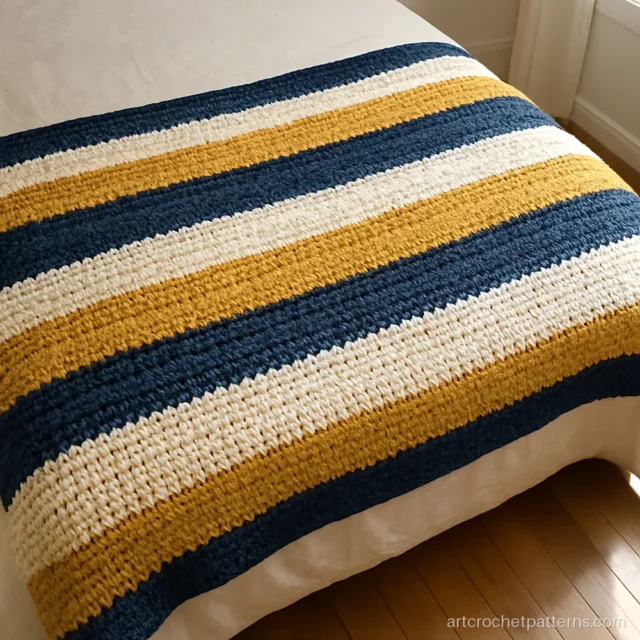 LevelBeginnerYarnWorsted cotton blendHook5.5 mm (I-9)
Wide stripes in navy and mustard
Change color every 8 rows for bold stripes, about 4.5 inches each. Carry nothing up the side; just fasten off and join so the edge stays flat.
Maker note: Bring in the new color during the very last dc you make in the row: pull it through the final two loops.
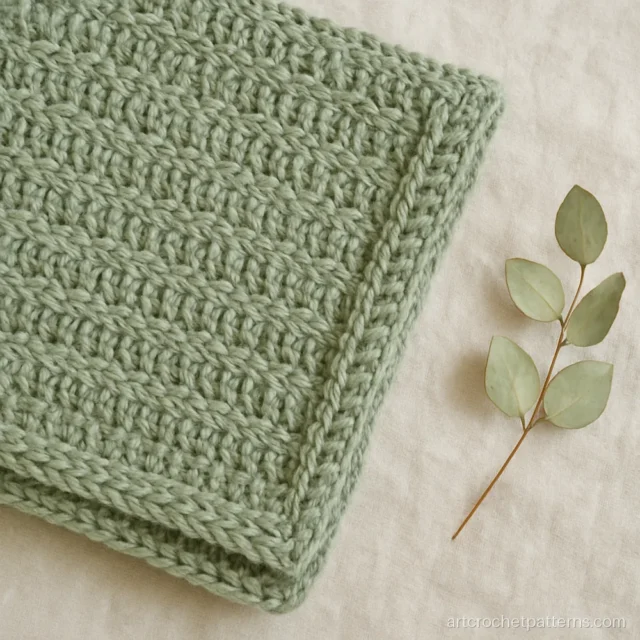 LevelEasyYarnWorsted wool blendHook6 mm (J-10)
Sage blanket worked between stitches
Working each dc into the gap between the posts below, instead of under the top loops, gives a dense, woven look with fewer holes.
Maker note: Switch to a J-10 here. Spaces are tighter than top loops and the blanket can shrink in width.
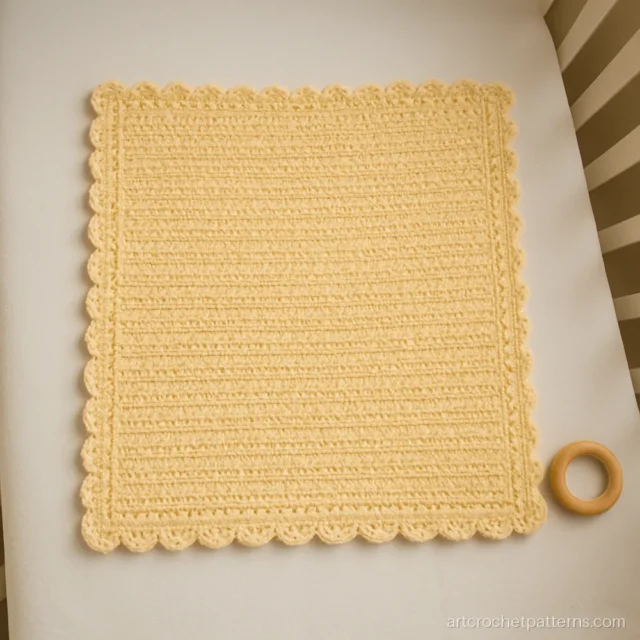 LevelBeginnerYarnDK baby acrylicHook5 mm (H-8)
Double crochet baby blanket in butter yellow
A 40 inch square in a soft baby acrylic with a simple shell border. Light enough for a stroller and easy to wash.
Maker note: Weave every end at least 3 inches and back again, so no tail can work loose in the wash.
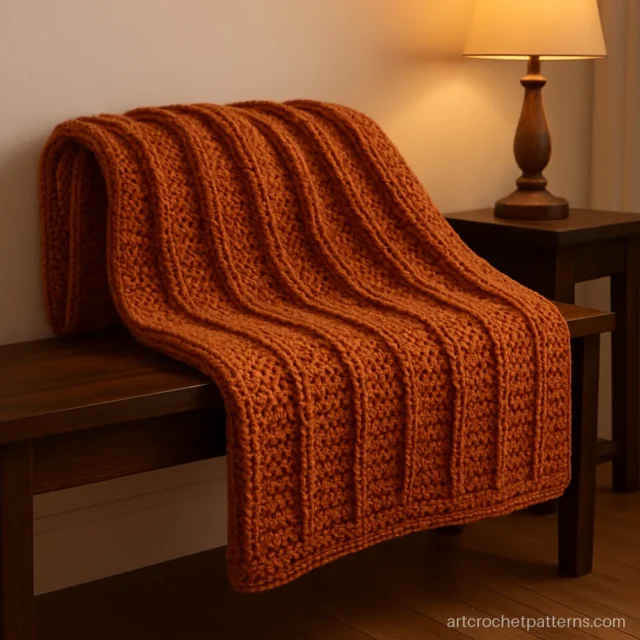 LevelEasyYarnWorsted acrylicHook5.5 mm (I-9)
Ribbed rust throw in back loops
Hook only into the back loops on every row, and the leftover front loops form a raised ridge on alternating sides. It looks knitted from across the room.
Maker note: BLO fabric stretches lengthwise. Measure while the blanket lies flat, never while it hangs.
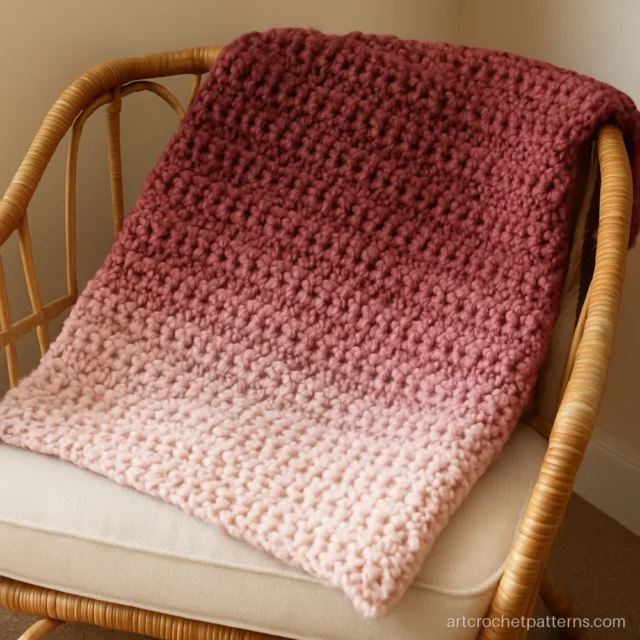 LevelBeginnerYarnBulky acrylicHook9 mm (M/N-13)
Chunky ombre in blush tones
Bulky yarn on an M/N-13 hook finishes a lap blanket in a weekend. Three shades of pink worked in thirds give a soft ombre effect.
Maker note: Chunky dc can feel stiff. Swatch with a bigger hook if the fabric does not bend easily over your hand.
Easy double crochet blanket pattern
Before edging, the throw below measures 50 inches across and 60 long. Any stitch count works, so use the chart in the next section for other sizes. Every row begins with a ch 3 that counts as a dc, and the final stitch of every row lands in the third chain of that ch 3.
Materials: about 2,300 yards (2,100 m) of medium weight (size 4) yarn, an I-9 (5.5 mm) hook, a yarn needle, 2 locking markers.
Gauge: over 4 inches, you want 13 stitches wide and 7 rows tall. Make a 20 stitch swatch first, wash it as you will wash the blanket, then measure.
- Ch 164.
- Row 1: Dc in 4th ch from hook (skipped chs count as a dc) and in each ch across, turn. (162 dc)
- Row 2: Ch 3 (counts as dc), sk first dc, dc in each dc across, dc in top of turning ch, turn. (162 dc)
- Rows 3 to 105: Rep Row 2. (162 dc)
- Edging: Ch 1, sc evenly around all 4 sides, working 1 sc in each st along the top and bottom, 2 sc around each dc post along the sides, and 3 sc in each corner. Sl st to first sc and fasten off.
Weave ends into the body of the fabric along a row, not up the edge, where they show. Block lightly with steam if the corners curl.
Starting chains for 5 blanket sizes
All counts use the gauge above. Add 2 to the dc count of one row to get the starting chain. For more measurements, use the blanket size chart.
| Size | Inches | Chain | Dc per row | Rows |
|---|---|---|---|---|
| Stroller | 30 by 35 | 100 | 98 | 61 |
| Receiving | 40 by 40 | 132 | 130 | 70 |
| Crib | 45 by 60 | 148 | 146 | 105 |
| Throw | 50 by 60 | 164 | 162 | 105 |
| Twin | 65 by 90 | 213 | 211 | 158 |
A long foundation chain tends to be tight. Make it on a J-10 instead of the I-9, or use foundation double crochet instead.
Keeping the edges straight
Wavy or slanting edges are the top complaint on a first blanket. Nearly every time, the fault sits in the opening or closing stitch.
- After turning, look for the ch 3 hanging over the first post. Skip the stitch directly under it; the ch 3 already fills that spot.
- Work across until you reach the ch 3 from the row below. It looks like a thin twisted column.
- Insert the hook into the 3rd chain of that column, under two strands, and make the last dc.
- Count every 10 rows. With 162 stitches, mark every 20th stitch so you count in groups.
If the ch 3 leaves a gap at the edge, try ch 2 instead and still count it as a stitch.
Texture tricks with one stitch
- Back loop only: raised ridges every other row, stretchy and soft.
- Between stitches: denser fabric, fewer holes, warmer.
- Front post and back post alternating: a ribbed look; see front post double crochet.
- Stripes: change color every 2, 4 or 8 rows; even numbers keep all joins on one side.
Still want more texture? The blanket stitch guide covers moss, waffle and puff.
Yarn and hook pairs
| Yarn | Hook | Feel of the dc fabric |
|---|---|---|
| DK (3) | 4.5 to 5 mm | Light, drapey, good for babies |
| Worsted (4) | I-9 or J-10 | Soft everyday throw |
| Bulky (5) | 8 mm or 9 mm | Thick, warm, very quick |
| Super bulky (6) | 10 to 12 mm | Heavy, best for lap size |
Tall stitches like dc relax nicely when the hook is a half size up from what you would pick for sc, so the posts are not stiff.
Double crochet baby blanket version
For a baby, use the receiving size from the chart (ch 132) in a DK baby acrylic or soft cotton and a 5 mm hook; it will come out slightly smaller, about 36 inches, which suits a stroller or car seat. Skip pom poms and long fringe. Keep all tails woven in, and no loose strands longer than about 7 inches. Machine washable yarn makes life easier for new parents. More ideas live on the crochet baby blanket page.
Dc blanket mistakes
| Sign | Behind it | Repair |
|---|---|---|
| Blanket gets narrower | Skipped the turning chain stitch | Count stitches every few rows |
| Blanket gets wider | Working into the first post | Skip the first st after ch 3 |
| Foundation edge puckers | Tight chain | Redo the chain on a larger hook |
| Gaps along the sides | Loose turning chain | Ch 2 instead of ch 3 |
Questions makers ask
What starting chain does a double crochet blanket need?
Work out how many stitches you need from your gauge, then add 2. For a 50 inch throw at 13 dc per 4 inches, that is 162 dc and a chain of 164.
Is a double crochet blanket good for beginners?
Very much so. There is one stitch and plain rows, and it grows quickly enough that you do not lose interest. The only tricky part is the turning chain, covered above.
How much yarn for a double crochet throw?
Plan roughly 2,300 yards of worsted for the 50 by 60 throw. A baby blanket of 36 to 40 inches takes about 900 to 1,100 yards of DK.
Does a double crochet blanket have holes?
Small gaps between the posts are normal and help the blanket breathe. For a solid look, work between stitches or choose single crochet instead.
Why is my double crochet blanket slanting?
The stitch count is changing at the edges or your hook enters the stitches at an angle. Count often and keep the turning chain the same every row.
What is a double crochet blanket called in UK terms?
In UK patterns the same stitch is a treble, so it is a treble crochet blanket. The fabric and steps are exactly the same.