
Foundation double crochet makes the starting chain and the first row of double crochet in one pass, which spares you the slow trip back along a long, twisty chain. Each stitch builds its own little chain at the bottom while the top becomes a normal double crochet.
Patterns call it fdc, and you will also hear it described as a chainless foundation or a double crochet foundation chain. The edge it gives is stretchy and the same width as the rows above, which is why sweater, hat and blanket makers love it. This guide walks through the first stitch, the repeat, how to count, and the mix ups that trip people at the start.
At a glance
Skill level
IntermediateAbbreviation
fdcReplaces
Chain plus a first row of dcYarn
Smooth worsted or DKHook
Same size as the patternGood for
Brims, hems, blankets, garments
Why use a foundation double crochet edge
A normal start has two problems. Chains are easy to miscount over long stretches, and a chain is usually tighter than the stitches you put into it, so the bottom edge puckers. Foundation stitches fix both. Each one makes a single chain at its base, so the chain is exactly as long as the row, and because every chain is worked with a stitch on top of it, the edge gives just as much as the body.
The same idea exists for shorter stitches. If fdc feels like a lot at once, warm up with foundation single crochet or foundation half double crochet, which follow the same pattern with fewer wraps.
How to make the first fdc
- Tie a slip knot and ch 3.
- Yarn over, then aim for the third chain back, the very first one you made.
- Draw up a loop. You are holding three loops now.
- Wrap, and pull through a single loop only. This tiny move is the base chain. The count on the hook stays at three.
- Finish like any dc: wrap, through two; wrap, through the final pair. Stitch one exists.
Step 4 is the one that makes foundation stitches different. That single pull through creates the chain at the base, and the next stitch will go into it.
In pictures
What the work should look like, with the yarn and hook used for each sample.
 LevelIntermediateYarnWorsted acrylicHook5 mm (H-8)
Strip of foundation dc in coral
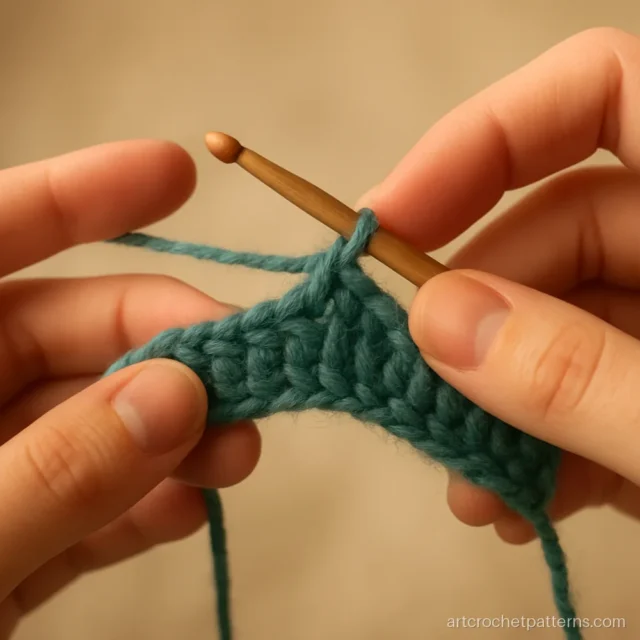
The bottom edge of an fdc strip looks just like a chain, and the top is a row of ordinary double crochet tops ready to work into.
Maker note: Lay the strip flat every ten stitches and check it is not twisting; a straight strip means even tension.
 LevelIntermediateYarnDK woolHook4.5 mm (7)
Finding the chain at the base
The next stitch goes into the small chain at the bottom of the last one. Look for two strands forming a V at the foot of the stitch.
Maker note: Pinch the base of the last stitch between thumb and finger so the chain V stays visible.
 LevelIntermediateYarnWorsted woolHook5 mm (H-8)
Fdc edge beside a chain edge
The swatch on the left started with fdc and lies flat. The right one started with a chain and pulls in along the bottom.
Maker note: If your chain edges always pucker, this comparison makes the case for learning fdc.
Repeating the double crochet foundation chain
- Yarn over to begin stitch two.
- Spot the base chain of stitch one, down at its foot, shaped like a little sideways V. Slide the hook beneath both of its strands.
- Draw up a loop. Three loops again.
- Wrap and go through one loop: a fresh base chain.
- Close the dc in two steps, two loops each time.
- Carry on until the strip holds the full first row count your pattern asks for.
Counting and moving on to row 2
Count the tops, not the chains. Each finished fdc has one top, and those tops are the stitches of your first row. In this method the 2 chains left over from the very first ch 3 sit beside the first stitch as a small post; do not count them as an extra stitch.
- Foundation: Work 20 fdc. Turn. (20 sts)
- Row 2: Ch 3 (counts as first dc), sk first st, dc in each st across, working the last dc in the top of the first fdc. Turn. (20 dc)
- Row 3: Ch 3 (counts as first dc), sk first st, dc in each st across, working the last dc in the top of the turning ch. Turn. (20 dc)
Some patterns treat the first ch 3 as a stitch and only work 19 fdc after it. Read the notes and follow your pattern's own count.
Using fdc for brims and other tubes
For a hat brim, cowl or sleeve, make an fdc strip close to the size you want, then join the last stitch to the first with a slip stitch, taking care that the strip is not twisted. Because the edge stretches, a beanie brim started this way slides on more easily than one made from a chain. Aim for a strip that falls an inch or two under the head measurement, and wrap it around to test before joining.
Fixing common fdc trouble
| What happens | Cause | Change to make |
|---|---|---|
| Strip curls into a spiral | Base chains tighter than the stitch tops | Loosen the single pull through in step 4 |
| Holes along the bottom edge | Hook went under only one strand of the base chain | Pick up the pair of strands each time |
| Stitches look like hdc | Forgot one of the final two pull throughs | Clear two loops twice after the base chain |
| Lost the base chain | The strip is turned the wrong way | Hold the bottom edge nearest you and hunt for that small V |
| Row 2 has an extra stitch | Counted the starting chains as a stitch | Count only the fdc tops |
When a plain chain is still fine
Fdc takes longer per stitch than chaining. For a small swatch, a dishcloth or anything with a firm border added later, a chain is quicker and nobody will see the edge. Save fdc for pieces where the bottom edge shows or needs to stretch: hems, cuffs, the start of a blanket you will not border, or a top-down garment. If you are new to starting chains, the crochet chain guide covers the basics, and the double crochet lesson explains the stitch at the top of every fdc. More techniques are collected under crochet stitches.
Questions makers ask
What is foundation double crochet?
A method that builds the starting chain and the first row of dc in a single pass. Each stitch makes its own base chain and a dc top in one sequence.
Is foundation double crochet hard?
It takes a few tries because of the single pull through that makes the base chain. Learn foundation single crochet first if you can; fdc adds one more wrap.
Should I count those first chains?
In the method shown here, no. Count only the finished fdc tops. Some patterns count the first ch 3, so check yours.
Why is my double crochet foundation chain twisting?
Usually the base chains are tighter than the tops. Keep the step 4 pull through relaxed and lay the strip flat as you go.
Can I use fdc to replace the chain in any dc pattern?
Yes. Work as many fdc as the pattern's first row of dc has stitches, then continue from the pattern's second row.