
These crochet patterns for beginners use only the chain, single crochet, half double crochet and double crochet, and each one is small enough to finish in a day or two. You get six project ideas, two complete patterns with a stitch count on every row, and a table of the problems new makers hit most.
If you have not made a stitch yet, work through how to crochet first and return with a size H crochet hook and a ball of smooth worsted cotton.
At a glance
Skill level
BeginnerYarn
Worsted cotton or acrylic, DK scrapsHook
4 mm (G-6) to 6 mm (J-10)Stitches used
ch, sc, hdc, dc, sl stTime
1 to 6 hours each
6 patterns for beginners designs to make
Every design lists the skill level, yarn and hook, with a note from the maker.
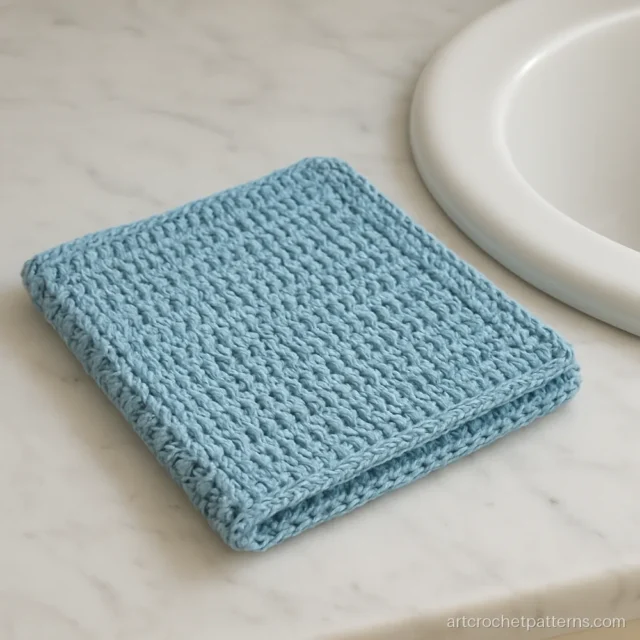 LevelBeginnerYarnWorsted cottonHook5 mm (H-8)
Half double crochet dishcloth
The first full pattern below. Half double crochet grows faster than single crochet and still makes a sturdy scrubbing cloth.
Maker note: Skip counting the turning ch 2. Work your first hdc into the very first stitch.
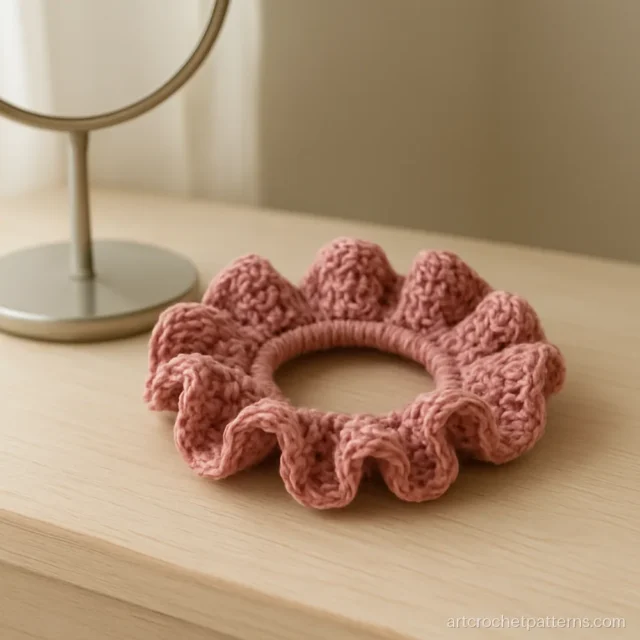 LevelBeginnerYarnDK cotton or acrylicHook4 mm (G-6)
Ruffle scrunchie from scrap yarn
The second full pattern. It uses about 30 yards, which makes it a top pick among scrap yarn crochet projects.
Maker note: Push the single crochet stitches together along the elastic so you can fit all 60.
 LevelBeginnerYarnBulky acrylicHook8 mm (L-11)
Chunky ribbed scarf
Working hdc through back loops only raises ridges that look like knit ribbing. A bulky yarn finishes it in an afternoon or two.
Maker note: Work the scarf lengthwise on a long chain, so each row adds width instead of length.
 LevelBeginnerYarnWorsted wool blendHook5.5 mm (I-9)
Twisted ear warmer headband
A long rectangle of single crochet folded with a twist and sewn at the back. The twist hides the seam.
Maker note: Stop when the band is about 2 inches shorter than the head so it stays put.
 LevelBeginnerYarnFingering cottonHook3 mm
Striped bookmark with a tassel
Five stitches wide and long enough for a paperback. Good practice for clean color changes.
Maker note: Run the idle color up the edge rather than cutting it every stripe.
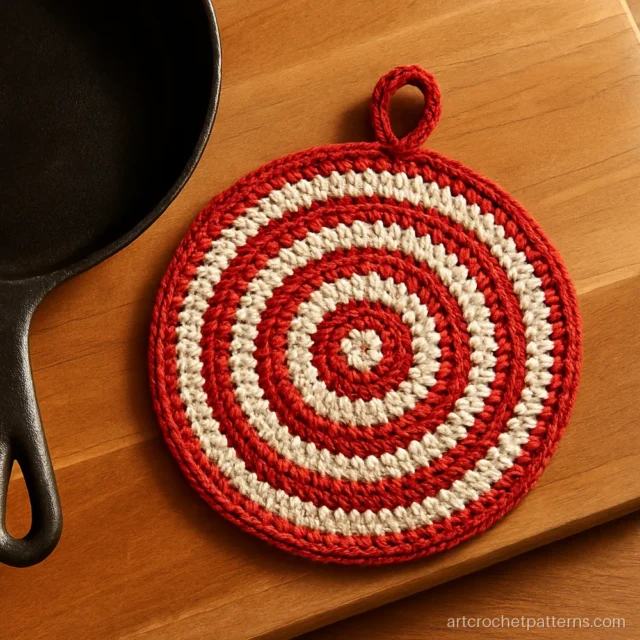 LevelEasyYarnWorsted cottonHook5 mm (H-8)
Round double thick potholder
Two flat circles of single crochet joined around the edge. Doubling the layers keeps heat off your hand.
Maker note: Use 100 percent cotton. Acrylic can melt against a hot pan.
Crochet patterns for beginners at a glance
| Project | Main stitch | Time | What it teaches |
|---|---|---|---|
| Dishcloth | Half double crochet | 2 to 3 hours | Turning chains and straight edges |
| Scrunchie | Single and double crochet | 1 hour | Working into a ring and joining rounds |
| Chunky scarf | hdc in the back loop | 4 to 6 hours | Long rows and keeping tension even |
| Ear warmer | Single crochet | 3 hours | Measuring for fit and seaming |
| Bookmark | Single crochet | 1 hour | Color changes |
| Potholder | Single crochet rounds | 3 to 4 hours | Increasing in the round |
Start at the top and work down. Each one adds a single new skill to the last.
Pattern 1: an easy half double crochet dishcloth
Materials: about 60 yards of worsted weight cotton, a tapestry needle and a 5 mm crochet hook, size H-8. Gauge: 4 inches equals 14 hdc by 10 rows. Finished size: roughly 7.5 inches across, border included.
- Ch 27.
- Row 1: hdc in 3rd ch from hook and in each ch across, turn. The 2 skipped ch do not count as a st. (25)
- Row 2: ch 2 (does not count as a st), hdc in first st and in each st across, turn. (25)
- Rows 3 to 18: rep Row 2. (25) Do not turn at the end of Row 18.
- Border: ch 1, 3 sc in first st, sc in next 23 sts, 3 sc in last st. Down the side, work 3 sc over every 2 row ends for Rows 17 to 2 (24 sts). Along the foundation, 3 sc in first ch, sc in next 23 ch, 3 sc in last ch. Up the other side, 3 sc over every 2 row ends for Rows 2 to 17 (24 sts). Sl st to first sc. (106)
Fasten off and weave in both tails. The cloth will feel stiff at first and soften after its first wash.
Pattern 2: a ruffle scrunchie from scrap yarn
Materials: about 30 yards of DK yarn, one plain hair elastic, plus a 4 mm crochet hook (G-6). Cotton gives a crisp ruffle and acrylic a softer one.
- Make a slip knot on the hook. Insert the hook through the center of the elastic, yo, pull up a loop, yo and pull through both loops. This is your first sc. (1)
- Rnd 1: work 59 more sc over the elastic, pushing them together as you go, sl st to first sc. (60)
- Rnd 2: ch 3 (counts as a dc), dc in same st, 2 dc in each st around, sl st to top of beg ch 3. (120)
Fasten off with a 6 inch tail and weave it into the base of the ruffle so it does not pull on your hair. For a fuller ruffle, work 3 dc in each stitch for a count of 180.
Choosing yarn and a hook for easy crochet
Smooth, light colored yarn makes learning easier because you can see where each stitch begins. Avoid black, navy, fuzzy and bouclé yarns for your first few things to crochet.
| Yarn weight | Hook | Result |
|---|---|---|
| DK | 4 mm (G-6) | Neat, fine fabric for scrunchies and small items |
| Worsted | 5 to 5.5 mm (H-8 to I-9) | The easiest to learn on; firm dishcloths and hats |
| Bulky | 6.5 to 8 mm (K to L) | Fast scarves; stitches are big and easy to count |
The hook size chart converts letters to millimeters, and cotton yarn for crochet explains why the dishcloth and potholder need cotton.
Why is my crochet curling, and other beginner problems
| What you see | Reason | How to fix it |
|---|---|---|
| The first rows curl up | The foundation chain is tighter than the stitches | Chain with a hook one size up, then switch back |
| A flat circle cups into a bowl | Not enough increases, or a tight hand | Follow the 6 per round rule and recount |
| A flat circle ruffles | Too many increases | Frog to the last correct round and recount |
| Edges are wavy | Stitch count changes from row to row | Check the number in brackets after every row |
| Fabric feels stiff as cardboard | The hook is too fine for the yarn weight | Move up 0.5 to 1 mm |
How to finish a crochet project
- After the last stitch, cut the yarn leaving a 6 inch tail.
- Yarn over and pull the tail all the way through the loop on the hook. Tug it snug. The fasten off guide shows an invisible version too.
- Thread the tail on a blunt needle and weave it through the backs of stitches for about 2 inches, then turn and go back the other way.
- Trim close to the fabric without cutting the stitches.
- Wet or steam block if the piece needs to lie flat. The blocking guide covers each method.
Easy crochet ideas to try next
Each pattern above doubles as a short crochet tutorial for beginners: read one row, work it, count it. When these feel comfortable, pick something with one new skill. A small granny square teaches working into chain spaces. A beanie teaches shaping in the round. For a longer list of things to crochet for beginners, try 30 minute projects or the crochet ideas gallery, and for tiny makes with one ball see one skein crochet projects.
Questions makers ask
What is the easiest crochet pattern for a beginner?
A dishcloth or a scarf in one stitch. Both are flat rectangles, so you only need to keep the stitch count steady and the edges straight.
What should I crochet first as a beginner?
Something small and flat in a smooth worsted cotton, such as the dishcloth above. It shows mistakes clearly and is useful even if it is a little wonky.
How do I end a crochet project so it does not unravel?
Snip the yarn with a tail, draw it up through the last loop and pull snug. Then weave the tail through stitches in two directions with a yarn needle before trimming.
Can I use acrylic yarn for the dishcloth?
You can, but cotton is better. It absorbs water and holds up to scrubbing, while acrylic pushes water around and can pill.
Why does my crochet project keep getting wider?
You are probably adding a stitch on every row by working into the turning chain. Count every row and compare with the number in brackets.
Are amigurumi toys good crochet projects for beginners?
They are a good third or fourth project. You need the magic ring, increases and invisible decreases, so learn flat rows first.