
Single crochet is the short, solid stitch most beginners learn first, and this page walks you through making it, counting it and fixing the usual slips. It is the easiest crochet stitch to read, which is why amigurumi, dishcloths and edgings lean on it so heavily.
In US patterns it is written sc. UK patterns call the same stitch a double crochet (dc), so check which terms a pattern uses before you start. You only need a slip knot, a foundation chain and two minutes of patience.
At a glance
Skill level
BeginnerAbbreviation
scUK term
Double crochet (dc)Turning chain
Ch 1, does not count as a stitchHeight
About as tall as it is wideGood for
Amigurumi, dishcloths, bags, edgings
What a single crochet stitch looks like
A finished row of single crochet looks like a line of small, tight knots with a V on top of each one. The two strands of that V are the front loop and back loop. A plain sc row goes under both strands unless the pattern names one.
On a stitch diagram (a crochet chart), single crochet is drawn as an X or a plus sign. Chains are small ovals and slip stitches are dots, so a single crochet stitch diagram reads like rows of little crosses sitting on a line of ovals.
Because the stitch is short, the fabric is dense and firm. That is great for toys that must hide stuffing and for a bag that should not stretch, but a whole blanket in plain sc feels stiff and eats yarn. For blankets, the taller half double crochet or double crochet grows faster and drapes better.
How to single crochet step by step
Make a slip knot, then work a foundation chain one longer than the number of stitches you want. For 10 sc, chain 11.
- Count back two chains. Ignore the loop on your hook. The chain right beside it gets skipped; it stands in as the turning chain, so your stitch goes into chain number two.
- Insert the hook into that chain, front to back.
- Yarn over: pass the hook under the working yarn from behind so the strand lies across the throat.
- Pull up a loop. Bring the strand back out toward you. Count them: two loops ride the hook now.
- Yarn over again and draw that strand through the pair. A single loop remains, and you have made one single crochet.
- Repeat in each chain to the end. Count: you should have 10 stitches from 11 chains.
For row two, chain 1 and flip the piece so its back faces you. Your opening sc goes into the stitch directly under that chain, not one over. Carry on across and finish in the final sc of the previous row.
In pictures
What the work should look like, with the yarn and hook used for each sample.
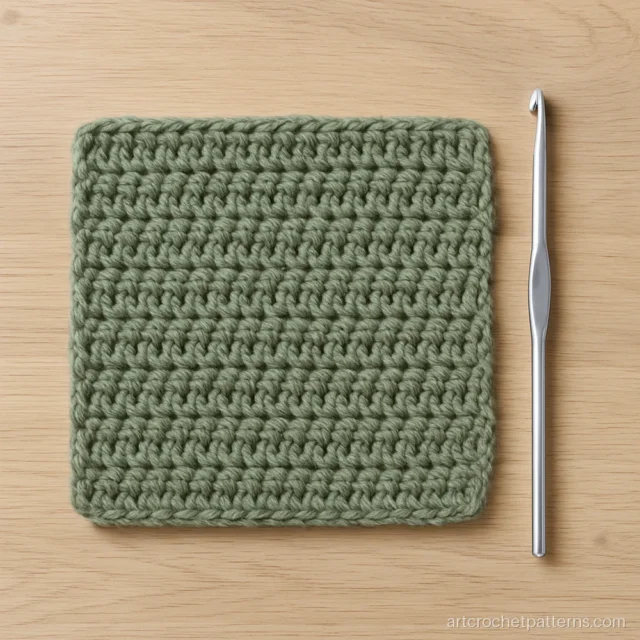 LevelBeginnerYarnWorsted cottonHook5 mm (H-8)
Sage cotton swatch in rows of sc
Twenty rows of plain single crochet in worsted cotton. Notice how each row forms a small horizontal ridge, which makes rows easy to count.
Maker note: Count the ridges on one side only, then double the number to get your row total.
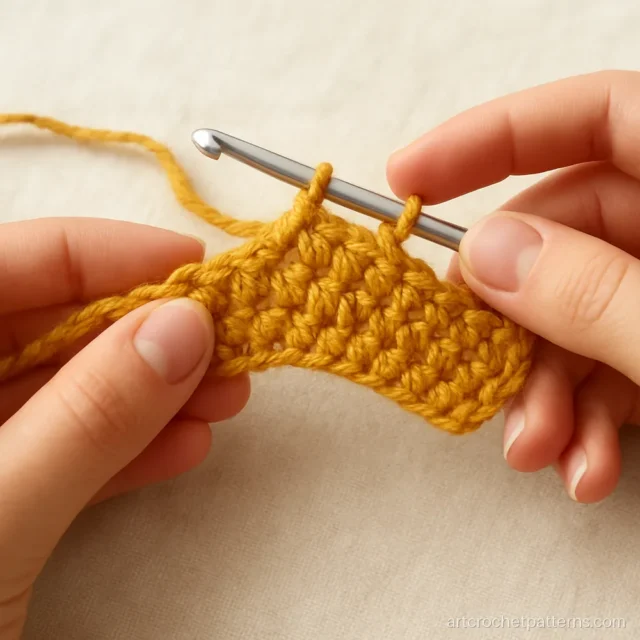 LevelBeginnerYarnWorsted acrylicHook5.5 mm (I-9)
Hook inserted under both top loops
The moment just before the final yarn over: two loops sit on the hook. Pull through both and the stitch is done.
Maker note: Keep the working loop on the wide shaft of the hook, not the throat, so every stitch comes out the same size.
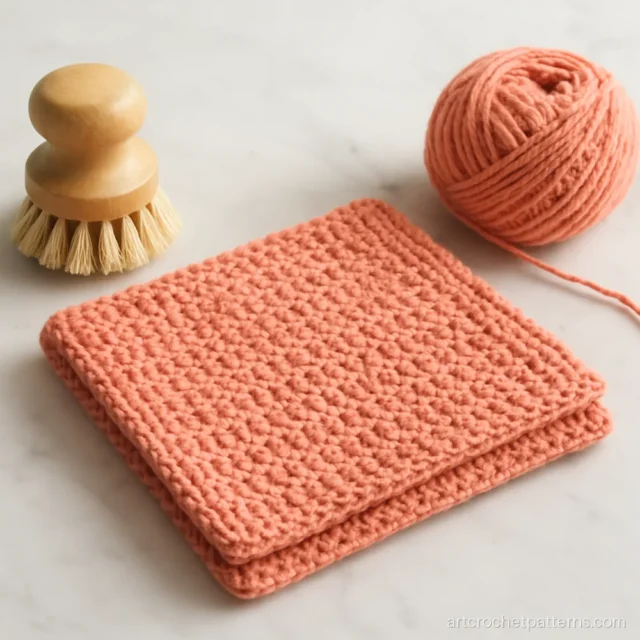 LevelBeginnerYarnWorsted cottonHook5 mm (H-8)
Coral practice dishcloth
The practice dishcloth from this page, 30 stitches wide. Cotton holds its shape and scrubs well, so a first project gets real use.
Maker note: Clip markers onto both edge stitches of each row until your sides stay straight without help.
Turning chains and edges that stay straight
That single chain only lifts the yarn to sc height. Modern patterns almost never treat it as a stitch, so leave it unworked. Sc rows drift wider or narrower for two reasons: a stitch slipped into that chain 1 (row grows), or the last stitch got skipped because it hides under the edge (row shrinks).
The end stitch is the sneaky one. It hugs the side and leans away from you, so tilt the work and find its V before inserting the hook. Clipping a locking marker onto it every row removes the guesswork while you learn.
How to count single crochet rows and stitches
To count stitches, look down on the top edge and count the Vs. Do not count the turning chain or the loop on your hook.
Counting rows takes one extra trick. When you work back and forth, each pair of rows makes one raised ridge on each side, with a flatter row between. Count the ridges on the side facing you and multiply by two. Add one if the last row you made is a flat one on that side. Spiral rounds in amigurumi have no ridges to read, so clip a marker onto stitch one of each round and move it up as you go.
Count after every row for the first few projects. Catching a missing stitch one row late takes a minute to fix; catching it twenty rows late means frogging back to it.
Single crochet increases and decreases
An sc increase (written inc or 2 sc in next st) is simply two single crochet worked into the same stitch. It is how amigurumi circles grow from 6 stitches to 12, 18 and 24. Our increase stitch guide covers spacing them so shapes stay round and do not turn into hexagons.
A decrease, sc2tog, joins two stitches into one: insert in the next stitch and pull up a loop (2 loops), insert in the following stitch and pull up a loop (3 loops), then yarn over and pull through all 3. The step by step version, plus the tidier invisible decrease used in toys, lives on the sc2tog page.
Variations of the single stitch in crochet
| Variation | How it differs | What you get |
|---|---|---|
| Back loop crochet (sc BLO) | Insert under the back loop only | Stretchy ribbing for cuffs and hat brims; see BLO crochet |
| Front loop only | Insert under the front loop only | A row of free back loops you can work into later |
| Extended single crochet (esc) | Pull up a loop, wrap and draw through just 1, then wrap and finish through the last 2 | A slightly taller, softer stitch between sc and hdc |
| Back post sc (BPsc) | Insert around the post from the back | A ridge on the far side of the fabric |
| Foundation sc | Builds the chain and first row together | A stretchy first edge; see foundation single crochet |
Left handed single crochet uses identical steps. The hook sits in your left hand and rows travel left to right, so a diagram or photo will look mirrored. Holding a small mirror beside a right handed picture shows you the exact hand position.
Single crochet trouble spots and how to repair them
| Trouble | Usual cause | Repair |
|---|---|---|
| Fabric curls or turns stiff | Gripping the yarn hard | Swap to a hook one size up and let the loop rest on the shaft |
| Holes between stitches | Hook went under only one loop by accident | Check that both top loops sit on the hook before each yarn over |
| Piece shaped like a trapezoid | Extra stitch in the turning chain, or the end stitch skipped | Mark both edge stitches and count every row |
| Foundation chain too snug for the hook | Chains were pulled hard | Chain on a bigger hook, then pick up your usual one |
| Strands split | A sharp hook head catches plies | Use a rounder headed hook or a smoother yarn |
Practice pattern: a single crochet cotton dishcloth
This square is all single crochet, so every row practices the same motion and the same edges. For this cloth, gather roughly 80 yards of cotton in worsted weight, an H-8 (5 mm) hook and a tapestry needle for the ends. Over 4 inches you should see roughly 14 sc across and 16 rows up; the finished cloth is about 8.5 inches square.
- Ch 31.
- Row 1: Sc in 2nd ch from hook and in each ch across. (30)
- Row 2: Ch 1 (does not count as a st), turn. Sc in each st across. (30)
- Rows 3 to 34: Rep Row 2. (30)
- Edging: Ch 1, do not turn. Sc evenly down the side, working 1 sc in the end of each row, 3 sc in each corner, and 1 sc in each st or ch along the other edges. Join with sl st to the first sc. Fasten off.
Weave the tails in through several stitches, change direction once, and trim. Cotton shrinks a little in a hot wash, so dry it flat the first time and follow the yarn label after that. Once the rows feel easy, try the same cloth in moss stitch, which mixes sc with chain spaces for a woven look.
Questions makers ask
What is the easiest crochet stitch for a beginner?
The chain comes first, but single crochet is the easiest real stitch to make fabric with. It has only one yarn over before the final pull through, and its short height makes stitches simple to see and count.
Is US single crochet the same as UK double crochet?
Yes. The motion is identical; only the name differs. A UK pattern that says dc means a US sc, so convert every stitch name in a UK pattern before you start.
Does the chain 1 count as a single crochet?
In nearly all current patterns it does not. Your opening sc goes right beside the chain, and on the way back you stop at the last real sc rather than stitching into that chain.
How do I do a single crochet increase?
Work 2 sc into the same stitch. Patterns write it as inc or 2 sc in next st. Each increase adds one stitch to the count.
Why is my single crochet fabric so stiff?
Short stitches pack tightly, and many new crocheters also pull each loop snug. For anything that should drape, such as a scarf, try a hook 0.5 to 1 mm bigger than the label recommends.
What does a single crochet stitch diagram symbol look like?
It is a small X or plus sign. Read a chart from the bottom up, following the row direction each line shows, and match each symbol to one stitch.