
BLO crochet means you put the hook under only the back loop of each stitch instead of under both loops. That small change leaves the front loop sitting on the surface as a line, and it turns plain rows into ribbing, ridges or a sharp fold.
You can use it with any stitch. Sc through that back strand alone gives the stretchy rib you see on hat brims and cuffs. In amigurumi and baskets, one BLO round marks the exact spot where a flat base turns up into walls. Below you will learn how to find the right loop, a ribbed headband to practice on and the mix-ups that confuse new makers.
At a glance
Skill level
BeginnerAbbreviation
BLO, sometimes bl or blpOpposite
FLO, front loop onlyWorks with
sl st, sc, hdc, dcGood for
Ribbing, baskets, amigurumiUK term
Back loop only, same name
What does BLO mean in crochet?
Look at the top of any finished row. Each stitch shows two strands that form a sideways V. The strand closest to you is the front loop. The strand farther away is the back loop. BLO tells you to insert the hook under that back strand alone.
Patterns may write it as "sc BLO", "sc in back loop only" or "sc tbl" (through back loop). The crochet abbreviations list has the other spellings you may meet. The loop you skip stays where it is and forms a raised line on the side facing you.
How to work BLO crochet, step by step
- Finish your row and turn as usual. Make the turning chain the pattern asks for.
- Find the first stitch. Tip the top of the row toward you so you can see both strands of the V.
- Slide the hook under the back strand only, from front to back. The front strand should stay in front of the hook.
- Complete the stitch as normal. For sc that means wrap, draw up, wrap, and close the stitch through the two loops left.
- Repeat in each stitch across. The front loops you skipped now lie as a chain-like line toward you.
After two or three rows you will see ridges forming. On flat rows the ridges show on both sides, because you turn the work and the front of the stitch keeps changing sides. That is what makes the fabric look like knit ribbing.
In pictures
What the work should look like, with the yarn and hook used for each sample.
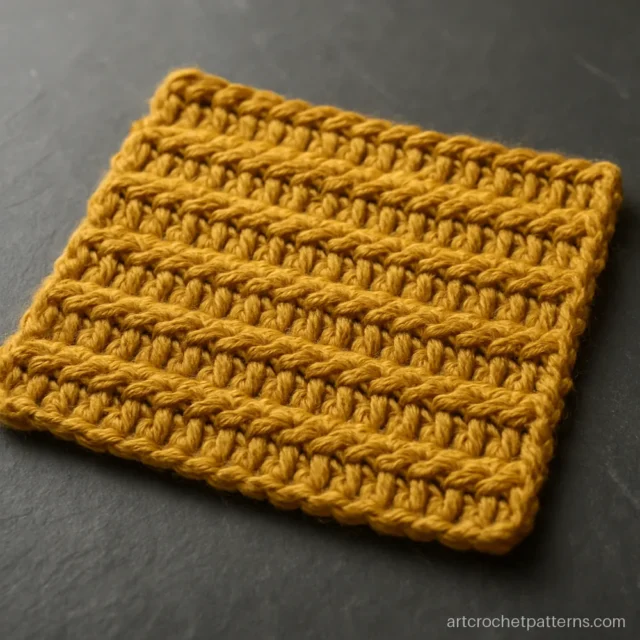 LevelBeginnerYarnWorsted woolHook5 mm (H-8)
Single crochet BLO rib swatch
Rows of sc through the back strand fold into soft ridges. Turn it on its side and it becomes a stretchy brim.
Maker note: Keep the first and last stitches in both loops for a firmer edge that is easier to seam.
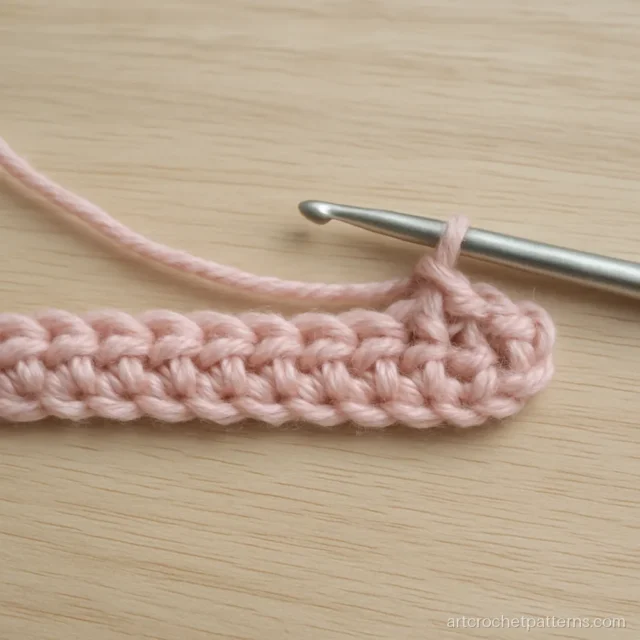 LevelBeginnerYarnWorsted cottonHook4.5 mm (7)
Hook under the back loop
Seen from above, every stitch top forms a little sideways V. Here the hook is lifting the farther leg of it.
Maker note: Tilt the work toward you. The two loops separate and the back one is easy to spot.
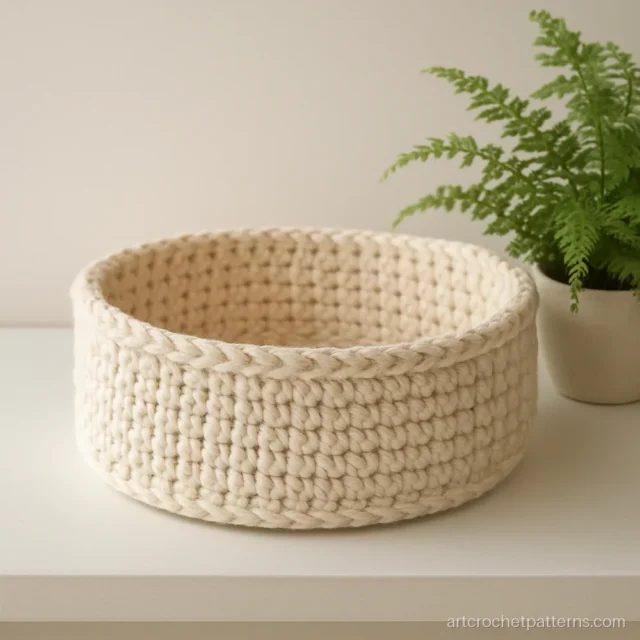 LevelEasyYarnBulky cotton cordHook6 mm (J-10)
Small basket with a BLO fold
A single round through back strands creates the crisp ledge between the base and the sides of this little basket.
Maker note: Work only the turning round in BLO. Every round after that goes back into both loops so the walls stay stiff.
Rows versus rounds: two different looks
In turned rows, BLO stitches build deep ridges with gaps between, on both faces. The fabric stretches a lot across the ridges and very little along them. That is why brims and cuffs are usually worked sideways: a short row the depth of the brim, repeated until the strip wraps the head.
In rounds without turning, the leftover front loops all land on the outside. You get a fine horizontal line on every round and a fabric that leans slightly. One BLO round on its own makes a fold, which is how baskets, slippers and amigurumi feet get a crisp corner. Our crochet basket patterns use this trick.
Practice pattern: ribbed BLO crochet headband
This 3-inch band fits most grown-up heads that measure 21 to 22 inches around. Rib stretches, so the band is made shorter than the head.
Kit list: roughly 70 yards of worsted wool or acrylic, an H-8 hook, a darning needle.
- Ch 13.
- Row 1: Sc in 2nd ch from hook and in each ch across. Turn. (12)
- Row 2: Ch 1 (does not count), sc in both loops of the first st, sc BLO in each st to the last st, sc in both loops of the last st. Turn. (12)
- Rows 3 on: Rep Row 2 until the band measures 19 inches when lying flat and unstretched.
- Seam: Hold the first and last rows together and sl st through both layers across. (12 sl st)
Turn the band right side out so the seam ridge is inside. For shaped bands with twists and knots, see our crochet headband ideas.
BLO, FLO and the third loop compared
| Method | Where the hook goes | Fabric you get |
|---|---|---|
| Both loops | Under both strands of the V | The standard, solid fabric |
| BLO | Back strand only | Ribs in rows, a fold in rounds, extra stretch |
| FLO | Front strand only | Softer, flatter ridges; leaves back loops for trims |
| Third loop (hdc only) | The bar below the V on the back | A knit-look line on the front |
Alternating FLO and BLO rows makes yet another texture. The crochet knit stitch page and our half double crochet guide show the third loop in more detail.
Back loop only crochet mistakes
| Symptom | Behind it | Remedy |
|---|---|---|
| No ridges appear | Hook going under the front loop | Tip the row toward you and take the farther strand |
| Edges stretch out and wobble | Edge stitches in BLO too | Work the first and last stitch through both loops |
| Rib band too long once on | Measured while stretched | Measure flat, and make it 2 to 3 inches under head size |
| Holes between ridges | Loose tension or big hook | Drop one hook size for ribbing |
| Basket walls splay out | Only rounded corner, no BLO turn | Work one BLO round right after the base |
Where to use the back loop only
- Brims and cuffs on crochet hats, mittens and sweaters. Make the rib strip before anything else and build the body off its long edge.
- Amigurumi: one BLO round where a foot meets a leg, or where a head flattens at the top.
- Stripes: a single BLO round in a new color makes a neat line with no jog.
- Blanket texture: rows of hdc BLO lie flatter than sc BLO and drape well on a throw.
Questions makers ask
What is BLO in crochet?
BLO stands for back loop only. You work into the back strand of each stitch top instead of under both strands. It adds ridges and stretch.
Which loop is the back loop?
With the row on your hook and the top facing up, the back loop is the strand farther from you. The closer strand is the front one. That stays true whether you are on a right side or wrong side row.
Why is my BLO ribbing not stretchy?
Ribbing stretches across the ridges, so it has to be worked sideways in short rows. If you worked long rows around the head, the ridges run the wrong way. Tight tension also cuts the stretch.
Do I work the turning chain in BLO?
No. The turning chain is made the same way as always. Only the stitches that go into the row below are worked in the back loop.
Should a new crocheter try BLO this early?
Sure. It is one of the first textures most makers learn, because it uses the same stitches and only changes where the hook goes. Try it on a small swatch of sc before a full project.