
This page shows how to crochet from nothing: what to buy, how to hold the hook and yarn, the first five stitches, and how to finish and weave in ends. Each step links to a full lesson, so you can go deep on one move and come back here for the next.
Crochet uses one hook and one working loop. You pull a loop of yarn through other loops, again and again, and that is the whole craft. Most beginners can make a straight row of single crochet in their first hour and a finished dishcloth by the end of the week.
At a glance
Skill level
Complete beginnerYarn
Smooth worsted acrylic or cotton in a light colorHook
5 mm (H-8) or 5.5 mm (I-9)First stitches
Chain, slip stitch, single crochet, half double, doubleTime to first project
About a week of short sessions
6 how to crochet designs to make
Every design lists the skill level, yarn and hook, with a note from the maker.
 LevelBeginnerYarnWorsted acrylicHook5 mm (H-8)
Pencil grip on a 5 mm hook
The pencil grip rests the hook between thumb and index finger like a pen. It gives fine control for small stitches.
Maker note: Keep your thumb on the flat thumb rest so the throat always faces you.
 LevelBeginnerYarnWorsted cottonHook5 mm (H-8)
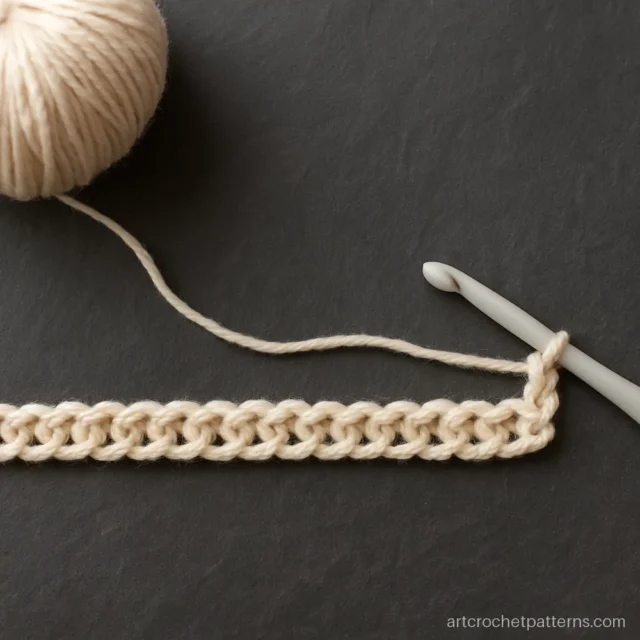
An even foundation chain
Twenty chains, each the same size. An even chain is the first sign that your tension is settling in.
Maker note: Count chains on the front, where each one looks like a small sideways V.
 LevelBeginnerYarnWorsted acrylicHook5 mm (H-8)
First single crochet practice swatch
Ten rows of fifteen stitches. Straight sides show you are hitting both end stitches each row.
Maker note: Mark the first stitch of each row with a clip marker until you can spot it by eye.
 LevelBeginnerYarnWorsted acrylicHook5.5 mm (I-9)
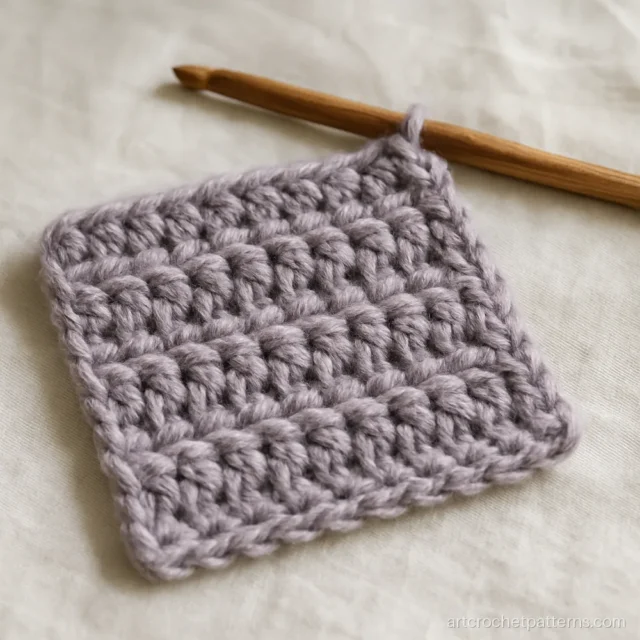
Double crochet rows in lavender
Taller stitches with visible gaps between the posts. This is the stitch that makes blankets grow quickly.
Maker note: Count the ch 3 as your first dc, then skip the first st below.
 LevelBeginnerYarnWorsted cottonHook4 mm (G-6)
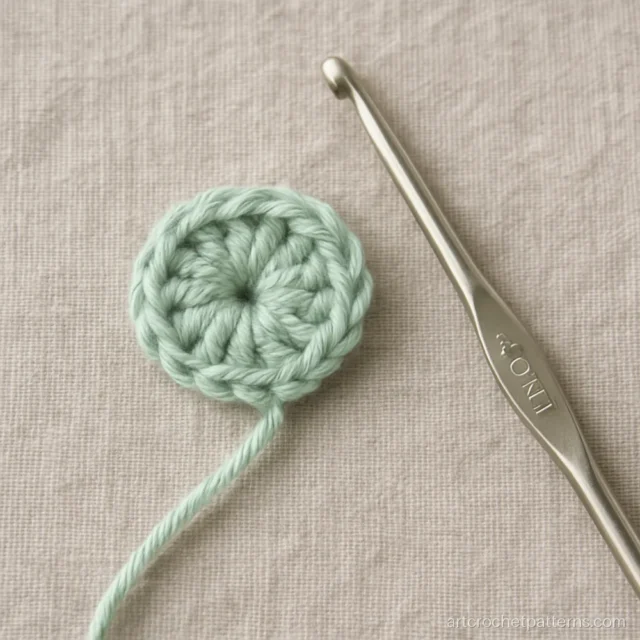
Magic ring with six single crochet
A magic ring pulled tight leaves no hole in the center. This is how hats and toys begin.
Maker note: Pull the tail firmly before joining, or the hole will open later.
 LevelBeginnerYarnWorsted cottonHook5 mm (H-8)
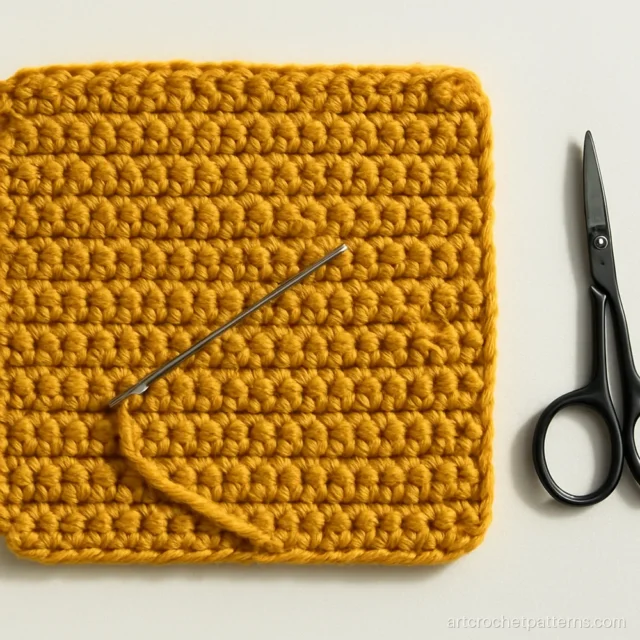
Ends woven in on a dishcloth
The back of a finished dishcloth with the tails woven in three directions. Nothing pokes out after washing.
Maker note: Run each tail about 2 inches one way, then turn and go back.
How to crochet for beginners step by step
Work through these in order. Each one takes a single short session, and each builds the hand movement for the next.
- Make a slip knot. Loop the yarn, draw a little of the ball end through, and slide it on the hook. See slip knot crochet.
- Chain. Bring the yarn over the hook, back to front, and draw it through the loop. Repeat until you have 20. The crochet chain lesson shows how to count them.
- Single crochet. Insert the hook into the second chain from the hook, yarn over, pull up a loop (two loops on hook), yarn over and pull through both. Learn it fully on the single crochet page.
- Turn, then make row two. Chain 1, turn the work like a page in a book, and single crochet into each stitch. Skip counting that ch 1; it is not a stitch.
- Taller stitches. Move on to half double crochet, then double crochet. Each adds one yarn over before you insert the hook.
- Finish. Snip the yarn, draw the tail through the final loop, and weave in the ends.
What you need before you start
Keep it small. You need one smooth, light colored worsted yarn, one 5 mm or 5.5 mm hook, scissors and a blunt yarn needle. Dark, fuzzy or novelty yarns hide the stitches, and you need to see them to learn where the hook goes.
- A crochet hook with a flat thumb rest is easier to keep facing the right way.
- A crochet kit bundles hooks and notions, but check the hook sizes match the yarn.
- The crochet supplies list covers markers, needles and a project bag.
- Stitch markers keep track of the first stitch in a row or round.
Holding the hook and the yarn
There are two common grips. The pencil grip holds the hook like a pen, with the hook resting on top of your hand. The knife grip holds it from above, like a dinner knife cutting food. Both make the same stitches. Try each for ten minutes and keep the one that does not tire your wrist.
Your other hand controls the yarn. Wrap it over your index finger and let it run loosely through your other fingers. If the yarn races through, wrap it once around your little finger. If it drags, unwrap one finger. A crochet tension ring can help if your hands ache.
Beginner crochet mistakes and fixes
| Mistake | Cause | Fix |
|---|---|---|
| Rows get narrower | The final stitch keeps getting missed | Mark the last stitch and work into it every row |
| Rows get wider | You are working into the turning chain | With single crochet, start in the first real stitch, not the chain 1 |
| Chain is too tight to work into | Gripping the yarn hard while you chain | Work the foundation on the next hook size up |
| Fabric curls up | Stitches are tighter than the chain | Relax your yarn hand or go up a hook size |
| Hook keeps snagging | The throat is turned away from you | Keep the thumb rest on top and the hook head facing down |
Learn to crochet with a pattern
Once you can make three rows of each stitch, follow a short pattern. Patterns use abbreviations such as sc, hdc and dc, and the number in brackets after each row is the stitch total you should reach. The guides to reading crochet patterns and crochet abbreviations walk through a real pattern line by line. Some designers also draw charts; crochet symbols explains what each mark means.
Choose a first project worked flat in rows. A dishcloth, a scarf or a coaster all work. The beginner crochet patterns page has six with full instructions.
Detailed guides in the Learn section
| Guide | What it covers |
|---|---|
| Crochet hook size chart | Millimeter, US letter and UK sizes with a converter |
| Best crochet hooks | Inline, tapered, ergonomic and other hook types compared |
| Crochet yarn | Weights, fibers and how to join a new ball |
| Cotton yarn for crochet | When to pick cotton and how it behaves |
| Best yarn for crochet | The right fiber for each kind of project |
| Changing colors | Clean stripes and color changes mid row |
| How to fasten off | Ending a piece so it never unravels |
| Blocking crochet | Wet, steam and spray blocking |
| Knitting vs crochet | How the two crafts differ and which to learn |
| Crochet meaning | The word, its origin and its history |
| Crochet ideas | What to make next, sorted by purpose |
| 30 minute projects | Tiny makes for short sessions |
| Crochet for kids | Teaching young makers with big hooks |
| Crochet books | What to look for in a stitch dictionary |
A one week plan to learn how to crochet
- Day 1: slip knot and 10 chains, ten times over. Pull them out and start again.
- Day 2: a swatch of single crochet, 15 stitches wide and 10 rows tall.
- Day 3: hdc and dc swatches of the same width.
- Day 4: a magic ring and three rounds of a flat circle (6, 12, 18 stitches).
- Day 5: switch to a second color on a row's final stitch and weave in the tails.
- Days 6 and 7: a full dishcloth from start to finish.
Fifteen to twenty minutes a day beats one long session. Your hands learn the motion while you rest.
Crochet basics in US and UK terms
Patterns from the US and UK use the same names for different stitches, which trips up many beginners. This site uses US terms.
| If the pattern is British | Use this US stitch |
|---|---|
| dc, double crochet | sc, single crochet |
| htr, half treble | hdc, half double crochet |
| tr, treble | dc, double crochet |
| dtr, double treble | tr, treble |
| Miss | Skip |
| Tension | Gauge |
A quick check: if a pattern never mentions single crochet, it is probably written in UK terms.
Questions makers ask
Is crochet hard to learn?
No. The hand motion feels awkward for the first hour, then it clicks. Most people can work even rows of single crochet after two or three short practice sessions.
How do you crochet if you are left handed?
Hold the hook in your left hand and the yarn in your right, and work rows from left to right. Every stitch is made the same way, only mirrored. Written patterns work as they are.
What is the best first stitch to learn?
The chain, then single crochet. Single crochet is short and dense, so you can see each stitch clearly and count it easily.
What size hook should a beginner use?
Either a 5 mm or a 5.5 mm hook (sizes H and I) with worsted weight yarn. The stitches are big enough to see but the yarn is not so thick that it is hard to handle.
How many days until the basics feel natural?
Beginning crochet goes fastest in short daily sessions. About a week gets you through the five basic stitches and a first flat project. Working in the round and reading patterns take a week or two more.
Can I learn crochet without a class?
Yes. Written steps and practice swatches are enough for most people. A crochet club or a friend who crochets can help you spot tension problems faster.