
A yarn holder for crochet does one simple thing: it keeps the ball in place while the strand feeds smoothly to your hook. Without one, the ball rolls under the chair, the cat finds it, and you spend more time untangling than stitching.
This guide covers the main holder types and what each does well, how to wind yarn so any holder works better, simple setups using things already in your kitchen, and full instructions for a crochet yarn holder basket with a guide loop on the rim. At the end there are tips for turning the same idea into a full crochet organizer for works in progress.
At a glance
Skill level
BeginnerHolder types
Bowl, spindle, jar, basket, bagBasket yarn
Bulky (5) cotton or acrylic, about 150 yardsBasket hook
6.5 mm (K-10.5)Basket size
About 7 inches across, 6 inches tallTime to make
2 to 3 hours
Types of yarn holder for crochet
| Holder | How it works | Best for | Downside |
|---|---|---|---|
| Yarn bowl | Heavy bowl with a curved slot for the strand | Single balls and cakes at home | Ceramic can chip; heavy to carry |
| Spindle or dispenser | Yarn cake sits on a dowel and spins | Smooth feed, colorwork with two strands | Only works with cakes, not skeins |
| Jar with a hole in the lid | Ball sits in a jar, strand exits the lid | Travel, slippery or fuzzy yarn | Must drill or punch the lid |
| Crocheted basket with guide loop | Soft walls, strand runs through a loop | Quiet, light, washable | Lighter than a bowl, may tip with a big skein |
| Wrist or drawstring bag | Ball hangs in a small bag | Crocheting on the move | Ball can still twist inside |
Wind it right first
No holder fixes a badly wound ball. The way yarn leaves the ball affects twist and tension.
- Center pull skein. Many skeins are wound so you can pull from the middle. They sit still in a bowl or basket and do not roll at all. Dig gently for the inner end; a clump of yarn often comes out with it, and that is normal.
- Yarn cake. A flat topped cylinder wound on a ball winder. It sits flat in a bowl and spins well on a spindle.
- Hand wound ball. Wind loosely over two fingers so the yarn keeps its stretch. Tight balls stretch the fiber and change your gauge.
- Hank. A twisted loop of yarn, common for hand dyed wool. Always wind a hank into a ball or cake before you crochet, or it becomes a knot in minutes.
In pictures
What the work should look like, with the yarn and hook used for each sample.
 LevelBeginnerYarnBulky cotton, oatmealHook6.5 mm (K-10.5)
Crochet basket with a rim guide loop
The strand runs up through a chain loop on the rim, so the cake stays put inside while you work. You will find its instructions further down.
Maker note: Stiff bulky cotton keeps the walls upright. Soft acrylic slumps unless you hold two strands together.
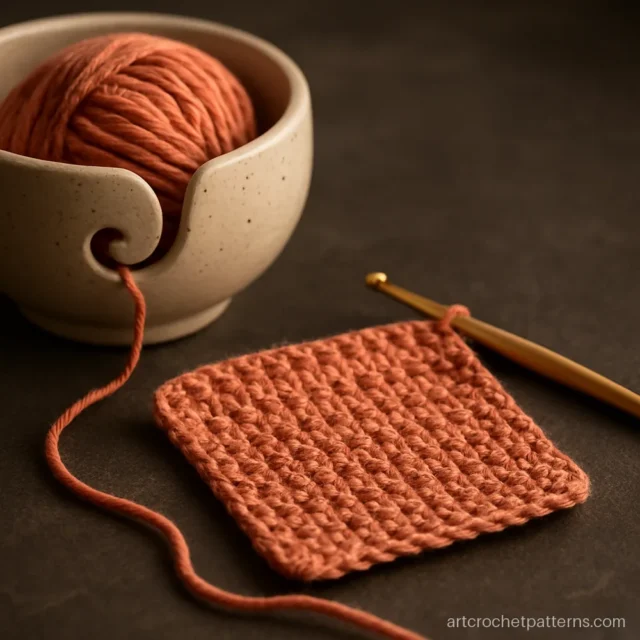 LevelBeginnerYarnWorsted acrylic, coralHook5 mm (H-8)
Ceramic bowl with a spiral slot
A heavy bowl does not slide, and the curled slot lets the strand out without letting the ball jump free.
Maker note: Pick a bowl at least 6 inches across so a full skein of worsted sits with room to turn.
 LevelBeginnerYarnDK wool, mint and creamHook4 mm (G-6)
Wooden spindle for center pull cakes
A cake sits on a smooth upright dowel and unwinds from the outside as it spins. Great for colorwork when two strands must not twist.
Maker note: Pull from the outside on a spindle. Center pull yarn on a spindle collapses as it empties.
Crochet yarn holder basket pattern
Materials: about 150 yards of bulky (5) cotton or worsted cotton used doubled; K-10.5 (6.5 mm) hook; locking marker; tapestry needle. Finished size: about 7 inches across and 6 inches tall. Worked in a spiral; move the marker up each round.
- Rnd 1: 6 sc in a magic ring. (6)
- Rnd 2: 2 sc in each st around. (12)
- Rnd 3: (sc in next st, 2 sc in next st) 6 times. (18)
- Rnd 4: (sc in next 2 sts, 2 sc in next st) 6 times. (24)
- Rnd 5: (sc in next 3 sts, 2 sc in next st) 6 times. (30)
- Rnd 6: (sc in next 4 sts, 2 sc in next st) 6 times. (36)
- Rnd 7: (sc in next 5 sts, 2 sc in next st) 6 times. (42)
- Rnd 8: (sc in next 6 sts, 2 sc in next st) 6 times. (48)
- Rnd 9: sc in the back loop only of each st around. This sets the base edge. (48)
- Rnds 10 to 22: sc in each st around. (48)
- Rnd 23: sc in next 24 sts, ch 10, sl st into the sc just made to form the guide loop, sc in each of the remaining 24 sts. (48 sc and one loop)
- Sl st in the next st to smooth the spiral step, fasten off.
Weave the tail down inside the wall. To use it, drop a cake or center pull skein in, pass the yarn end up through the guide loop from the inside, and start crocheting. The loop holds the strand to one spot on the rim so it cannot wrap around the ball.
If you have not worked a flat base before, the magic ring page explains the start, and the crochet basket page has bigger sizes.
Free holders from things you already own
- Clean jar or tub. Punch a hole in the lid with a hot skewer or drill, and smooth the edge with sandpaper so it cannot fray the yarn.
- Teapot. Drop the ball in and feed the strand out of the spout. Sounds odd; works beautifully.
- Paper towel holder. An upright one becomes a spindle for yarn cakes.
- Zip bag. Seal it most of the way and feed the strand out of the gap. Handy for fuzzy mohair that sheds.
- Shoebox. Cut a small hole in each end for two colors, so stripes do not twist together.
When a crochet yarn holder helps most
Some projects need a holder far more than others.
- Two color work. In tapestry crochet the strands twist every time you switch colors. Two holders side by side, one on each side of you, let you untwist by turning the work back.
- Slippery yarn. Silk, bamboo and mercerized cotton bounce off the table. A jar or deep bowl contains them.
- Fuzzy yarn. Mohair and chenille pick up lint and pet hair from the floor. Keep them in a closed jar.
- Tension trouble. If a rolling ball tugs the strand, your stitches tighten and loosen. A still ball gives even pull. Pair a holder with a tension ring if you still struggle.
Turn it into a crochet organizer
Once one project has a home, the rest want one too. Keep each work in progress in its own drawstring bag or basket with the yarn, the pattern and the hook together. Clip a stitch marker to the last live loop so nothing unravels. A hanging organizer with clear pockets on the back of a door holds hooks, scissors and needles where you can see them. Hooks get their own home in a crochet hook case, one slot per size.
Yarn holder problems and quick fixes
| The trouble | What causes it | Quick fix |
|---|---|---|
| Ball jumps out of the bowl | Pulling up, not sideways | Feed the strand through the slot, keep work at bowl height |
| Yarn twists into kinks | Pulling from the outside of a still ball | Use a spindle so the ball turns, or let the yarn hang and spin out |
| Center pull skein collapses | Last third has no core | Rewind the rest into a small ball |
| Basket tips over | Big skein, light walls | Drop a smooth stone in the bottom, or use stiffer cotton |
| Strand snags on the holder | Rough slot or lid hole | Sand the edge smooth or line the hole with a grommet |
Questions makers ask
What can I use as a yarn holder for crochet?
A heavy bowl, a jar with a hole in the lid, a teapot, an upright paper towel holder or a crocheted basket. Anything that keeps the ball still and lets the strand leave from one point works.
Do I need a yarn bowl to crochet?
No. A bowl is a comfort, not a requirement. A center pull skein in any basket stays still on its own.
How do I stop two yarn colors twisting together?
Put each color in its own holder on opposite sides of you. Rotate the piece clockwise at one color change and counterclockwise at the next.
Which yarn makes the sturdiest crochet yarn holder basket?
Bulky cotton, or a doubled strand of worsted cotton. Both make firm walls that stand up. Soft acrylic slumps unless worked very tightly.
Why does my yarn keep getting kinks?
Pulling from the outside of a ball that cannot turn adds twist. Use a spindle, pull from the center, or let the work hang now and then to untwist.