
Tapestry crochet is colorwork done in tight single crochet, where the resting shade rides along inside each stitch until it is needed again. Nothing floats loose on the back, so the fabric is thick, sturdy and nearly the same on both faces.
That density is why the method shows up on bags, baskets, rugs and wall hangings. Below are six original designs, a counted checkerboard mug rug for your first try, and tips for drawing your own chart on squared paper.
At a glance
Skill level
Easy to intermediateYarn
Worsted cotton, two or more colorsHook
4 to 4.5 mm, a size downStitches used
ch, sc, color changeTime
3 to 4 hours for the mug rugAlso called
Jacquard crochet, carried colorwork
6 tapestry crochet designs to make
Every design lists the skill level, yarn and hook, with a note from the maker.
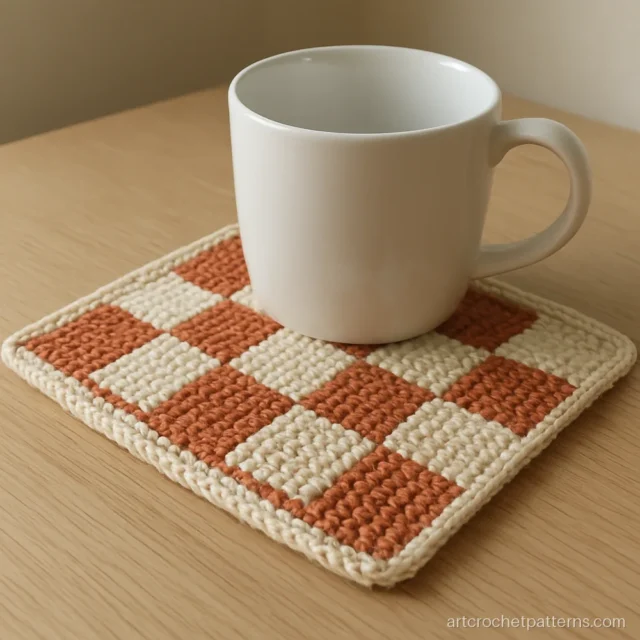 LevelBeginnerYarnWorsted cottonHook4.5 mm (7)
Rust and cream checkerboard mug rug
The starter pattern on this page. Blocks of three stitches by three rows teach the carry and the color change with no chart reading at all.
Maker note: Twist nothing. Just lay the idle strand along the tops of the row below and crochet over it.
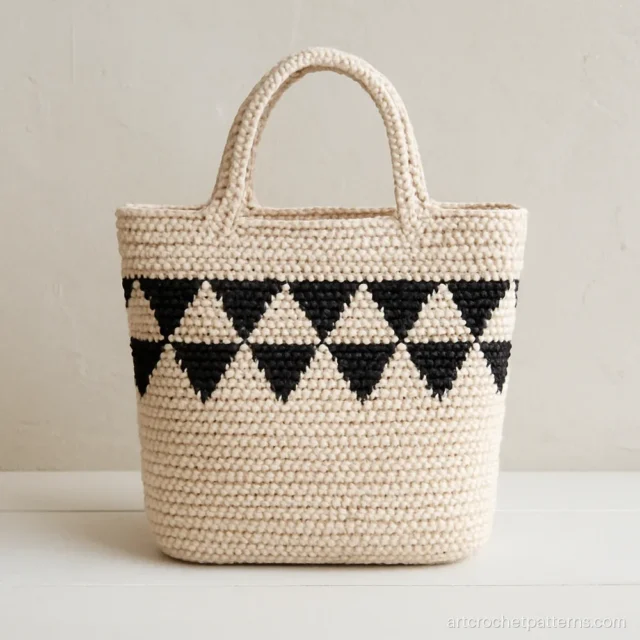 LevelIntermediateYarnWorsted cottonHook4 mm (G-6)
Triangle band market tote
Worked in the round from a flat oval base, so every round is read right to left. The firm fabric holds groceries without stretching.
Maker note: Work in the back loop on the first round of the sides to make a sharp fold between base and wall.
 LevelIntermediateYarnWorsted acrylicHook4.5 mm (7)
Mountain dusk wall hanging
A flat panel worked in rows from a hand drawn chart, then hung on a wooden dowel. Each mountain ridge is just a staircase of color changes.
Maker note: Use short lengths for small sky patches and carry only two colors at once to keep the panel from getting too stiff.
 LevelIntermediateYarnBulky cotton blendHook6 mm (J-10)
Round storage basket with zigzags
Holding two strands together makes the walls stand up alone. A zigzag of four stitches repeats cleanly around any round that divides by four.
Maker note: Stop increasing once the base is the width you want, then work even rounds for the walls.
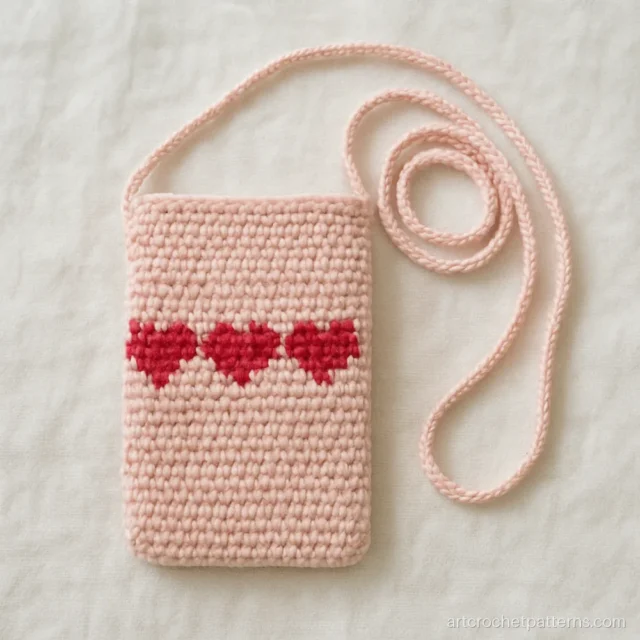 LevelEasyYarnDK cottonHook3.5 mm (E-4)
Heart phone pouch
Two flat panels with a row of small hearts, joined on three sides. A cord strap lets it hang across the body.
Maker note: DK yarn with a small hook gives enough stitches across for a clear heart shape on a narrow piece.
 LevelAdvancedYarnWorsted acrylicHook4.5 mm (7)
Desert cactus cushion
Three cacti in two greens stand on a sandy band, with the color carried behind every stitch. The dense fabric makes a firm cushion front.
Maker note: Carry at most two colors across any one row. Add the third green only where the chart needs it.
How tapestry crochet carries the second color
Plain sc, which UK patterns call double crochet, simply goes into whatever stitch comes next. In tapestry work you do the same, but you first lay the idle color along the tops of the row below. Your hook goes under that strand too, so the new stitch swallows it. The idle yarn stays hidden and ready.
The switch itself happens one stitch early. On the final sc in the outgoing shade, stop once you hold two loops, then catch the incoming shade and draw it through both. The stitch on the hook now wears the new shade, and the next stitch starts clean.
Because the strand is buried in every stitch, the fabric gets thicker and a little stiffer than plain sc. That is a feature for bags and baskets and a good reason to keep blankets in other methods like c2c crochet.
Free tapestry crochet pattern: checkerboard mug rug
Materials: worsted cotton in cream (A, about 40 yards) and rust (B, about 25 yards), a size 7 hook and a tapestry needle. Size: about 6 by 4.5 inches before the edge. Skip counting the single turning chain; only sc stitches go in the tally. Carry the idle color inside every stitch on rows 2 to 16.
- Row 1 (A): Ch 25, sc in 2nd ch from hook and each ch across. Turn. (24 sc)
- Row 2: Join B by laying it along the row. Ch 1, (3 sc in A, 3 sc in B) 4 times. Turn. (24 sc)
- Row 3: Ch 1, (3 sc in B, 3 sc in A) 4 times. Turn. (24 sc)
- Row 4: Ch 1, (3 sc in A, 3 sc in B) 4 times. Turn. (24 sc)
- Rows 5 to 16: Rep rows 2 to 4 four more times. Because each band starts on the opposite edge from the last one, the blocks switch places and the checkerboard forms. (24 sc in each row, 5 bands)
- Row 17 (A): Cut B, leaving a 4 inch tail to weave in. Ch 1, sc in each st across in A. (24 sc)
- Edging: Ch 1, sc evenly around all four sides with 3 sc in each corner. Join with sl st and fasten off.
Stop after row 4 and look. You should see three cream blocks and three rust blocks along one edge and their opposites along the other edge. If the block lines wander, the color change happened one stitch late.
Step by step color change
- Count ahead. Know which stitch is the last one in the current color.
- Start that last stitch. Hook into the stitch and draw up a loop of the outgoing shade, so you hold two loops.
- Drop and pick up. Let the outgoing shade hang behind. Wrap the incoming shade over the hook.
- Finish the stitch. Pull the new color through both loops. The top of this stitch is now the new shade.
- Bury the old strand. Lay it along the row and work over it with the new color.
Tug the carried strand gently every few stitches so it lies flat inside, but never so hard that the fabric puckers.
Drawing your own crochet tapestry pattern
A tapestry crochet pattern maker can be as simple as graph paper and colored pencils. One square equals one sc. Since sc is a bit wider than it is tall, a drawn circle will come out slightly squat, so stretch your sketch about one extra row in every five.
- Pick a width that matches the repeat. A 6 square motif fits evenly on 24, 30 or 36 stitches.
- Keep color runs to at least two stitches where you can. Single stitch dots look muddy.
- Limit each row to two colors at a time. A third carried strand makes the fabric very stiff.
- Number the rows on both edges of the chart, since flat rows are read right to left and then left to right.
The same chart can also be worked as corner to corner tiles, which gives a lighter, larger picture. Geometric charts with one color per row are better suited to mosaic crochet.
Yarn and hook for tapestry crochet patterns
| Yarn | Hook | Fabric |
|---|---|---|
| DK cotton | E-4 hook at 3.5 mm | Fine detail; pouches and small cases |
| Worsted cotton | G-6 or size 7 | The usual pick; mug rugs, totes, wall art |
| Worsted acrylic | Size 7 hook | Softer cushions, easier on the hands |
| Bulky cotton blend | 6 mm (J-10) | Baskets with walls that stand on their own |
Choose colors with strong contrast in lightness, not just in hue. Take a phone photo in black and white mode: if the colors turn the same gray, the motif will blur.
When the colorwork looks off
| Sign | Behind it | Remedy |
|---|---|---|
| Hidden color peeks through | Loose hook for the yarn | Use a hook one step finer, so each stitch hugs the buried strand |
| Motif leans to one side | Sc stitches slant in rows and rounds | Normal in rounds; working in rows or in the back loop reduces it |
| Fabric puckers | Carried strand pulled tight | Spread the stitches on the hook before tugging the strand |
| Yarns twist into a rope | Turning the same way every row | Turn clockwise on one row and counterclockwise on the next |
More stitch help lives on our crochet stitches hub, and bag ideas on the crochet accessories page.
Questions makers ask
What is the difference between tapestry crochet and c2c?
Tapestry crochet uses single crochet and carries unused colors inside the stitches, so the fabric is dense. C2C builds diagonal tiles of double crochet with no carry, so it is lighter and faster but less crisp.
Can I find tapestry crochet patterns free for beginners?
The mug rug on this page is a complete free pattern with two colors and no chart. After it, try a simple stripe or triangle band before any picture chart.
Why does my crochet tapestry slant?
Single crochet leans a little with every round, so motifs worked in the round drift sideways. Working in rows, or in the back loop only, keeps the columns straighter.
Should the idle shade be snipped whenever the color switches?
No. Carry the idle color inside the stitches and pick it up again when the chart calls for it. Cut only when a color is done for good.
What hook size works for tapestry crochet?
Pick a hook one step finer than the ball band lists. Tight stitches hide the carried strand and make the color edges sharp.
Is tapestry crochet good for a blanket?
It works, but a full blanket gets heavy and stiff. Many makers use tapestry bands only near the edges, or pick c2c or mosaic for large pieces.