
A crochet hook case you made with your own hook is the first tool most makers crochet for themselves, and it solves a real problem: hooks that roll off tables, sink to the bottom of a project bag and vanish down the side of the sofa. This page gives a complete roll up case with nine sewn slots, plus a quicker zip pouch and notes on turning the same fabric into a phone or glasses case.
Both designs use dense single crochet in worsted cotton, so hook tips cannot poke through and the case keeps its shape for years. If you can work rows of single crochet and sew a straight line with a yarn needle, you can finish either one in an evening or two.
At a glance
Skill level
Advanced beginnerYarn
Worsted (4) cotton, about 140 yardsHook
5 mm (H-8)Finished size
9 by 13 inches flat, 9 slotsStitches used
Chain, single crochet, backstitchTime
4 to 6 hours
What makes a good crochet hook case
A case has three jobs: keep each hook in its own place, show the sizes at a glance, and close so nothing escapes in a bag. Fabric choice does most of the work.
- Dense stitches. Single crochet worked a size tighter than the label suggests leaves almost no gaps. Open stitches like double crochet let thin steel hooks slip through.
- Fiber that stays put. Cotton, or cotton mixed with linen, keeps a pocket in shape. Acrylic stretches as hooks go in and out, so the slots grow loose.
- A top flap. A strip that folds over the hook ends before you roll is the difference between a case and a hook spill.
- Slots sized to your hooks. Standard aluminium hooks are about 5 1/2 to 6 inches long and slim. Ergonomic handles are thicker and need wider slots, as the table below shows.
Not sure which hooks you will be storing yet? Our guide to hook types compares inline and tapered heads, and the hook size chart lists the millimeter sizes worth labeling on your slots.
Slot sizes for each type of hook
| Hook type | Handle width | Slot width (stitches at gauge) |
|---|---|---|
| Standard aluminium, 2.25 to 6 mm | Slim, under 1/2 inch | 1 inch (4 sc) |
| Wooden or bamboo, 6 to 10 mm | About 1/2 inch | 1 inch (4 sc) |
| Ergonomic with rubber grip | 3/4 to 1 inch | 1 1/2 inches (6 sc) |
| Large plastic, 12 mm and up | Over 1 inch | 2 inches (8 sc) |
| Steel thread hooks | Very slim | Two per 1 inch slot |
Lay your hooks side by side on the table before you start. Add up the slot widths you need, and that total is the width to crochet.
In pictures
What the work should look like, with the yarn and hook used for each sample.
 LevelAdvanced beginnerYarnWorsted cotton, sageHook5 mm (H-8)
Roll up case in sage cotton
The pocket holds hooks from 2.25 mm to 10 mm, and the top flap folds down so nothing slides out when it is rolled. A chained tie wraps around twice.
Maker note: Sew the slot lines in a darker yarn so they act as a guide, or match the color for a cleaner look.
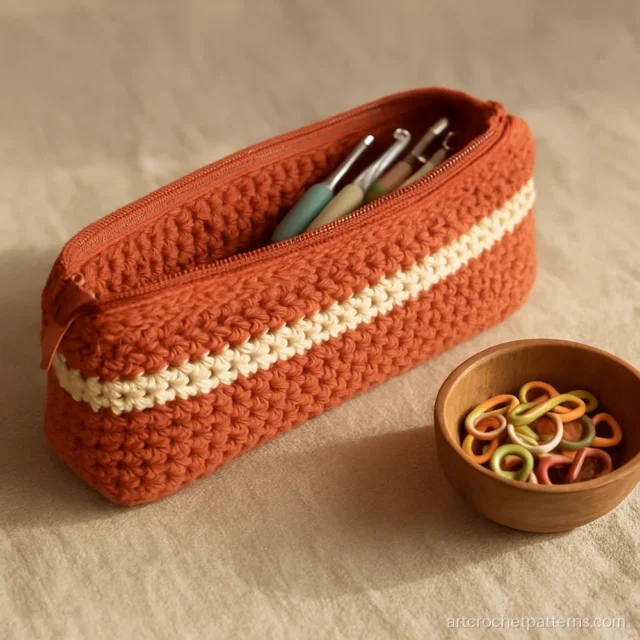 LevelIntermediateYarnWorsted cotton, terracottaHook5 mm (H-8)
Zip pouch hook holder
A folded rectangle with a sewn in zipper holds a full set of standard hooks plus a needle and scissors. It suits makers who carry a project bag everywhere.
Maker note: Pin the zipper in place first and sew it with matching sewing thread, backstitching close to the teeth.
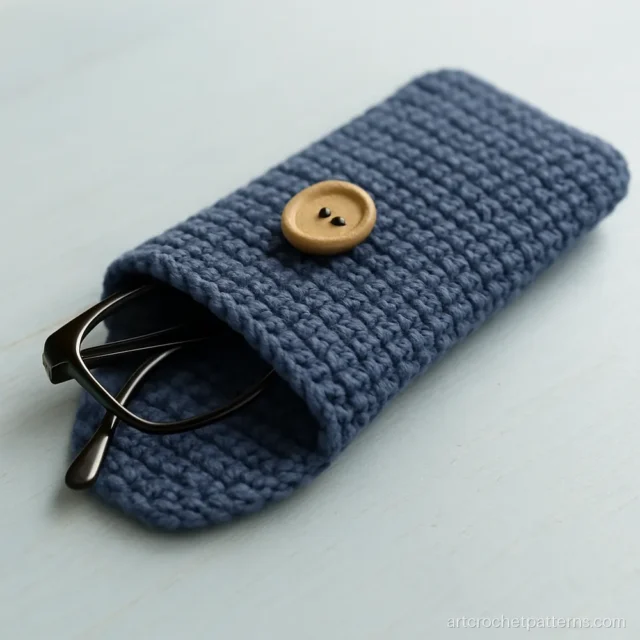 LevelBeginnerYarnWorsted cotton, navyHook5 mm (H-8)
Glasses case from the same fabric
Make the rectangle 8 inches wide, skip the slots and seam it into a sleeve. The same dense fabric protects lenses and phones well.
Maker note: Measure the glasses folded, then add half an inch to the width so they slide in without stretching the stitches.
Roll up crochet hook case pattern
Materials: about 140 yards of worsted weight cotton in the main color, 5 yards of a contrast color for the slot lines, one H-8 hook (5 mm), a blunt yarn needle, pins.
Gauge: 16 sc and 18 rows to 4 inches. Gauge matters here only for the slot widths, but check it, because a looser fabric lets hooks fall through. Each row opens with a turning ch 1 that you never count.
- Foundation: ch 37.
- Row 1: sc in 2nd ch from hook and in each ch across. (36)
- Row 2: ch 1, turn, sc in each st across. (36)
- Rows 3 to 58: rep Row 2. The piece measures about 9 by 13 inches. (36)
- Edging: do not fasten off. Ch 1 and sc evenly around all four sides, working 3 sc in each corner. Join with a sl st to the first sc and fasten off, leaving a 24 inch tail.
- Tie: ch 110, about 30 inches. Fasten off, leaving a 6 inch tail.
Assembly
- Lay the piece flat with the right side down. Fold the bottom 5 inches (about 22 rows) up to make the pocket. Pin the sides.
- Using the long tail, whip stitch both side edges of the pocket closed through both layers.
- With the contrast yarn, mark slot lines with pins after every 4th stitch across the pocket: after stitches 4, 8, 12, 16, 20, 24, 28 and 32. That is 8 lines and 9 slots.
- Backstitch along each pinned line from the fold to the pocket top, going through both layers. Knot inside the pocket and weave the end up the line you just sewed.
- Fold the tie in half and sew the fold to the outside of one short edge, halfway up the case.
- Slide the hooks in, fold the top 2 1/2 inches down over the handles, roll from the untied edge toward the tie and wrap it twice before a bow.
Quick zip pouch version
A pouch is faster than a roll because there are no slots to sew. Chain 33 and work rows of single crochet on 32 stitches until the piece is 7 inches tall. Fold it in half so the short edges meet at the top, then whip stitch or slip stitch the two side seams. The pouch measures about 8 by 3 1/2 inches.
Use a 7 or 8 inch zipper. Pin it inside the opening with the teeth just below the top edge, and sew it with sewing thread and a sharp needle. Crochet fabric stretches as you sew, so pin every inch and ease the fabric rather than pulling it. A loop of chains through the zipper pull makes it easier to open with cold hands.
This pouch doubles as a home for the rest of your kit: a needle, a tape measure and a few markers. The crochet supplies list covers what is worth packing, and a larger crochet pouch holds a small project too.
Turn the same fabric into a phone or glasses case
The dense cotton rectangle in the hook case pattern is also the right fabric for a crochet phone case or a crochet glasses case. Only the measurements change.
- Measure the item at its widest point and add 1/2 inch for ease. Multiply by 4 to get the stitch count at the gauge above.
- Measure the length and double it, then add 2 inches if you want a flap.
- Crochet the rectangle, fold it so the flap sticks out at the top, and seam both sides.
- Sew a button to the front and work a chain loop at the flap tip to fit it.
A typical phone needs a rectangle 13 stitches wide for a slim phone and up to 16 for a large one. For glasses that hang on a cord instead of living in a case, see the crochet glasses holder page.
Yarn choices for a hook holder
| Yarn | Hook | How the case turns out |
|---|---|---|
| Worsted (4) cotton | 5 mm (H-8) | Firm, holds slots well, washes cleanly |
| DK (3) cotton | 4 mm (G-6) | Thinner and lighter, good for a slim travel case |
| Worsted acrylic | 7 (4.5 mm) | Soft, but slots stretch; go a size down |
| Cotton and linen blend | 5 mm (H-8) | Crisp, stiff, softens with use |
| Bulky (5) cotton | 6.5 mm | Chunky and fast, best for large hooks |
Hook case mistakes and how to avoid them
| Trouble | Likely cause | Remedy |
|---|---|---|
| Hooks poke out of the bottom | Fabric too loose | Go down a hook size and work tighter single crochet |
| Slot lines wander | Sewn without a guide | Pin first, follow one column of stitches |
| Edges ripple after seaming | Whip stitch pulled tight | Sew with relaxed tension, then steam lightly |
| Small hooks fall out when rolled | Top flap too short | Make the flap at least 2 inches deep |
| Case leans when unrolled | Rows not counted, sides uneven | Keep 36 stitches every row; check every few rows |
If you fly with your hooks, a soft cotton case is easy for screening officers to unroll. The current rules are covered on flying with crochet tools.
Questions makers ask
Which yarn works best for a crochet hook case?
Worsted cotton. It does not stretch, so slots keep their size, and the tight single crochet fabric stops hook tips from poking through. Acrylic works if you drop a hook size.
How many slots should a hook case have?
Count the hooks you use most and add two spares. Nine slots fit every standard size between 2.25 and 6 mm plus two larger hooks.
Can I make a crochet hook holder without sewing slots?
Yes. The zip pouch holds hooks loose, and an upright jar cozy on your desk works for hooks you keep at home. Slots only matter when you want to see sizes at a glance.
What size should a crochet phone case be?
Measure the width of the phone with its cover on, add half an inch, and work single crochet to that width. Fold and seam it, then add a flap and button so it cannot slide out.
Can I wash a crocheted hook case?
Yes. Check the yarn band first; cotton cases usually take a cool wash and a flat dry. Take the hooks out first and reshape the slots while the case is damp.