
A crochet hook is a short rod with a hooked tip that pulls loops of yarn through other loops, and it is the only tool crochet truly needs. This guide shows the five parts of a hook, how to hold it, the sizes beginners use most and what each material feels like in the hand.
Some people call it a crochet needle. It is the same tool, but unlike a sewing or knitting needle it has no eye and no second point. One working loop sits on it at a time.
At a glance
Also called
Crochet needleFirst size to buy
5 mm (H-8) for worsted yarnSize range
About 0.6 mm steel up to 25 mmMaterials
Aluminum, steel, bamboo, wood, plasticUK sizing
Millimeters; older hooks used numbers
The five parts of a crochet hook
- Point: the tip you push into each stitch. A sharper point slides into tight stitches; a rounder one splits yarn less.
- Throat: the groove that catches the yarn when you yarn over. A deep throat holds yarn securely; a shallow one releases loops faster.
- Shaft: the straight section behind the throat. Its width is the hook size, and it sets how big each loop will be.
- Thumb rest: a flat pad where your thumb sits. It keeps the throat facing the right way and usually shows the size.
- Handle: everything behind the thumb rest. Ergonomic hooks add a thick soft grip here.
If loops slide up onto the throat as you work, your stitches will be tight and uneven. Push each new loop back onto the shaft before the next stitch.
How to hold a crochet hook
There is no wrong grip as long as your stitches are even and your hand does not hurt.
- Pencil grip: pinch the hook near the thumb rest with thumb and forefinger, as if writing. The handle rests on the web of your hand. Good for fine thread and small, precise stitches.
- Knife grip: hold it from above with the handle under your palm, like cutting with a table knife. This uses bigger arm muscles and tires the wrist less over long sessions.
Whichever you choose, keep the throat facing toward you or slightly down as you pull through. If it rotates away, the yarn slips off. The how to crochet lesson shows how the yarn hand works with each grip.
In pictures
What the work should look like, with the yarn and hook used for each sample.
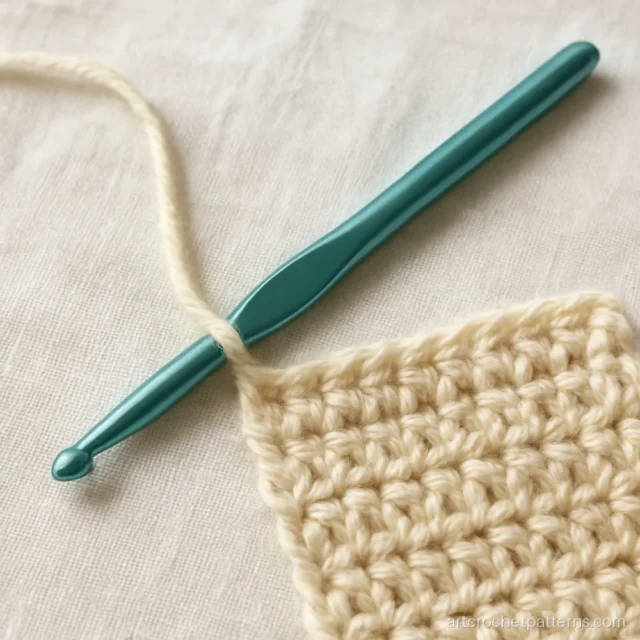 LevelBeginnerYarnNone shownHook5 mm (H-8)
Parts of an aluminum hook
From the left: the point, the throat that catches yarn, the shaft that sets stitch size, and the flat thumb rest printed with the size.
Maker note: The shaft decides your stitch size. Loops should sit there, not on the narrow throat.
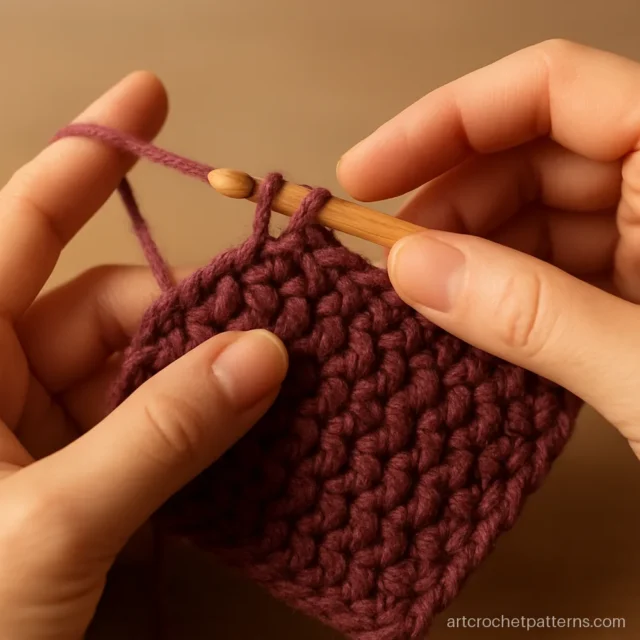 LevelBeginnerYarnWorsted acrylicHook5.5 mm (I-9)
Knife grip in action
The knife grip holds the hook from above with the handle under the palm. Many makers find it easier on the wrist for long sessions.
Maker note: Rest your index finger near the thumb rest to steer the point into each stitch.
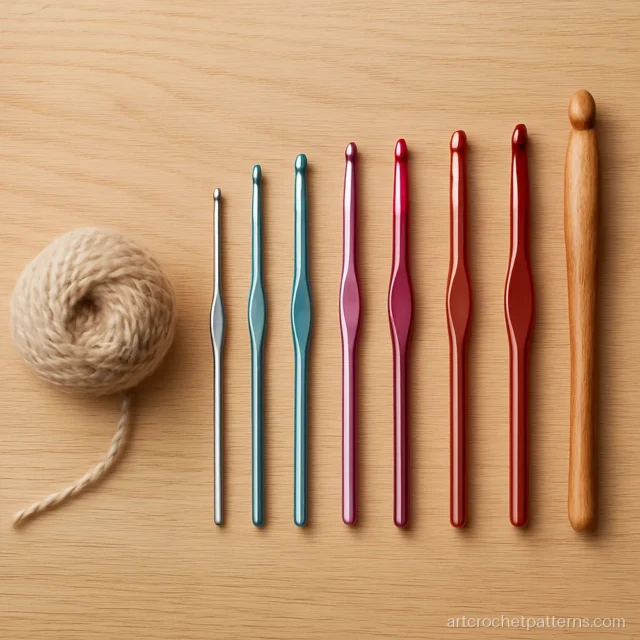 LevelBeginnerYarnNone shownHook3 mm to 8 mm
A graded set from 3 mm to 8 mm
Laid side by side, the jump from a fine 3 mm to a chunky 8 mm is easy to see. Each one matches a different yarn weight.
Maker note: Store hooks in size order so you can grab the next size up or down in a moment.
Common crochet hook sizes for beginners
Hooks are sized by the width of the shaft in millimeters. US hooks add a letter and number, but those can vary between makers, so trust the millimeters.
| Millimeters | US label | Used with |
|---|---|---|
| 2.5 mm | Between B-1 and C-2 | Fingering yarn, small toys |
| 3 mm | No standard letter | Fingering and sport, fine amigurumi |
| 3.5 mm | E-4 (size E) | Sport yarn; worsted toys |
| 4 mm | G-6 | DK and light worsted |
| 5 mm | H-8 | Worsted, the classic beginner size |
| 5.5 mm | I-9 | Worsted blankets and hats |
| 6 mm | J-10 | Heavy worsted and aran |
| 8 mm | L-11 | Bulky yarn |
| 9 mm | M/N-13 | Bulky and super bulky |
Notice that a 3mm crochet hook has no standard US letter, so patterns list it in millimeters only. For every size from steel thread hooks to 25 mm jumbo hooks, use the crochet hook size chart, which also converts old UK numbers.
Types of crochet hooks by material
| Material | How it feels | Best with |
|---|---|---|
| Aluminum | Smooth and fast, light, cool to touch | Acrylic and cotton; most beginners start here |
| Steel | Very fine sizes, rigid | Crochet thread, lace, doilies |
| Bamboo or wood | Warm, a little grippy, quiet | Slippery yarns such as silk or bamboo blends |
| Plastic | Very light, flexes in thin sizes | Large hooks for super bulky yarn |
| Ergonomic | Thick soft handle over a metal head | Long sessions, sore hands or wrists |
Head shape matters too. On inline crochet hooks the throat is a sharp notch level with the shaft, which keeps loops even. Tapered hooks have a rounded throat that glides. The best crochet hooks guide compares both in detail, and Tunisian crochet hooks covers the long hooks used for that technique.
Specialty hooks worth knowing
- Light up crochet hooks have a small light in a clear plastic head. They help with dark yarn such as black or navy, where it is hard to see the stitches.
- Long crochet hooks hold many loops at once for Tunisian crochet, and some have a cable on the end.
- Double ended hooks have a head at each end, either two sizes or for working two colors in Tunisian rounds.
- Jumbo plastic hooks from 15 mm to 25 mm work jumbo yarn for rugs and fast blankets.
A crochet subscription box sometimes includes one of these alongside yarn, but check the sizes match your projects before you sign up.
Troubleshooting your hook
| What you notice | Likely cause | Try this |
|---|---|---|
| Hook splits the yarn | Point too sharp for a loose plied yarn | Switch to a hook with a rounder point |
| Yarn drags on the hook | Rough finish or a grippy wood with sticky acrylic | Try a smooth aluminum hook |
| Hand cramps after twenty minutes | Gripping a thin handle too hard | Use an ergonomic handle or slip a foam grip on |
| Fabric too stiff | The hook is undersized for that yarn | Swatch again on a hook half a millimeter wider |
Caring for and traveling with your crochet hook
Wipe aluminum and steel hooks with a dry cloth. Keep wood and bamboo away from water and heat, and rub a little beeswax on them if they start to feel rough. A roll up crochet hook case keeps sizes in order and stops thin hooks from bending in a bag. Hooks are currently fine in US carry on luggage under airport screening rules, though the officer at the checkpoint decides; see bringing crochet hooks on a plane before a trip.
Questions makers ask
What is the letter for a 4mm crochet hook?
A 4 mm hook is a G-6 in US sizing. Some older or imported hooks label 4 mm differently, so check the millimeters printed on the thumb rest.
What letter is a 5mm crochet hook?
A 5 mm hook is an H-8. Worsted yarn and an H-8 go together in most beginner patterns.
What size is a size E crochet hook?
A size E, or E-4, is 3.5 mm. It is popular for amigurumi in worsted cotton and for sport weight garments.
Is a crochet needle the same as a crochet hook?
Yes. Crochet needle is an older or regional name for the same tool. It has a hooked tip and no eye.
Are plastic crochet hooks good for beginners?
In large sizes they are fine and very light. In small sizes they can bend and feel draggy, so an aluminum hook is usually easier for a first project.
What is an 8mm crochet hook used for?
An 8 mm, or L-11, hook works bulky yarn for quick scarves, cowls and chunky blankets.