
The best crochet hooks are the ones that suit your grip, your yarn and how long you crochet in one sitting, so there is no single winner. A head shape that one maker loves will snag for another. This guide compares hook types by head, handle and material so you can match a hook to the way you work.
We do not name makers or shops here. Every type below is sold by several companies, and what matters is the shape and the material, not the label.
At a glance
Head shapes
Inline and taperedHandles
Plain or ergonomicMaterials
Aluminum, steel, bamboo, wood, plasticBest for sore hands
Ergonomic handle, light weightFirst set
3.5 mm to 6.5 mm in one head style
How to choose the best crochet hooks for you
Three things decide how a hook feels: the head shape, the handle and the material. Change any one and your stitches change. Before you buy, think about:
- Your grip. Pencil grip users often like a slim handle. Knife grip users often like a thick one.
- Your tension. Tight crocheters usually do better with an inline head or a smooth metal; loose crocheters with a tapered head or grippy wood.
- Your yarn. Slippery yarns behave better on wood or bamboo. Sticky acrylic slides best on polished aluminum.
- Your sessions. If you crochet more than an hour at a time, an ergonomic handle is worth having.
Inline vs tapered crochet hooks
| Feature | Inline | Tapered |
|---|---|---|
| Head | Point and throat are in line with the shaft; the throat is cut in sharply | Head is wider than the throat, which slopes into the shaft |
| Feel | Grabs yarn firmly and keeps loops the same size | Glides; loops slip off quickly |
| Point | Often more pointed | Often rounder |
| Good for | Even stitches, amigurumi, tight crocheters | Fast work, smooth motion, people who rock the hook |
| Watch out | Can snag loosely plied yarn | Loops can creep onto the throat and tighten |
Neither is better. Try both in the same size with the same yarn and compare your swatches.
In pictures
What the work should look like, with the yarn and hook used for each sample.
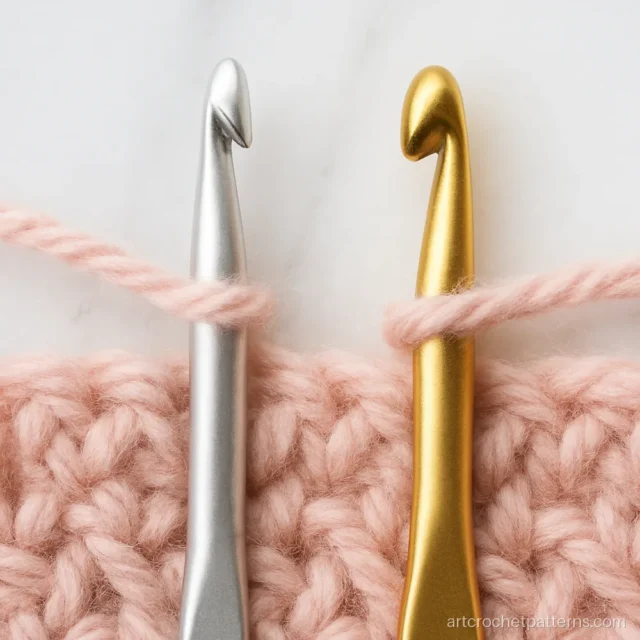 LevelBeginnerYarnNone shownHook5 mm (H-8)
Inline and tapered heads compared
The inline head on the left has a throat cut straight into the shaft. The tapered head on the right narrows smoothly into a rounded throat.
Maker note: If you pull loops tight onto the throat, an inline hook keeps each stitch the same size.
 LevelBeginnerYarnWorsted acrylicHook3.5 mm to 6.5 mm
Ergonomic hook set with soft handles
Thick soft handles spread the pressure over more of your hand. A set like this covers most yarn from sport to bulky.
Maker note: Hold the handle for a minute before you buy. It should fill your hand without stretching it.
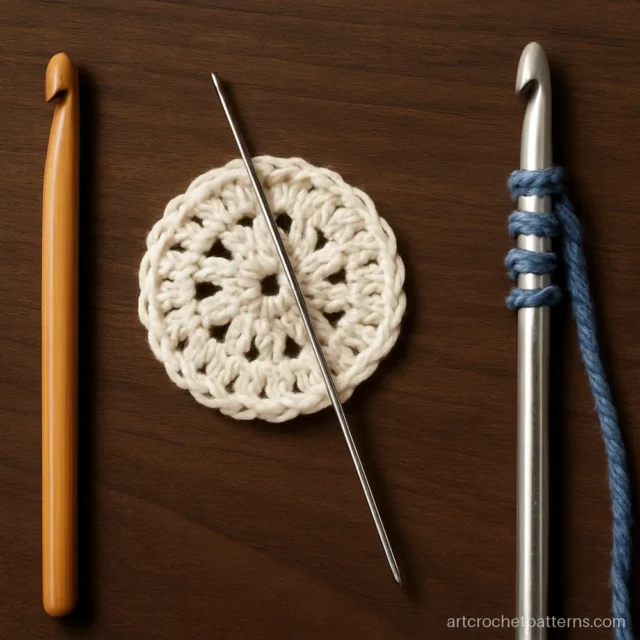 LevelIntermediateYarnMixedHook1.5 mm to 6 mm
Bamboo, steel and Tunisian hooks
Three specialists. Bamboo grips slippery yarn, steel works fine thread, and the long Tunisian hook holds a full row of loops.
Maker note: Buy specialist hooks only when a project needs them. One good everyday hook comes first.
Ergonomic crochet hooks
An ergonomic hook has a thick handle, often soft rubber, silicone or shaped wood, fitted around a metal head. The wider grip means your fingers do not have to pinch, which is what causes most aches after long sessions. Some handles are flattened where the thumb sits, which also stops the hook from rolling in your fingers.
If you already own plain hooks, foam or clay handle covers can turn them into ergonomic ones. Pair any hook with short breaks: stretch your fingers every 20 minutes, and see crochet tension ring if gripping the yarn is what hurts.
Hook materials compared
| Material | Strengths | Drawbacks |
|---|---|---|
| Aluminum | Light, smooth, durable, colored by size | Cold in winter; thin handles can strain hands |
| Bamboo | Warm, light, gentle grip on slippery yarn | Small sizes can snap; may roughen over time |
| Hardwood | Warm, often shaped by hand, quiet | Larger and heavier; grips acrylic |
| Steel | Very fine sizes for thread, does not bend | Too small for yarn; thin handles |
| Plastic | Very light in jumbo sizes | Thin plastic hooks flex and drag |
Aluminum is the usual first choice for acrylic and cotton. Many makers keep a bamboo hook for silk, bamboo and rayon blends.
Steel hooks and Tunisian hooks
Steel hooks run from about 0.6 mm to 3.5 mm and use their own numbers, with bigger numbers for smaller hooks. They are made for crochet thread and lace. Look for a smooth, burr free throat, since fine thread catches on any rough spot.
Tunisian hooks are long, with a stopper at the end or a flexible cable, because each row picks up every stitch onto the hook before working them off. A Tunisian hook is usually one or two sizes larger than you would use for regular crochet with the same yarn. Learn more in Tunisian crochet hook.
Building a crochet hook set
A full ergonomic crochet hook set saves money compared to buying one at a time, but only if every size gets used. A useful set for yarn covers:
- 3.5 mm (E-4) for amigurumi in worsted and for sport yarn
- 4 mm (G-6) and 4.5 mm (7) for DK
- 5 mm (H-8) and 5.5 mm (I-9) for worsted
- J-10 and K-10.5 (6 and 6.5 mm) for aran and light bulky
Add 8 mm and 9 mm only when you start chunky projects. Keep all hooks in one head style so your gauge stays consistent across sizes. Check each size against the hook size chart, and store them in a crochet hook case.
Test a hook before you commit
- Run a fingernail along the throat. It should feel smooth with no ridge or burr.
- Hold it in your usual grip for a full minute. Your fingers should not press white.
- Check the size is stamped or printed in millimeters.
- Work ten stitches with your usual yarn if the shop allows. Loops should slide on the shaft without sticking.
- Look at the thumb rest. It should sit right where your thumb lands.
New to all of this? Start with the crochet hook basics, then come back here once you know your grip.
Questions makers ask
What are the best crochet hooks for beginners?
A smooth aluminum hook in the H-8 (5 mm) size, with a clear thumb rest. Add an ergonomic handle if your hand tires quickly.
Are ergonomic crochet hooks worth it?
For long sessions or sore hands, yes. The thicker handle reduces the pinch that causes cramps. If you crochet only now and then, a plain hook is fine.
Is an inline or tapered hook better for amigurumi?
Many toy makers prefer inline hooks because the sharp throat keeps tight stitches even. Tapered hooks work well too if you push each loop back onto the shaft.
Why does my hook keep snagging the yarn?
The point may be too sharp for a loosely plied yarn, or the finish may be rough. Try a rounder tapered head or a different material.
Do I need a different hook for Tunisian crochet?
Yes. Tunisian crochet needs a long hook with a stopper or cable, since a full row of loops sits on the hook at once.