
A Tunisian crochet hook is longer than a regular hook because every loop in the row waits on its shaft together. You pick up loops across the row on the forward pass, then work them off again on the return pass. The fabric that results is dense and woven looking, somewhere between crochet and knitting.
This page explains the three kinds of Tunisian crochet hooks, how to pick a size and length, what to look for in the shaft, and gives a small swatch so you can try the stitch the day your hook arrives. If you are still choosing a regular hook too, see the best crochet hooks guide.
At a glance
Also called
Afghan hookTypes
Straight, cabled, double endedSizing
Usually 1 to 2 sizes bigger than the yarn labelStraight length
About 10 to 14 inchesSkill level
Advanced beginnerGood for
Blankets, scarves, dense textured fabric
Three kinds of Tunisian crochet hooks
| Type | What it looks like | Best use |
|---|---|---|
| Straight | A long rigid shaft with a stopper knob at the end | Scarves, dishcloths, swatches and other narrow work |
| Cabled | A stubby head on a bendy nylon cord that ends in a stopper | Blankets and wide panels, since the bulk sits on your knees |
| Double ended | Two working heads, one on each tip | Seamless tubes, plus color work that differs on each face |
Some cabled sets use interchangeable heads and cords, so one set covers several sizes and widths.
Sizing a Tunisian crochet hook
Tunisian fabric is thicker and tighter than regular crochet, and it curls toward the front. Going up in hook size loosens it and reduces the curl. A common starting point is one to two sizes above whatever the ball band recommends.
| Yarn | Label hook | Tunisian hook to try |
|---|---|---|
| DK (3) | 4.5 mm | 5.5 mm to 6 mm |
| Worsted (4) | 5 mm | 6 mm to 6.5 mm |
| Bulky (5) | 6.5 mm | 8 mm to 9 mm |
Millimeter sizes are the same as for regular hooks, so the hook size chart works for Tunisian hooks too.
In pictures
What the work should look like, with the yarn and hook used for each sample.
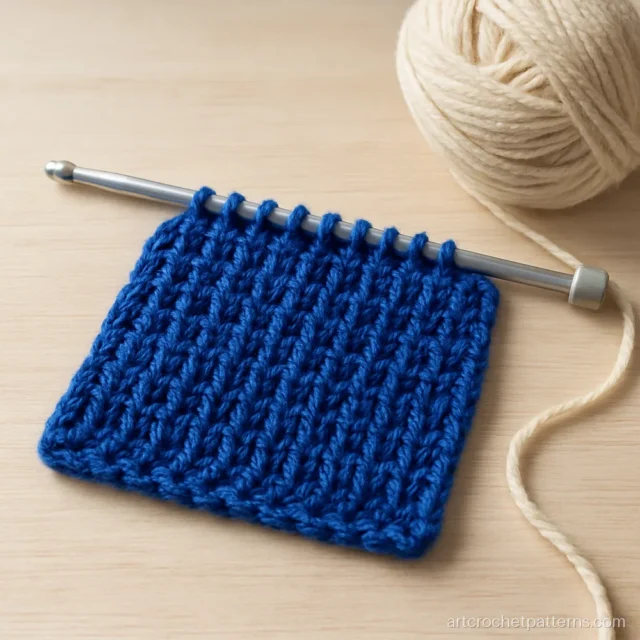 LevelBeginnerYarnWorsted acrylicHook6 mm (J-10) Tunisian
Straight hook holding a row of loops
On the forward pass, every loop stays on the shaft. A stopper at the end keeps them from sliding off while you work.
Maker note: Keep loops even by pulling each one up to the full width of the shaft, not just the throat.
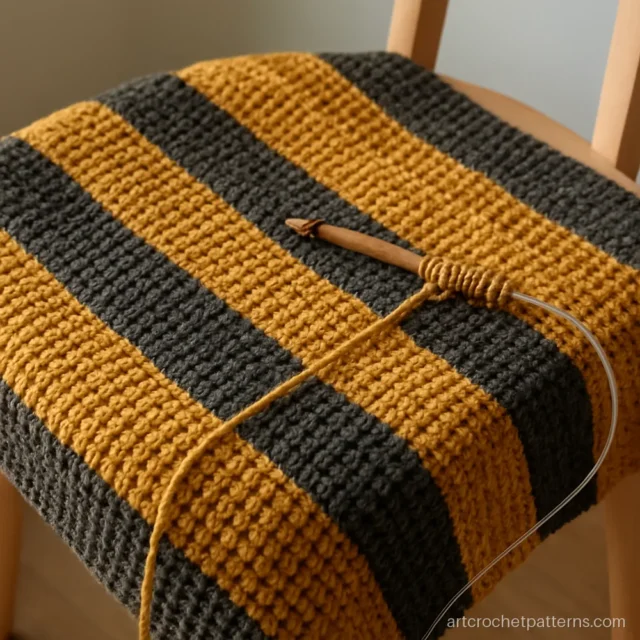 LevelIntermediateYarnWorsted woolHook6.5 mm cabled
Cabled hook on a wide blanket panel
A flexible cord lets a blanket wide row sit in your lap instead of hanging off a rigid shaft. The weight stays close to you.
Maker note: Spread the loops along the cord as you go so the fabric does not bunch near the hook head.
 LevelAdvancedYarnDK cottonHook5.5 mm double ended
Double ended hook working two colors
One color picks up loops from one end, the second color works them off from the other. The result is reversible two tone fabric.
Maker note: Slide the loops to the opposite end before you turn so the second color can reach them.
Length, material and shaft shape
- Length. Straight hooks commonly run from about 10 to 14 inches. Longer holds more loops but is heavier at the far end. For anything wider than the shaft can comfortably hold, use a cable.
- Material. Aluminum is smooth and fast. Bamboo and wood grip the yarn a little, which helps with slippery cotton. Plastic is light for large sizes.
- Even shaft. The shaft should be the same thickness all along. That diameter sets the loop size, so a tapered shaft gives uneven stitches.
- Throat. A smooth, moderately deep throat catches the yarn on the return pass without splitting it.
- Stopper. It should be secure. A loose cap lets the whole row slide off.
First swatch: Tunisian simple stitch
Grab some worsted and a 6 mm afghan hook. Two rules make Tunisian different: the loop sitting on the shaft is stitch number one, and you never flip the work over between rows.
- Ch 16.
- Row 1, forward pass: insert hook in 2nd ch from hook, yo, pull up a loop; rep in each ch across, keeping all loops on the hook (16 loops).
- Row 1, return pass: yo, pull through 1 loop; *yo, pull through 2 loops; rep from * until 1 loop remains (16 sts).
- Row 2, forward pass: skip the first vertical bar; *insert hook under next vertical bar, yo, pull up a loop; rep from * to the last bar; insert under both strands of the last bar and pull up a loop (16 loops).
- Row 2, return pass: work as row 1 return pass (16 sts).
- Rows 3 to 14: repeat row 2 (16 sts).
- Bind off: *insert hook under next vertical bar, yo, pull through bar and loop on hook; rep from * across. Fasten off.
Count the loops at the end of every forward pass, and see the Tunisian crochet lesson for more stitches. The total should match your starting chain each time.
Can you use a regular hook for Tunisian crochet?
For a narrow strip, yes. A regular hook with an even shaft and no thumb rest in the way can hold maybe 10 to 15 loops of worsted. It is a fine way to try the stitch before buying a dedicated tool. For anything wider, the loops slide over the grip and the row falls apart. A dedicated Tunisian crochet hook also keeps the shaft diameter steady, which keeps every loop the same height.
Once you know you like it, buy one straight hook in your favorite yarn weight. Add a cabled one when you are ready for a blanket from the blanket patterns.
When Tunisian fabric misbehaves
| What goes wrong | Likely reason | Try this |
|---|---|---|
| Fabric rolls into a tube | Hook too small; Tunisian simple stitch curls by nature | Go up a size, add a border, then block it |
| Loops slide off the end | No stopper, or the stopper is loose | Use a cap or a tight rubber band at the end |
| Uneven loops | Loops pulled up only to the throat | Pull each loop onto the full shaft |
| Last stitch looks loose | Only one strand of the edge picked up | Catch the edge bar with two strands, not one |
| Too many loops | The first bar was not skipped | The loop on the hook already counts as stitch one |
Flattening a curled piece is covered on the blocking crochet page.
Questions makers ask
How does a Tunisian hook differ from a regular crochet hook?
A Tunisian hook is much longer and has an even shaft with a stopper, so it can hold a full row of loops. A regular hook holds only one or two loops at a time.
What size Tunisian crochet hook should I start with?
With worsted, begin around 6 mm, moving to 6.5 mm for a firm hand. That is about one to two sizes bigger than the hook on the yarn label, which helps reduce curling.
Do I need a cabled Tunisian hook?
Only for wide pieces. A straight hook handles scarves and swatches. A cabled hook lets blankets rest in your lap and holds far more loops.
Help, my afghan stitch swatch keeps rolling. Why?
Tunisian simple stitch naturally curls toward the front. Sizing up the hook, opening with a few rows of a less curly stitch, adding an edging and then blocking will each reduce the roll.
What is a double ended Tunisian hook used for?
It has a hook at each end, so you can work loops on and off from either side. With it you can work tubes and make fabric that shows a different color on each face.