
Crochet symbols are little drawings that stand for stitches, and once you know about a dozen of them you can follow a chart from almost any country. One upright T crossed by a single slash means double crochet whether the designer writes in English, Japanese or Spanish. That is the big gift of a chart.
Below you will find what each common symbol looks like, how to tell which way to read rows and rounds, and an easy granny square written out alongside a description of its diagram so you can check yourself. Keep the crochet abbreviations list handy too, since most charts come with written notes.
At a glance
Skill level
Beginner to intermediateBest for
Lace, motifs, doilies, granny squaresRead rows
Right to left, then left to rightRead rounds
From the center, counterclockwiseAlso called
Crochet chart or stitch diagram
Crochet symbols chart for the basic stitches
These shapes follow the international standard most designers use. A chart should still include a key, so check it before you start, because a few designers draw some stitches their own way.
| Symbol looks like | Stitch (US) | UK name |
|---|---|---|
| Small open oval | Chain (ch) | Chain |
| Small filled dot or oval | Slip stitch (sl st) | Slip stitch |
| Plus sign or X | Single crochet (sc) | Double crochet |
| T | Half double (hdc) | Half treble |
| T with one slash across the stem | Double crochet (dc) | Treble |
| T with two slashes | Treble crochet (tr) | Double treble |
| T with three slashes | Double treble (dtr) | Triple treble |
| Open circle or loop at the center | Magic ring (MR) | Magic loop |
See each stitch worked in yarn on the crochet stitches page.
Increases, decreases and special stitches
Once the basic shapes make sense, the rest are built from them.
- Increase: two or three symbols fanning out from one point at the bottom, like a V. That means several stitches worked into the same stitch.
- Decrease: two symbols that start apart and meet at the top, like an upside down V. For single crochet this is sc2tog.
- Cluster: several double crochet symbols joined at the top. You leave the last loop of each on the hook and close them together.
- Puff: a tall narrow oval, often with a line at the base.
- Popcorn: a group of double crochet symbols with a small oval or bar across the top.
- Post stitches: a double crochet symbol with a little hook curve at the foot of the stem. The direction of the curve shows front post or back post.
- Front or back loop only: a small arc drawn under the stitch. Charts use one curve direction for each loop, so read the key.
In pictures
What the work should look like, with the yarn and hook used for each sample.
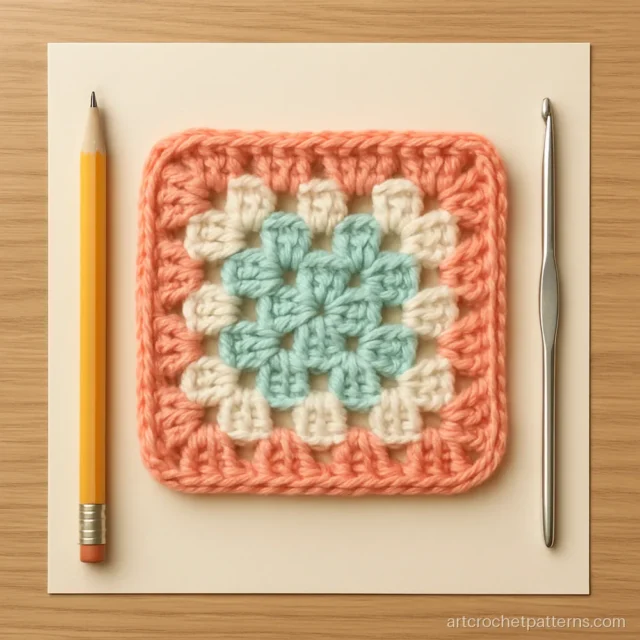 LevelEasyYarnWorsted cottonHook5 mm (H-8)
Granny square that matches its chart
Each cluster of three double crochets in this square is drawn on its chart as three T shapes with one slash, fanned out from the same space.
Maker note: Count the slashes on each stem. One slash is a double crochet, two slashes a treble.
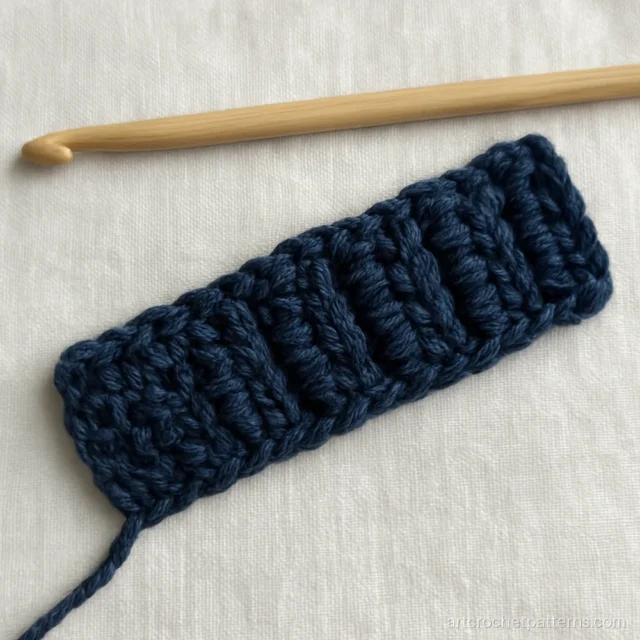 LevelBeginnerYarnWorsted acrylicHook5.5 mm (I-9)
Sampler of stitch heights in one row
Short to tall: slip stitch, single, half double, double and treble crochet in one strip. Charts draw each one at roughly its real height.
Maker note: Work a strip like this once and the symbols stop feeling abstract, because you can see the T grow taller.
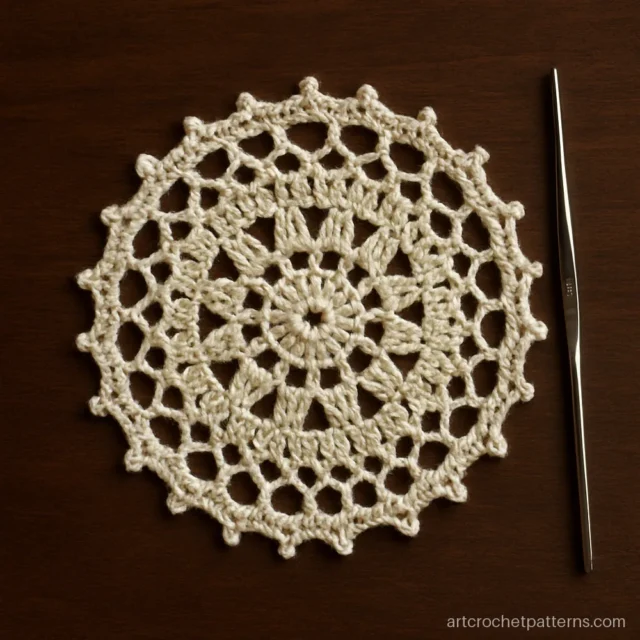 LevelIntermediateYarnSize 10 cotton threadHook1.5 mm steel
Lace doily center worked from a diagram
Lacy rounds like these are far easier to follow from a chart than from words, since you can see where every chain space sits.
Maker note: Put a sticky note under the round you are working on the chart and slide it outward as you go.
How to read crochet charts worked in rows
- Find row 1. The foundation chain runs along the bottom. Row numbers sit at the edge where that row begins.
- Read right side rows right to left. That matches the way a right handed crocheter works across.
- Read wrong side rows left to right. You turned the work, so the chart direction flips too.
- Look at the turning chain. The little tower of ovals where a row begins shows how tall it is, and if it counts as a stitch it is drawn standing in place of one.
- Follow the stems. The bottom of each symbol points to the stitch or space it goes into.
Reading a crochet diagram in rounds
Round charts start at the center ring and spiral outward. For right handed work, read each round counterclockwise, starting where the round number is printed. Rounds are often drawn in alternating colors, black and blue for instance, so you can tell where one ends. Joins are shown as a filled dot at the end of the round, and a new color start may be marked with a small arrow or triangle.
Look at how the symbols lean. A fan of five double crochets drawn into one chain space tells you exactly where the stitches sit, even when the written notes are brief. Motifs and crochet flowers are nearly always easier to follow this way.
Practice: an easy granny square with its diagram described
Picture the chart: a small circle in the middle, then four groups of three slashed T shapes around it, separated by two ovals at each corner. Round 2 shows two groups per corner with one oval between corners, and round 3 adds a single group on each side. Here is the same square in words. In the written version, each opening chain of three is counted as the first dc of its round.
- Ch 4, sl st in first ch to form a ring.
- Rnd 1: ch 3, 2 dc in ring, ch 2, (3 dc in ring, ch 2) 3 times, sl st to top of ch 3 (12 dc, 4 ch-2 corners).
- Rnd 2: sl st in next 2 dc and into the ch-2 sp, ch 3, (2 dc, ch 2, 3 dc) in same sp, ch 1, *(3 dc, ch 2, 3 dc) in next ch-2 sp, ch 1; rep from * 2 more times, sl st to top of ch 3 (24 dc).
- Rnd 3: sl st in next 2 dc and into the corner sp, ch 3, (2 dc, ch 2, 3 dc) in same sp, ch 1, 3 dc in next ch-1 sp, ch 1, *(3 dc, ch 2, 3 dc) in next corner sp, ch 1, 3 dc in next ch-1 sp, ch 1; rep from * 2 more times, sl st to top of ch 3 (36 dc).
- Fasten off and weave in ends.
Compare your square to the description. Each corner should hold six double crochets with a chain 2 gap, and each side of round 3 should hold one group of three.
Crochet pattern symbols that trip people up
| Mix up | How to tell them apart |
|---|---|
| Chain oval vs slip stitch dot | Chain is open, slip stitch is filled in |
| Single crochet X vs plus | Both mean sc; the designer just picked one style |
| Half double vs double | Half double has no slash on the stem |
| Cluster vs decrease | A cluster joins tall stitches into one stitch or space; a decrease spans separate stitches |
| Space vs stitch | If the stem ends under an oval arch, work into the chain space, not into a chain |
When symbols and words disagree, the written notes usually win, because typos in a chart are harder to spot. Learning to read crochet patterns in words gives you a second way to check.
Questions makers ask
Are crochet chart symbols the same everywhere?
Mostly. The core shapes are shared internationally, which is why charts cross language borders so easily. A few special stitches vary, so always look at the key.
What does a T with a line through it mean in crochet?
It is a double crochet in US terms, called a treble in UK terms. Each extra slash adds one more yarn over, so two slashes is a treble crochet.
Which way do you read a crochet chart?
Rows alternate: right side rows go right to left and wrong side rows go left to right. Rounds start in the center and go counterclockwise for right handed crocheters.
Is a chart easier than written instructions?
For lace, doilies and motifs, many makers find it faster because you can see the shape. For simple rows of one stitch, written instructions are just as clear. Using both together catches mistakes.
Can I make my own crochet chart?
Yes. Graph paper and a pencil are enough to draw stitches and rounds. The pattern maker guide shows how to plan and write up your own design.