
Knowing how to read crochet patterns is mostly about knowing where to look. Every written pattern follows a similar layout: what you need, how big it comes out, the shorthand it uses, then the rows or rounds. Once you know that order, you can open any pattern and find your way.
This lesson walks through each part, explains the punctuation that marks repeats, and decodes a short sample piece line by line so you can see how a sentence of shorthand turns into stitches. Keep the abbreviations list open in another tab while you practice.
At a glance
Skill level
BeginnerRead first
Materials, gauge and pattern notesKey symbols
* repeats, ( ) groups, end number is the countTerms
Check US or UK before you startPractice time
One small swatch, about 30 minutes
The parts of a written crochet pattern
| Section | What it tells you | Why to read it first |
|---|---|---|
| Skill level | Beginner, easy, intermediate or advanced | Shows how many techniques are involved |
| Materials | The yarn, how much of it, the hook, and any extras | So you buy enough of the right yarn |
| Gauge | How many stitches and rows fit in a 4 inch square | Matching it makes your piece the stated size |
| Finished size | Measurements of the completed item | Lets you choose a size or adjust |
| Abbreviations | The shorthand used, and US or UK terms | Avoids working the wrong stitch |
| Pattern notes | Whether chains count, joined or spiral rounds | Holds the rules every line depends on |
| Instructions | Rows or rounds, with stitch counts | The work itself |
| Finishing | Assembly, edging, blocking, weaving in | Turns pieces into a finished item |
How to read crochet patterns one line at a time: a worked example
A single line packs in four pieces of information: which row, what to do at the start, what to repeat, and what count to end on. Take this line apart:
Row 2: Ch 1, turn, sc in first st, *ch 1, sk next st, sc in next st; rep from * across (15 sts).
- Row 2: the row number. Row 1 was the first row worked into the chain.
- Ch 1, turn: the turning chain. Per the notes, it is left out of the total.
- sc in first st: one single crochet in the very first stitch.
- *ch 1, sk next st, sc in next st: the repeat. Chain one, leave one stitch empty, single crochet in the stitch after it.
- rep from * across: return to the star and keep going until no stitches remain.
- (15 sts): the check. Count 8 single crochets and 7 chain spaces, which together make 15.
In pictures
What the work should look like, with the yarn and hook used for each sample.
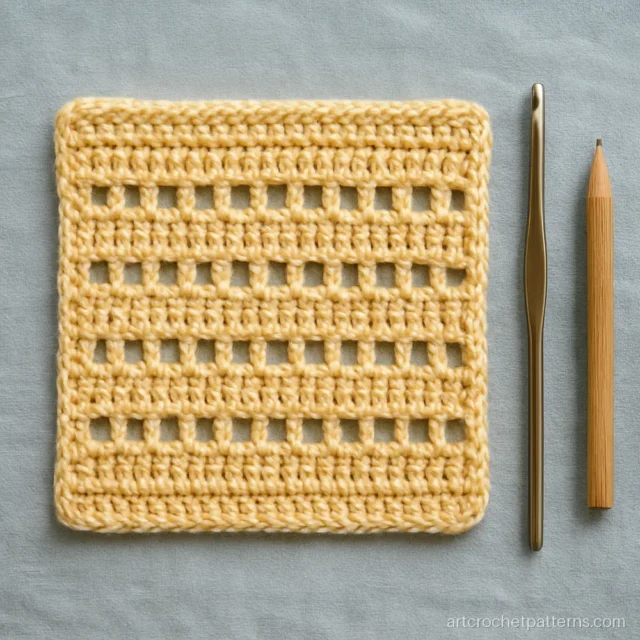 LevelBeginnerYarnWorsted cottonHook5 mm (H-8)
Sample mesh swatch from the lesson
This is the practice piece written out below. Rows of single crochet alternate with rows of chain spaces, so you can see every repeat.
Maker note: Count the stitches and the spaces separately at the end of every mesh row until the rhythm feels natural.
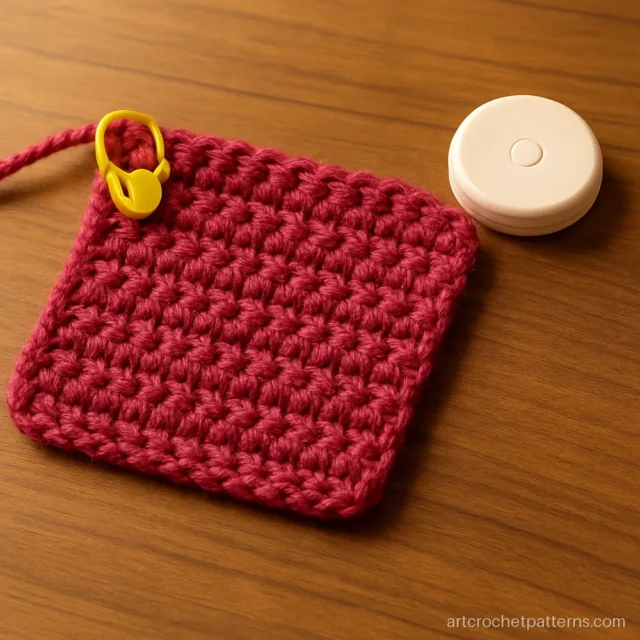 LevelBeginnerYarnWorsted acrylicHook5.5 mm (I-9)
Swatch with marker and row counter
Clip a marker at the row's opening stitch and keep a counter nearby, and you can stop anywhere without losing your place.
Maker note: Click the counter as soon as you turn, not when you start the next row, so you never wonder if you counted.
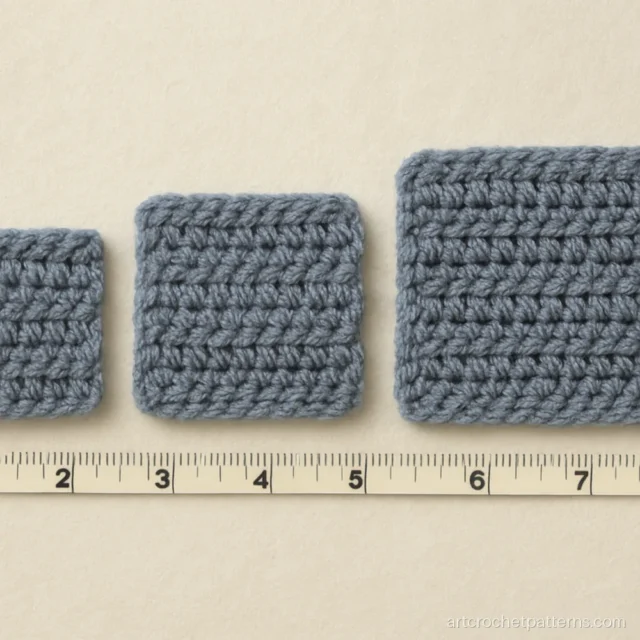 LevelEasyYarnDK woolHook4 mm (G-6)
Three swatch sizes from one sizing line
One instruction line gave three widths. Each swatch was worked with the number in the matching position of the brackets.
Maker note: Highlight your size in every line before starting, so your eye jumps to the right number.
Practice piece: read it, then work it
Here is the full mesh swatch the line above comes from. Grab any worsted yarn plus a 5 mm hook. The ch 1 that turns each row is never counted, but each ch-1 space in the mesh is.
- Ch 16.
- Row 1: sc in 2nd ch from hook and in each ch across (15 sts).
- Row 2: ch 1, turn, sc in first st, *ch 1, sk next st, sc in next st; rep from * across (8 sc and 7 ch-1 sps, 15 sts).
- Row 3: ch 1, turn, sc in first sc, *sc in next ch-1 sp, sc in next sc; rep from * across (15 sts).
- Rows 4 to 11: repeat rows 2 and 3 four more times (15 sts).
- Fasten off and weave in ends.
If row 2 ends with a stitch left over or one missing, recount row 1 first. Most problems start in the foundation row.
Repeats, brackets and asterisks
- * ... ; rep from * across: repeat the steps after the asterisk until the row runs out.
- * ... ; rep from * 4 more times: you have done it once, now do it 4 more, for 5 total.
- (sc, inc) 6 times: the steps inside parentheses form one group. Work the group six times.
- (sc, ch 3, sc) in next sp: everything inside goes into the same place.
- [ ... ] twice: square brackets often hold a repeat that contains a smaller repeat.
- A closing figure: the total you should be holding once the line is done.
Drawn charts mark the same ideas with shapes. If you prefer pictures, crochet symbols explains how to read a diagram.
Patterns with more than one size
Garments and hats often list sizes like this: Ch 61 (67, 73, 79). Read the outside figure as the smallest size, with each larger size inside the brackets, left to right. Making the third size? Then you chain 73. When only one number appears, it applies to every size.
Before you start, go through the pattern and circle or highlight your number in each line. A zero, or a dash in the place of your size, means skip that step for your size. Measure before choosing, and see the hat size chart for head measurements.
Common reading mistakes and their fixes
| Slip up | What went wrong | Next time |
|---|---|---|
| One stitch too many each row | The turning chain was treated as a stitch when it should not be | Read the pattern notes on chains |
| Piece much bigger than shown | British terms read as American ones, or no gauge swatch made | Check terms and swatch first |
| Repeat ends early | Started counting the repeat at the wrong asterisk | Underline each repeat in pencil |
| Lost place mid row | Put the work down without a marker | Hook a marker through the live loop before you set it down |
| Wrong size in some rows | Mixed up which number in the brackets to use | Highlight your size throughout |
Ready for a real project? Choose one from the beginner patterns and read it through once before you pick up the hook.
Questions makers ask
What should I read first in a crochet pattern?
Read the materials, gauge and pattern notes before any rows. The notes hold rules like whether the turning chain counts, which change how every line works.
What does rep from * mean?
Return to the star symbol and work everything after it again. The pattern tells you how many times, or says across or around to mean until the row or round ends.
Why does each row finish with a number?
That figure is your checkpoint. Tally what you just made and compare it. A match means the row is right and you can carry on.
How do I know if a pattern uses US or UK terms?
The pattern should say so near the abbreviations. If it does not, look for sc: US patterns use it often, while UK patterns never do and use dc for that stitch instead.
Is it easier to read a chart or written instructions?
It depends on the project and on you. Written steps suit simple rows. Charts are faster for lace and motifs. Many patterns give both so you can check one against the other.
What is a pattern multiple?
It is the chain math that lets a repeat fit evenly, for example a multiple of 2 plus 1. Our sample uses 15 stitches, which is 7 repeats of 2 plus 1.