
This crochet hat size chart gives you head circumference and crown to brim height for every age from newborn to large adult, plus the simple math that turns a size into a starting circle. Use it with any top down beanie, bucket hat or baby hat pattern when the pattern only comes in one size, or when the hat you made last time came out too loose.
A chart is a starting point. Heads vary a lot, even among babies the same age, so measure the real head whenever you can and check the hat against the numbers as you work.
At a glance
Good for
Beanies, baby hats, bucket hats, slouchy hatsYou need
Soft tape measure, a gauge swatchKey rule
Hat 1 to 2 inches smaller than the headCrown math
Diameter = hat circumference / 3.14Skill level
Beginner
How to measure a head for a hat
- Use a soft tape measure. A strip of paper or yarn marked with a pen works too; measure it against a ruler after.
- Circle the tape where the head is fullest: mid forehead, a finger width above the brows, across the upper ears, then around the rounded bump at the back.
- Keep the tape snug but not tight. One finger should slide under it.
- Read the number where the tape overlaps. Write it down in inches.
- For a baby or a gift you cannot measure, use the age row in the chart below.
Also measure from the crown of the head down to the earlobe if you want a hat that covers the ears. That number is your hat height.
Crochet hat size chart: head and hat circumference
A crocheted hat stretches, so you make it smaller than the head. This is called negative ease. Subtract 1 or 2 inches from the tape reading for a snug beanie. For a slouchy or bucket hat, aim close to the head size.
| Age or size | Head circumference | Snug beanie circumference |
|---|---|---|
| Newborn | 13 to 14 | 12 to 13 |
| Baby 3 to 6 months | 14 to 17 | 13 to 15 |
| Baby 6 to 12 months | 16 to 19 | 15 to 17 |
| Toddler | 18 to 20 | 16.5 to 18 |
| Child | 19 to 20 | 17.5 to 18.5 |
| Teen and adult small | 20 to 21 | 18.5 to 19.5 |
| Adult, average head | 21 to 22.5 | 19.5 to 21 |
| Adult, large head | 22.5 to 24 | 21 to 22.5 |
Very stretchy fabric, like ribbing or loose half double crochet, can take the full 2 inches. Firm fabric, like tight single crochet or cotton, needs closer to 1 inch.
In pictures
What the work should look like, with the yarn and hook used for each sample.
 LevelBeginnerYarnWorsted (4) acrylicHook5 mm (H-8)
Measuring a crown circle
Measure the flat crown straight across the center. When the diameter matches the chart, stop increasing.
Maker note: Lay the circle on a table without stretching it. Measure twice, at right angles, and use the average.
 LevelEasyYarnWorsted (4) wool blendHook5 mm (H-8)
Baby, child and adult beanies
Same pattern, three sizes. Each one stops increasing at a different crown diameter and works a different number of body rounds.
Maker note: Lay finished hats flat and measure across the brim, then double it. That is the hat circumference.
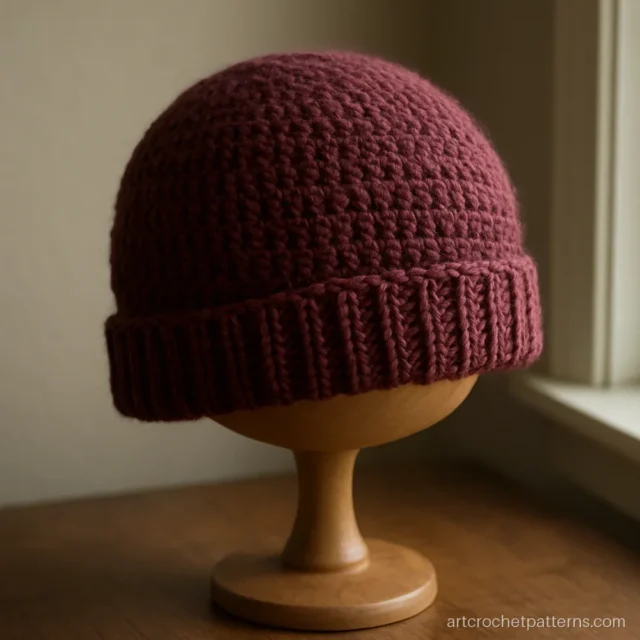 LevelEasyYarnWorsted (4) acrylicHook5 mm (H-8)
Fitted beanie on a hat stand
An adult beanie about 8.5 inches from crown to brim, with negative ease so it hugs the stand.
Maker note: Try the hat on before the brim. If it covers the ears comfortably, start the brim right there.
Crochet beanie size chart: hat height
Height runs from the center of the crown to the edge of the brim, measured with the hat flat. The chart is for a fitted beanie that covers the ears. A slouchy style wants an extra 2 to 3 inches; subtract 1 to 2 inches for a short fisherman beanie that sits above the ears.
| Age or size | Beanie height | Slouchy height |
|---|---|---|
| Newborn | 5 to 5.5 | Not recommended |
| Baby 3 to 6 months | 5.5 to 6.5 | Not recommended |
| Baby 6 to 12 months | 6.5 to 7 | 8 to 9 |
| Toddler | 7 to 7.5 | 9 to 10 |
| Child | 7.5 to 8 | 9.5 to 10.5 |
| Teen and adult small | 8 to 8.5 | 10 to 11 |
| Adult, average head | 8.5 to 9 | 11 to 12 |
| Adult, large head | 9 to 9.5 | 11.5 to 12.5 |
All heights are in inches. For baby hats, keep it snug and skip the slouch so the fabric cannot slip over the eyes.
Turning a hat size into a crown circle
Most top down hats start with a flat circle. When that circle is the right size, the increases end and plain rounds carry on down to the brim. To find the size of the circle, divide the hat circumference by 3.14.
| Hat circumference | Crown diameter | Typical wearer |
|---|---|---|
| 12.5 inches | 4 inches | Newborn |
| 14 inches | 4.5 inches | Baby 3 to 6 months |
| 16 inches | 5.1 inches | Baby 6 to 12 months |
| 17.5 inches | 5.6 inches | Toddler |
| 18 inches | 5.7 inches | Child |
| 19 inches | 6 inches | Teen and adult small |
| 20.5 inches | 6.5 inches | Adult, average head |
| 22 inches | 7 inches | Adult, large head |
Crochet circles grow a little as you add rounds and when worn, so if you land between rounds, stop at the smaller one.
From inches to stitches: a worked example
Say your gauge is 13 hdc per 4 inches, which is 3.25 stitches per inch, and you want a 20 inch adult beanie.
- Multiply: 20 inches times 3.25 is 65 stitches.
- Round to a number your increase pattern can reach. A hdc crown that adds 8 stitches each round lands on 64 (Rnd 8) or 72 (Rnd 9). Pick 64 for a snug fit.
- Check the crown: 64 stitches at 3.25 per inch is about 19.7 inches, and 19.7 / 3.14 is about 6.3 inches across.
- Work even rounds until the hat measures 8.5 inches from the center of the crown, minus the height of the brim you plan to add.
Write down your gauge and stitch counts. For the next size, only the count of crown rounds has to change. The crochet beanie and crochet slouchy beanie patterns use this exact method.
Why a finished hat ends up the wrong size
- Too big all over: your gauge is looser than the pattern. Go down a hook size, or stop one increase round sooner.
- Fits around but too short: you measured height before the brim. Always plan the body height so the brim is included.
- Crown pokes up in a cone: too few increases per round for your stitch height. See the increase stitch guide.
- Crown ripples: too many increases. Pull back and add one even round between increase rounds.
- Fits at first, then grows: acrylic and cotton relax with wear. Next time, take an extra half inch of negative ease.
Sizing other kinds of hats
A crochet bucket hat needs almost no negative ease because the brim must sit flat and firm; aim for the head size or half an inch under. Baby hats with ear flaps and bonnets follow the same circumference, with extra length at the sides. For the newborn to toddler range, the crochet baby hat page has full patterns, and more hat styles are listed under crochet hats.
Questions makers ask
What size should a crochet hat be for an adult?
Most adult heads measure 21 to 22.5 inches. A snug beanie for that head should be 19.5 to 21 inches around and 8.5 to 9 inches tall. Measure the real head if you can.
How much smaller than the head should a crochet beanie be?
About 1 to 2 inches. Use the full 2 inches for stretchy stitches like ribbing or loose hdc, and closer to 1 inch for firm fabric like tight single crochet or cotton.
How do I find the crown diameter for a crochet hat?
Divide the hat circumference by 3.14. A 19 inch hat needs a crown about 6 inches across. Stop increasing when your flat circle reaches that diameter.
What size is a newborn crochet hat?
A newborn head is about 13 to 14 inches around. Make the hat 12 to 13 inches around and 5 to 5.5 inches tall. Keep any ties or dangling ends under about 7 inches for safety.
How do I measure a crochet hat I already made?
Lay it flat without stretching. Measure across the brim and double that number for the circumference. Measure from the center top to the brim edge for the height.