
An increase stitch crochet move is nothing more than working two stitches into one stitch of the row below. That one extra stitch is how flat pieces widen, how circles stay flat and how an amigurumi head grows round.
Patterns write it as inc. This page shows the single crochet increase in detail, then the same idea in taller stitches, at row edges and spread around a circle. You will also get the simple division that tells you where to put increases when a pattern says only to add them evenly.
At a glance
Skill level
BeginnerAbbreviation
inc (2 sts in 1 st)Works with
sc, hdc, dc and taller stitchesOpposite of
Decrease (dec, sc2tog)Used in
Amigurumi, hats, shawls, circlesUK note
US sc inc = UK dc inc
What is an increase in crochet?
An increase adds one stitch to your count by putting two stitches in the same place. Patterns write a single crochet increase as inc, sc inc, or spelled out as two sc into one stitch. They all mean the same thing. Taller stitches work the same way: 2 hdc in one stitch or 2 dc in one stitch.
You will also see bigger groups. Three sc in one stitch adds two, which is how corners turn. Shells of 5 dc are a kind of decorative increase too. In the bracketed totals that close each pattern line, every inc you made counts twice.
How to work a single crochet increase
- Work one ordinary sc into the next stitch: hook under both loops, wrap, draw a loop up, wrap again, finish through both loops on the hook.
- Stay put. Go back into that same stitch a second time.
- Work a second sc there. You now have two sc tops sitting side by side on one base.
- Resume the pattern in the following stitch.
That is the whole crochet increase stitch. If your second sc feels cramped, loosen the first one a little. The same method gives an hdc or dc increase; just make the taller stitch twice. For a refresher on the base move, see our single crochet lesson.
In pictures
What the work should look like, with the yarn and hook used for each sample.
 LevelBeginnerYarnWorsted cottonHook4 mm (G-6)
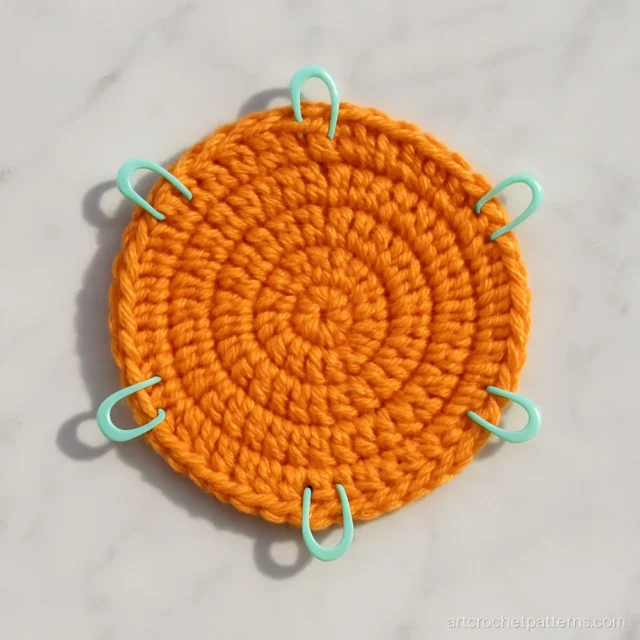
Flat circle with six increases a round
Six increases a round keep this circle flat. A marker in each increase shows the six spokes forming.
Maker note: Stagger the increases from round 4 on. Stacking them in the same spot turns your circle into a hexagon.
 LevelBeginnerYarnWorsted acrylicHook5 mm (H-8)
Two sc going into one stitch
Here the hook revisits the stitch it just used. Two V tops sitting on one base is what an increase looks like.
Maker note: After the second sc, look down. You should see two separate V tops coming out of one stitch.
 LevelEasyYarnDK woolHook4.5 mm (7)
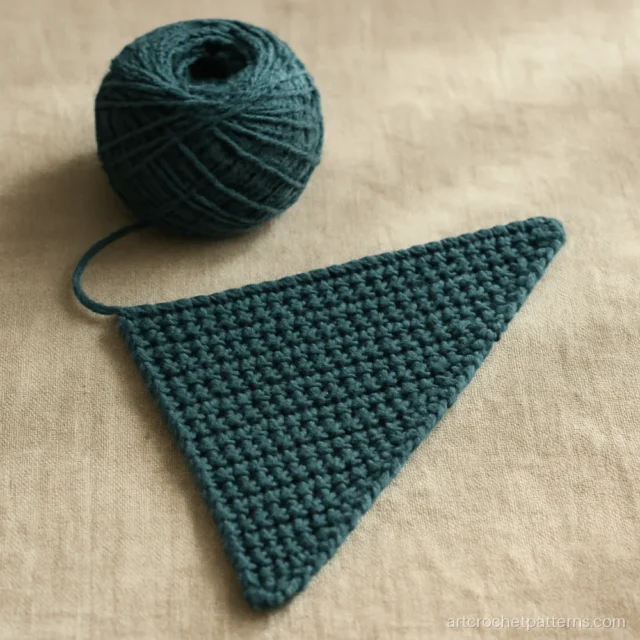
Triangle wedge grown by edge increases
One extra stitch on the last stitch of every row builds a neat right triangle. It is the same edge shaping used in many shawls.
Maker note: Always increase on the same edge. Switching edges makes a lopsided shape instead of a clean slant.
Increase stitch crochet in rows: edges and evenly across
At an edge: work 2 sc in the first or last stitch of the row. For dc rows where ch 3 counts as a stitch, put a dc in the very stitch the ch 3 rises from; that is your increase. To add several stitches at once at the start, chain the extra number on the previous row's last stitch and work back over those chains.
Evenly across a row: divide the current count by the number of stitches to add. The answer is the size of each group, with the increase as its last stitch.
| Current stitches | To add | Repeat | New count |
|---|---|---|---|
| 30 | 6 | (4 sc, inc) x 6 | 36 |
| 24 | 4 | (5 sc, inc) x 4 | 28 |
| 40 | 5 | (7 sc, inc) x 5 | 45 |
| 20 | 10 | (sc, inc) x 10 | 30 |
If the math leaves a remainder, spread the extra plain stitches between a few groups so the increases do not bunch at one end.
Practice piece: a right triangle
This little wedge teaches edge increases in ten minutes. Scrap worsted and an H-8 are plenty.
- Ch 2.
- Row 1: 2 sc in 2nd ch from hook. Turn. (2)
- Row 2: Ch 1 (does not count), sc in first st, 2 sc in last st. Turn. (3)
- Row 3: Ch 1, sc in each st to the last st, 2 sc in last st. Turn. (4)
- Rows 4 to 15: Rep Row 3, adding one stitch each row. (16 at the end of Row 15)
The added stitch always falls on one side. The count always equals the row number plus one, an easy way to check your work.
Increases in the round and the flat circle
A flat circle in sc gains 6 stitches every round. Start with a magic ring and move a marker up into the opening stitch as every round begins.
- Rnd 1: 6 sc in MR. (6)
- Rnd 2: Inc in each st around. (12)
- Rnd 3: (Sc, inc) x 6. (18)
- Rnd 4: Sc, inc, (2 sc, inc) x 5, sc. (24)
- Rnd 5: (3 sc, inc) x 6. (30)
- Rnd 6: 2 sc, inc, (4 sc, inc) x 5, 2 sc. (36)
Rounds 4 and 6 shift the starting point so the increases do not line up. Offsetting them every other round keeps the edge round instead of six-sided. Stop increasing and the circle turns up into a tube, which is how a ball or an amigurumi body forms; see our amigurumi patterns for the full shapes. For hdc circles, start with 8 stitches; for dc, 12.
Inc crochet shapes that misbehave
| You notice | Most likely | Try this |
|---|---|---|
| Circle turns into a shallow dish | Missing incs, or tension on the tight side | Check each round count; go up a hook size |
| Circle ruffles | Too many increases | Count the inc in each round; there should be 6 in sc |
| Circle looks like a hexagon | Incs piled on top of one another | Begin the repeat a stitch or two later on alternate rounds |
| Row count keeps coming up one short | Counting an inc as one stitch | Count each inc as two tops |
| Edge grows without meaning to | Working into the ch 1 turning chain | The ch 1 for sc does not count; skip it |
Invisible and less visible increases
A standard inc leaves a tiny gap at its base, which is fine on blankets but can show on smooth amigurumi. To hide it, work the first sc of the increase into both loops and the second through just the front loop of that same stitch. The fabric closes up and the shaping blends in. For hats, many makers increase in dc only on the first few crown rounds, then switch to straight rounds; our crochet hat patterns show where the crown stops growing. Increases and sc2tog decreases together are all the shaping most projects ever need.
Questions makers ask
What does inc mean in a crochet pattern?
Inc is short for increase. You make two stitches where the pattern would usually have one, and your count rises by one. In an sc pattern, inc means two sc sharing a base.
How do I increase evenly across a row?
Divide your current stitch count by the number of stitches to add. Work that many minus one plain stitches, then an increase, and repeat. For 30 stitches and 6 to add, that is (4 sc, inc) 6 times.
Why does my crochet circle curl up?
It has too few stitches for its size. Recount the last round. In sc each round should be 6 more than the one before. A tight tension can also make it cup.
Is an increase the same as 2 sc in one stitch?
Yes, for single crochet patterns. Designers simply choose between the long form and the short one. Taller stitch patterns may write 2 dc in next st instead.
How do I increase at the beginning of a double crochet row?
Chain 3, which counts as the first dc, then work a dc into the same stitch at the base of the chain. That gives two stitches in the first stitch.
What is the opposite of an increase?
A decrease, which joins two stitches into one. In single crochet it is written sc2tog or dec. See our invisible decrease guide for the neatest version.