
A decrease stitch crochet move joins two (or more) stitches into one top, so the row or round gets one stitch shorter. That is how a hat crown closes, how an amigurumi head turns into a neck and how a triangle shawl narrows to a point.
Most patterns write it as dec or sc2tog. Below you will find the standard single crochet decrease, the invisible version for toys, taller decreases for hdc and dc fabric, edge decreases for rows and a short practice piece that uses all of them.
At a glance
Skill level
BeginnerAbbreviations
dec, sc2tog, hdc2tog, dc2togStitches lost
1 per decrease (2 become 1)Yarn
Any; practice in light worstedHook
The one your pattern calls forOpposite of
How to decrease in crochet: the single crochet decrease
The single crochet decrease (US sc2tog; the UK pattern word is dc2tog) is the one you will use most.
- Half a stitch. Hook into the coming stitch and draw one loop through it. You hold 2.
- Half of another. Leave those loops alone, go into the neighbor stitch and bring up one more loop. You hold 3.
- Close them together. Catch the yarn once and draw it through every loop at once. One top now sits over two stitches of the row below.
Look at the top of your work: a sc2tog has a single V where two used to be. For a full photo guide and more drills, see the sc2tog crochet page.
Crochet invisible decrease for toys
On amigurumi, a standard decrease leaves a little gap because its two legs pull apart. The invisible version hides that.
- Slip the hook under just the front strand of the coming stitch.
- Pick up the front strand of its neighbor too, with no wrap in between. Count 3 on the hook.
- Wrap and pull through those two front strands only.
- Wrap once more and finish through both loops left.
The back loops stay behind and fill the gap. This is the decrease the site uses in every toy pattern, and our invisible decrease crochet guide covers it in detail. You can browse toys that use it on the amigurumi patterns hub.
In pictures
What the work should look like, with the yarn and hook used for each sample.
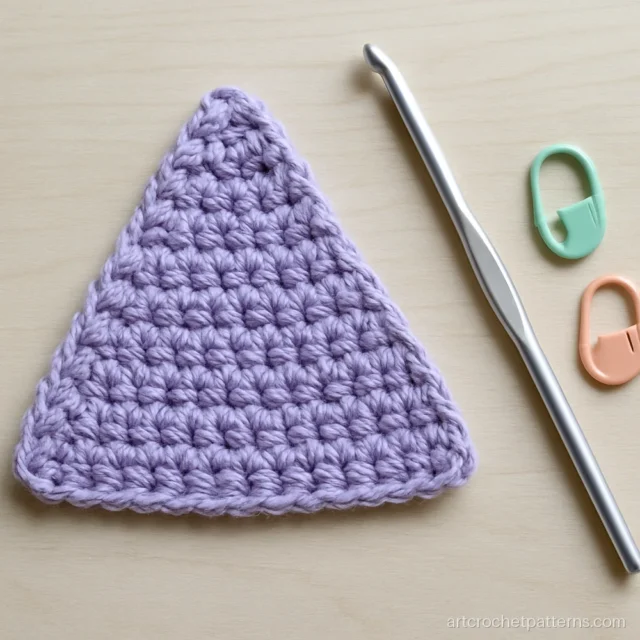 LevelBeginnerYarnWorsted cottonHook5 mm (H-8)
Practice triangle in lilac
The practice piece from this page, decreasing at both ends of every row. Clean, straight slopes mean the decreases are sitting in the right place.
Maker note: Clip markers to both edge stitches on every row so the decreases stay at the very ends.
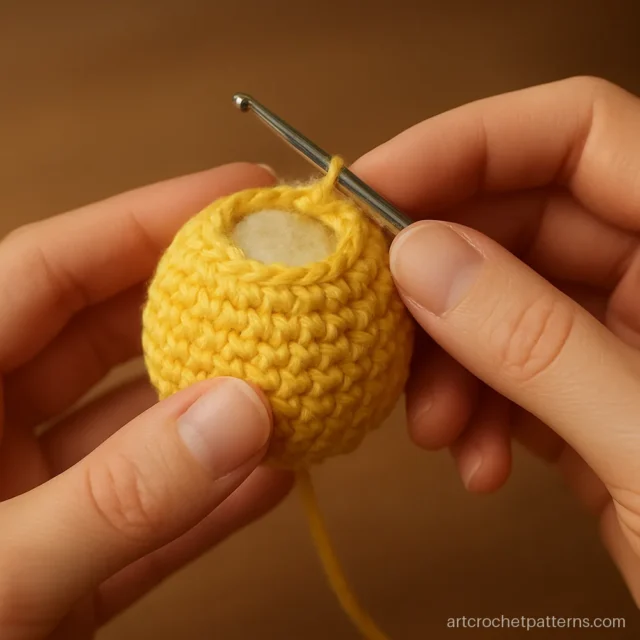 LevelEasyYarnWorsted cottonHook3.5 mm (E-4)
Invisible decrease on a toy ball
Front loops only, two at a time. The finished round shows no gap or bump, which matters on a smooth amigurumi head.
Maker note: Stuff firmly when you have a few rounds left. Once the opening is small, stuffing is hard to push in.
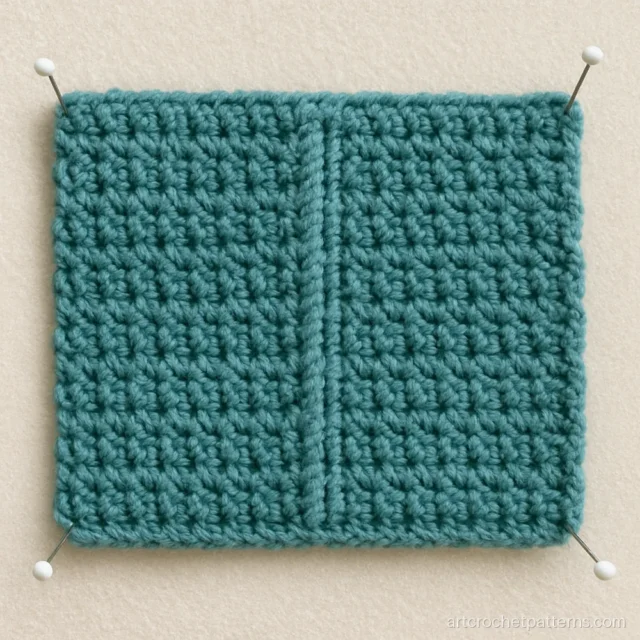 LevelEasyYarnWorsted acrylicHook4.5 mm (7)
Standard and invisible side by side
Left half: standard sc2tog through both loops. Right half: invisible decrease in front loops. The left shows small holes; the right looks like plain sc.
Maker note: Make a test strip like this with your own yarn before a toy. It shows which decrease suits your tension.
Taller decrease stitch crochet options: hdc2tog and dc2tog
Each taller stitch has its own decrease, built the same way: work each stitch until the last pull through, then finish them all at once.
| Decrease | Loops before closing | Where you see it |
|---|---|---|
| sc2tog | 3 | Toys, hats, sc fabric |
| hdc2tog | 5 | Beanie crowns, hdc sweaters |
| dc2tog | 3, after a partial dc in each st | Ripples, shawls, lace |
| sc3tog | 4 | Sharp points, chevron valleys |
For a dc2tog, the partial dc means: wrap, go in, bring a loop up, wrap and close 2 loops, then stop. Do that in two stitches, then pull through the 3 remaining loops. Our double crochet 2 together page walks through it slowly.
Spacing a crochet decrease evenly in rounds
In a round, decreases are spread out so the piece closes into a smooth dome instead of a lumpy point. Amigurumi heads close by reversing the increase rounds:
- Rnd A: (sc 2, dec) 6 times. (18)
- Rnd B: (sc, dec) 6 times. (12)
- Rnd C: dec 6 times. (6)
Each of those rounds removes 6 stitches. To check any round, count stitches used: (sc 2, dec) uses 4 stitches and makes 3, and 6 repeats use 24, making 18. Do the same sum on any pattern line and you will catch errors before they show. For a hat crown, the same rule applies with taller stitches and 8 or 10 repeats instead of 6.
Decreasing at the edges of rows
- Decrease at both ends: an sc2tog opens the row and another closes it. Smooth slope, loses 2 per row. Best for shawls and sleeves.
- Skip and stop short: slip stitch across the first few stitches and leave the last few unworked. Makes a stepped edge, used for armholes and necklines.
- Turning chain trick on dc rows: chain 2 instead of 3 and work into the second stitch. Use only when a pattern says so, since counts change.
To practice, make a triangle: chain 13 and work 12 sc along it, skipping the chain nearest the hook. Then on every row, ch 1, sc2tog, sc to the last 2 stitches, sc2tog. You will see 10, 8, 6, 4 and 2 stitches, and a final sc2tog leaves 1.
When a decrease misbehaves
| What happens | Reason | Fix |
|---|---|---|
| Holes at each decrease | Standard sc2tog on tight toy fabric | Switch to the invisible decrease |
| Count drops by 2 instead of 1 | Decrease worked over 3 stitches by accident | Count the legs: a dec covers exactly 2 stitches |
| Dome closes into a cone | All decreases stacked in the same spot | Shift the start of each repeat by 1 stitch every round |
| Edges look jagged | Mixing edge methods in one piece | Pick one method and use it on both sides |
New to the basics? The how to crochet hub starts from the slip knot.
Questions makers ask
What does dec mean in crochet?
Dec means decrease: work two stitches together so they share one top. In most patterns, dec in a sc round means sc2tog or the invisible decrease, and the stitch count drops by one.
How do I do a decrease in crochet without a gap?
Use the invisible decrease. Work through the front loops only of two stitches, then finish like a normal sc. The back loops stay in place and hide the gap.
Is sc dec crochet the same as sc2tog?
Yes. Sc dec, sc2tog and single crochet 2 together all describe one stitch made over two stitches. UK patterns write dc2tog, since the British dc matches the American sc.
What is the invisible decrease stitch crochet makers use for amigurumi?
It is a decrease worked into the front loops only of two neighboring stitches. It sits flat and looks like a plain sc, which keeps toy heads and bodies smooth.
Where should the decreases go in a round?
Spread them evenly. If a round has 30 stitches and needs 6 decreases, work (sc 3, dec) 6 times. The pattern repeat tells you how many plain stitches sit between each one.
Why is my crochet getting narrower when I did not decrease?
Most often the final stitch gets skipped, since it tucks in beside the turning chain. Count the stitches every row, or keep a marker on that easy to miss end stitch.