
Double crochet 2 together, written dc2tog, turns two double crochet stitches into one by joining their tops. It is the standard decrease for any project worked in dc: it shapes hat crowns, armholes, the valleys in a chevron blanket and the edges of a triangle shawl.
You make two half finished double crochets side by side, then close them with one final pull through. Below are clear steps, the half double version (hdc2tog), a practice swatch with counts for every row, and fixes for the holes and bumps that beginners often see.
At a glance
Skill level
Beginner (after dc)Abbreviation
dc2togChanges count by
Minus 1 stitchLoops before closing
3 on the hookUK term
Treble 2 together (tr2tog)Used in
Hats, chevrons, shawls, sleeves
Double crochet 2 together, step by step
- Start the first stitch. Yo, hook into the next st, yo, draw a loop up to row height. You hold 3 loops now.
- Stop halfway. Yo, pull through 2 loops. Two loops remain. This is an unfinished dc.
- Start the second stitch. Yo, insert the hook in the following st, yo, pull up a loop. Four loops are on the hook.
- Stop halfway again. Yo, pull through 2. Three loops remain.
- Close both. Yo, pull through all 3. One stitch top now sits over two legs, like an upside down V.
That is one dc2tog. Two stitches went in and one came out, so the row loses one stitch.
How to do hdc2tog crochet
The half double crochet two together decrease follows the same idea with a shorter stitch.
- Wrap, enter the next st, wrap again and lift a loop. (3 loops)
- Wrap, enter the neighbor st, wrap and lift once more. (5 loops)
- Yo and pull through all 5 loops.
Pulling through 5 loops is tight. A smoother option many makers prefer: make the first half exactly as above (3 loops), then go straight into the neighbor st with no wrap and lift a loop (4 loops), then wrap and pull through all 4. It looks almost the same and slides through more easily. Either way, it counts as one stitch. Learn the base stitch first in the half double crochet guide.
In pictures
What the work should look like, with the yarn and hook used for each sample.
 LevelBeginnerYarnWorsted acrylicHook5 mm (H-8)
Triangle swatch in cornflower blue
A dc2tog on both ends of each pass turns a rectangle into a neat triangle with straight slanted edges.
Maker note: Each slanted edge shrinks by one per row; leave the ch 2 alone and decrease into real stitches.
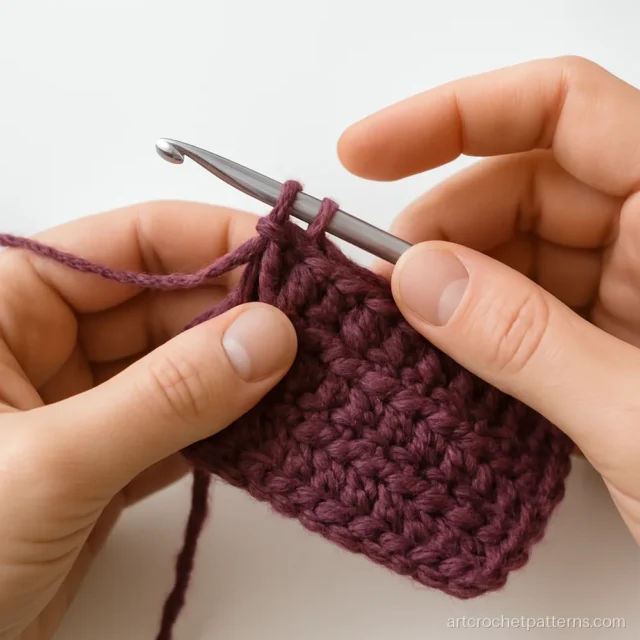 LevelBeginnerYarnWorsted woolHook5 mm (H-8)
Three loops before closing
Once both partial stitches are made, a trio of loops waits on the shank, and one wrap pulled through them all locks the decrease.
Maker note: Count the loops out loud before the final pull; three means you are right.
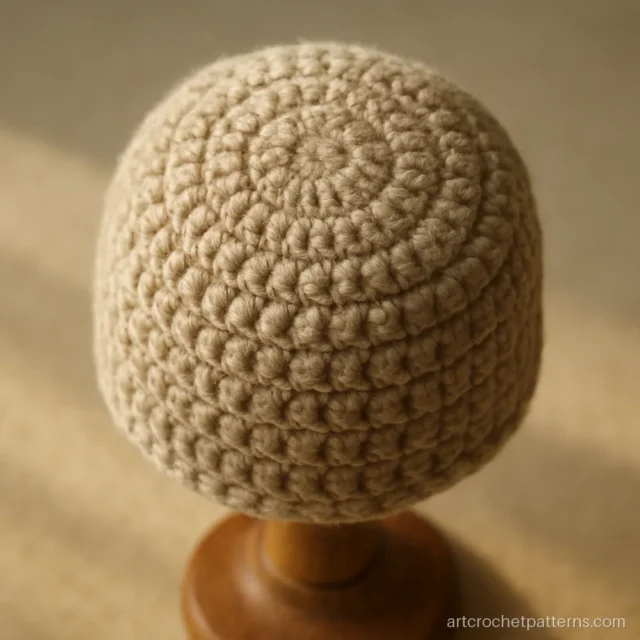 LevelEasyYarnAran wool blendHook5.5 mm (I-9)
Oatmeal hat crown decreases
Even spaced decreases close a top down or bottom up crown without a puckered center.
Maker note: Stagger decreases each round so they do not stack into a visible line.
Triangle swatch to practice dc2tog crochet
Here the stitch count drops by two per row, one from each side. US terms; UK makers read dc as tr.
- Ch 22.
- Row 1: Dc in 3rd ch from hook and in each ch across. The skipped 2 ch do not count. (20)
- Row 2: Ch 2 (does not count), turn. Dc2tog over first 2 sts, dc in each st to last 2 sts, dc2tog over last 2 sts. (18)
- Row 3: Rep Row 2. (16)
- Row 4: Rep Row 2. (14)
- Row 5: Rep Row 2. (12)
- Row 6: Rep Row 2. (10)
- Row 7: Rep Row 2. (8)
- Row 8: Rep Row 2. (6)
- Row 9: Rep Row 2. (4)
- Row 10: Ch 2, turn. [Dc2tog] twice. (2)
- Fasten off.
Both slanted sides should be straight. If one side has steps, check that you decreased into the very first stitch of that row.
Where to place decreases
| Goal | Where the dc2tog goes | Example |
|---|---|---|
| Slant an edge | First 2 and last 2 sts of a row | Triangle, V neck, raglan |
| Close a round | Spaced evenly around, offset each round | Hat crown, bottom of a bag |
| Make a valley | Paired in the middle of a repeat | Chevron and ripple blankets |
| Gather fabric | Every other stitch across a row | Ruffle base, cuff |
See it in action in the chevron crochet pattern, where two dc2tog side by side form each valley.
Holes, bumps and other decrease troubles
| What you see | Why | How to correct it |
|---|---|---|
| Hole above the decrease | Final pull through left loose | Snug the last loop before the next stitch |
| Count drops by 2 | Worked over 3 sts instead of 2 | Use two neighboring stitches only |
| Count stays the same | Finished the first dc fully | Stop each dc with 2 loops left before closing |
| Edge is lumpy | Decrease worked into the turning chain | Start the decrease in the first real st |
Questions makers ask
What does dc2tog mean in crochet?
It means double crochet 2 together. You make two unfinished double crochets in two neighboring stitches and close them with one yarn over, so two stitches become one.
How many loops should be on my hook for dc2tog?
You want 3 sitting there before that last wrap. If you have 2 or 4, one of the half stitches was finished too far or not far enough.
Does dc2tog count as one stitch?
Yes. Treat its single shared head as one stitch; on the following row, put a stitch into it just as you would into a plain dc.
What is the difference between dc2tog and a cluster?
A dc2tog spreads its legs over two stitches. A cluster puts all its legs into the same stitch or space, so it does not decrease.
How do I do half double crochet two together?
Wrap and lift a loop in each of two neighboring stitches, then wrap and draw through all 5. Leaving out the second wrap gives a smoother 4 loop variant.
What is dc2tog in UK terms?
It is written tr2tog, treble crochet 2 together, because a US double crochet is a UK treble.