
Double crochet is the tall, quick stitch behind granny squares, shawls and most fast blankets, and this lesson covers making it, beginning each row and shaping it. One dc stands about twice as high as a single crochet, so the fabric grows fast and drapes well.
US patterns write it dc. A UK pattern calls this stitch a treble (tr), while a UK "double crochet" is the US single crochet. That name swap trips up more beginners than the stitch itself, so check the terms before you buy yarn.
At a glance
Skill level
BeginnerAbbreviation
dcUK term
Treble crochet (tr)Turning chain
Ch 3, usually counts as the first dcHeight
About 2 single crochetGood for
Granny squares, shawls, scarves, throws
What is a double crochet?
A double crochet starts with one yarn over, goes into a stitch, and then closes in two separate pull throughs of two loops each. Those two steps are what make it tall. A dc row looks like a fence of upright posts with a V across each top.
On a diagram the dc symbol is a T with one short slash across its stem. Each extra slash means one more yarn over, so the treble crochet symbol has two slashes. Learning to read these symbols makes charts for granny squares and lace far less scary.
How to do a double crochet stitch
Chain 2 more than the number of dc you need. Twenty dc start from a chain of 22.
- Wrap first. Yarn over once; the wrap plus your working loop makes two.
- Count to the fourth chain from the hook and insert there. The three chains you skip stand up as the first dc of the row.
- Wrap and draw back through the chain. You hold 3 loops.
- Wrap, then pull through just the first 2. Two loops stay on the hook.
- Wrap, then pull through those last 2. One loop stays. That is your dc.
- Continue into every chain to the end. The skipped 3 plus 19 new stitches give 20.
Once a row is complete, ch 3 and turn. Treat this ch 3 as a real dc, so skip the stitch right below it and put your next dc into the second stitch. Your closing dc lands in the uppermost chain of the previous row's ch 3. Miss that one and your fabric loses a stitch each row.
In pictures
What the work should look like, with the yarn and hook used for each sample.
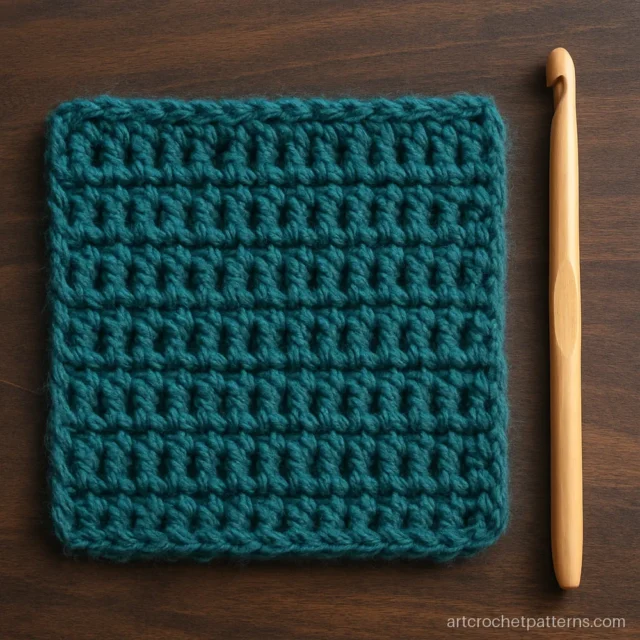 LevelBeginnerYarnWorsted woolHook5.5 mm (I-9)
Teal wool swatch of dc rows
Rows of dc in a springy worsted wool. Notice the small gaps between posts, which give dc its soft drape.
Maker note: Keep each post the same height by letting the first loop rise to the hook shaft every time.
 LevelBeginnerYarnWorsted acrylicHook5 mm (H-8)
Second pull through, two loops left
Halfway done: the first pull through two loops is finished. One more yarn over and pull through closes the stitch.
Maker note: Say the rhythm out loud: wrap, in, wrap, pull, wrap two, wrap two. It sticks after a dozen stitches.
 LevelBeginnerYarnWorsted acrylic wool blendHook5.5 mm (I-9)
Heather gray dc scarf with short fringe
The 22 stitch scarf from this page, worked straight in dc. A short fringe on each end hides the start and finish tails.
Maker note: Add each new ball where a row begins, never mid row, so the woven end hides in the edge.
Neater edges: standing and chainless starts
The ch 3 turning chain is a little thinner than a real dc, so the side edges can show small holes. Two fixes help:
- Chainless start: instead of ch 3, pull the working loop up tall, wrap once, and close the stitch as a normal dc into the first st.
- Standing double crochet: when starting a new color, put a slip knot on your hook, yarn over, insert where the round begins, and finish the dc. There is no visible join and no ch 3.
Some designers also start with ch 2 and call that the first dc, which keeps edges snug in thick yarn. Follow the pattern notes, since the stitch count changes.
Double crochet decrease and increase
Dc2tog (double crochet two together) combines two stitches into one at the top while keeping both posts at the bottom:
- Yo, insert in next st, yo, pull up a loop, yo and pull through 2 (2 loops on hook).
- Yo, insert in following st, yo, pull up a loop, yo and pull through 2 (3 loops on hook).
- Yo and pull through all 3 loops. (2 sts become 1)
A full lesson with ways to hide it at row ends is on the double crochet 2 together page. For a double crochet increase, simply work 2 dc into one stitch. Placing those increases at the same spot every row makes a corner or a point, which is how granny squares and ripples get their shape.
Dc variations you will meet in patterns
| Stitch | What changes | Used in |
|---|---|---|
| Linked double crochet | Instead of a yarn over, you pick up the horizontal bar halfway down the stitch before | Solid, gap free fabric for bags and warm blankets |
| Front post dc (FPdc) | Hook wraps the post, entering from the front | Ribbing, cables, basketweave; see front post double crochet |
| Back post dc (BPdc) | Hook wraps the post, entering behind the fabric | The partner to FPdc; see back post double crochet |
| Foundation dc | Chain and first row made in one step | Stretchy edges for hats and sweaters; see foundation double crochet |
| Dc in spaces | Worked into a gap, not a stitch top | Granny squares and the V stitch |
When dc goes wrong
| You see | The cause | Try this |
|---|---|---|
| Rows get narrower | The last dc into the turning chain was missed | Look for the ch 3 top at the row end and work into it |
| Rows get wider | A dc was worked into the first stitch as well as the ch 3 | Skip the stitch directly below the turning chain |
| Big holes at the sides | The ch 3 is loose or skinny | Use a chainless start or ch 2 instead |
| Stitches look short and lumpy | Pulling through 3 loops at once by habit from hdc | Always pull through 2, then 2 |
| Posts lean like a slanted fence | Twisting the hook as you pull through | Keep the hook throat facing down as you draw through |
Practice pattern: an easy double crochet scarf
This straight scarf is the classic first dc project. You need about 350 yards of worsted yarn (a wool blended with acrylic stays soft and warm), a 5.5 mm hook, also sold as I-9, and a blunt needle for weaving. Gauge runs about 13 dc and 7 rows in 4 inches. Expect a finished width near 7 inches and a length of roughly 60. Every turning ch 3 stands in for one dc.
- Ch 24.
- Row 1: Dc in 4th ch from hook and in each ch across. (22, counting the skipped 3 ch)
- Row 2: Ch 3 (counts as dc), turn. Sk first st, dc in each st across, ending with a dc in the top ch of the turning ch. (22)
- Rep Row 2 until the scarf measures about 60 inches, or the length you prefer. Fasten off.
- Optional fringe: cut 20 pieces of yarn 8 inches long. Fold 2 pieces in half, pull the fold through an edge st with your hook, then pull the ends through the fold. Make 5 on each short end.
Count to 22 at the end of each of the first five rows. After that, your eye will catch a missing stitch at the edges on its own. For more scarf ideas, see the crochet accessories section.
Questions makers ask
What is a double crochet in UK terms?
The UK name is treble (tr). The stitch is identical; the UK simply names stitches by a different count of loops.
Does the ch 3 count as a double crochet?
In most patterns, yes. Pass over the first stitch, and close out each row by working into the highest chain of the ch 3. If the pattern says the chain does not count, put a dc in the first stitch and skip the chain at the end.
How do I decrease in double crochet?
Use dc2tog. Work two unfinished dc, one in each stitch, each stopping with its last loop still on the hook. One final wrap closes all 3 loops together.
What is linked double crochet?
It is a dc that replaces the first yarn over by picking up a bar from the stitch beside it. The posts lock together so there are no gaps, which makes a denser, warmer fabric.
Why does my double crochet look loose and holey?
Dc is an airy stitch by nature. If gaps feel too big, drop one hook size or try half double crochet, which is shorter and closes up the fabric.
How long does a dc scarf take to make?
Most new crocheters finish a 60 inch dc scarf in about 8 to 12 hours. Dc grows about twice as fast as sc for the same yarn.