
This ripple crochet pattern gives you a full striped blanket in double crochet, plus six other ripple ideas to try next. The ripple stitch is a row stitch, so if you can work a double crochet and count to fourteen, you can make it.
Every ripple works the same way. You add stitches to build a peak, then remove the same number to sink into a valley. Because each peak and valley balance out, every row ends with the same number of stitches. Stripes show off the zigzag, so most ripple blankets change color every two to four rows.
Sharp, pointed zigzags are usually called chevrons, and there is a separate chevron crochet pattern page for those. The ripples here are softer and rounder.
At a glance
Skill level
Easy, once the first row is rightYarn
Worsted (4) acrylic or wool blendHook
5.5 mm (I-9)Stitches used
ch, dc, dc2togRepeat
14 stitches per waveTime
20 to 30 hours for a lapghan
6 ripple crochet pattern designs to make
Every design lists the skill level, yarn and hook, with a note from the maker.
 LevelEasyYarnWorsted acrylicHook5.5 mm (I-9)
Sunset stripe ripple lapghan
Warm stripes that fade from coral to mustard. Two rows per color keeps the waves crisp and the yarn changes easy to count.
Maker note: Carry no yarn up the side. Snip each color at the row end and weave it in, which keeps both sides flat.
 LevelEasyYarnDK cotton blendHook4.5 mm (7)
Mint and white baby ripple
A crib or stroller blanket in soft cotton. Mint and white read as calm, and cotton stays smooth after many washes.
Maker note: Weave every tail at least 3 inches so nothing pokes out after washing a baby blanket.
 LevelEasyYarnWorsted woolHook5 mm (H-8)
Ocean blues ripple scarf
Work the ripple the long way for a scarf with waves running from end to end. Only three wave repeats wide.
Maker note: Chain a long row for a lengthwise scarf and count it twice. A wrong chain count shows in row two.
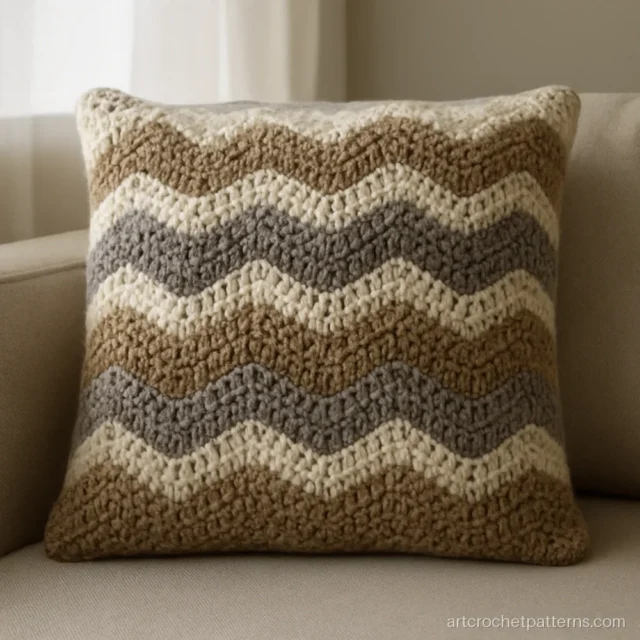 LevelEasyYarnBulky (5) acrylicHook8 mm (L-11)
Chunky neutral ripple pillow
Bulky yarn turns the ripple into a bold texture. Two panels seamed on three sides cover a square pillow form.
Maker note: Make the front panel 1 inch smaller than the pillow form so the cover fits snug.
 LevelEasyYarnWorsted scrapsHook5.5 mm (I-9)
Rainbow scrap ripple afghan
A home for leftover worsted. Use each scrap for one or two rows and repeat a single neutral every few stripes to tie it together.
Maker note: Keep all scraps the same weight. A thin yarn in one stripe makes that band pull in.
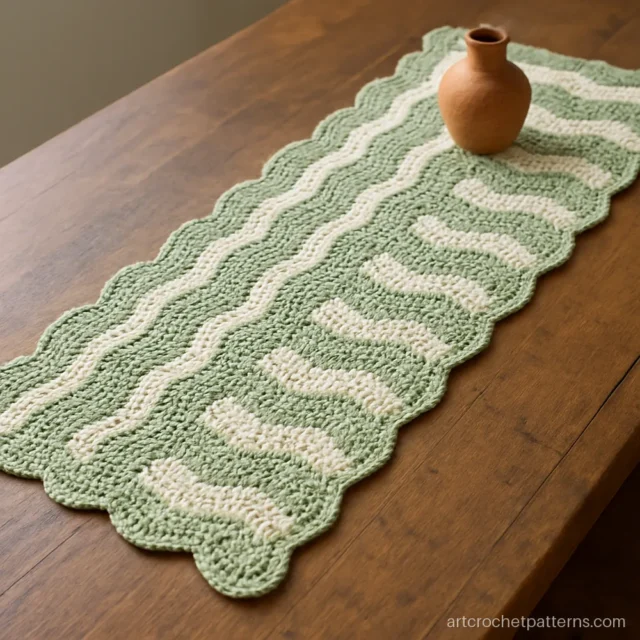 LevelEasyYarnWorsted cottonHook5 mm (H-8)
Sage cotton ripple table runner
Cotton holds the wave shape on a table and washes well. The ripple edges at each end give a scalloped finish without a border.
Maker note: Block it flat with pins at each peak and valley so the waves dry even.
How the ripple stitch crochet repeat works
One wave uses 14 stitches. Read across a single repeat and you see four parts:
- 2 dc in one stitch at each side of the repeat. Two repeats sit side by side, so their increases meet and form a peak of four stitches.
- 4 plain dc climbing down from the peak.
- 2 dc2tog in the middle. These two decreases pull the fabric down into the valley.
- 4 plain dc climbing back up.
Each repeat takes 14 stitches from the row below and makes 14 new ones, so the count stays fixed. If your stitch count drifts, one of the increases or decreases was skipped. A double crochet 2 together guide shows the decrease in close detail.
Free ripple crochet pattern: striped lapghan
Finished size: about 34 inches wide by 46 inches long, a lapghan size. Gauge: plain dc rows measure 13 stitches and 7 rows per 4 inches with a 5.5 mm hook. Gauge is not critical for a blanket, but a looser gauge uses more yarn.
Materials: worsted weight acrylic in four colors, about 350 yards each; an I-9 hook (5.5 mm); yarn needle; scissors. Your ch 3 turning chain stands in for the first dc of every row.
- Foundation: with color A, ch 115.
- Row 1: dc in 4th ch from hook (skipped 3 ch count as the first dc), dc in next 4 ch, (dc2tog over next 2 ch) twice, dc in next 4 ch, 2 dc in next ch; *2 dc in next ch, dc in next 4 ch, (dc2tog) twice, dc in next 4 ch, 2 dc in next ch; rep from * 6 more times. Turn. (112 sts, 8 waves)
- Row 2: ch 3 (counts as dc), dc in first st, dc in next 4 sts, (dc2tog) twice, dc in next 4 sts, 2 dc in next st; *2 dc in next st, dc in next 4 sts, (dc2tog) twice, dc in next 4 sts, 2 dc in next st; rep from * across, working the last 2 dc into the top of the turning ch. Change to color B in the last yo. Turn. (112 sts)
- Rows 3 and 4: with color B, rep Row 2. Change to color C at the end of Row 4. (112 sts)
- Rows 5 and 6: with color C, rep Row 2. (112 sts)
- Rows 7 and 8: with color D, rep Row 2. (112 sts)
- Rows 9 to 80: keep repeating Row 2, changing color every 2 rows in the order A, B, C, D. (112 sts)
- Fasten off and weave in all ends.
Finishing: the wavy ends need no border. For the straight sides, work one row of sc evenly along each edge, about 2 sc per dc row end. Wet block the blanket and pin each peak so the waves dry even. The color change guide explains the clean last yo swap used here.
Yarn and hook for a ripple stitch crochet blanket
| Yarn weight | Hook | Result |
|---|---|---|
| Light DK | 4.5 mm | Light, drapey baby or stroller blanket |
| Worsted | 5.5 mm | The classic sofa ripple, warm but not heavy |
| Chunky | 8 mm | Fast, thick waves; the repeat looks wider |
| Worsted cotton | 5 mm (H-8) | Crisp waves for runners and summer throws |
Acrylic is the easy choice for a first ripple because it washes well and comes in many colors. Wool blocks into the smoothest waves. To change the blanket size, add or remove whole 14 stitch repeats: chain 14 times the number of waves, plus 3. The blanket size chart helps you pick a target.
When the waves go wrong
| Wave trouble | What causes it | How to correct it |
|---|---|---|
| Waves drift sideways | Peaks are not stacked over peaks | Work the 2 dc increases into the first dc of each peak pair; place a marker in each peak on Row 2 |
| Count grows or shrinks | A dc2tog was worked as two dc, or one was missed | Count each row once; 112 is right for this pattern |
| Edges curl or bow | The first 2 dc or last 2 dc were skipped | Open each row with a dc beside the ch 3, at its foot, and close it with 2 dc in the turning ch |
| Foundation row is tight | Chains pulled snug | Make the foundation on a bigger hook, then go back to 5.5 mm |
| Flat spots instead of points | Only one dc2tog in the valley | Work two decreases side by side |
Ripple variations to try after the first blanket
Wider waves: add 2 plain dc on each side of the valley for an 18 stitch repeat. The waves get longer and calmer.
Deeper waves: use 3 dc in each peak stitch and a dc3tog in the valley. The fabric tilts more and looks closer to a chevron.
Textured ripple: work alternate rows into back loops. This adds ridges along the stripes. The back loop only guide shows where that loop sits.
Half double ripple: swap every dc for an hdc and every dc2tog for an hdc2tog. The blanket gets denser and warmer, and it takes more rows.
Soft waves: if you like round curves more than points, the wave crochet pattern page uses stitch height instead of increases.
Ripple stitch crochet pattern tips for beginners
Clip a marker into every peak top on Row 2. On every later row, your 2 dc increases go into the marked peak stitches, so you can check yourself at a glance. Move the markers up every few rows.
Count only the first three rows. After that, the waves guide your hands: you will feel the increase spots rise and the decreases dip.
Plan your stripes before you start. Four colors in two row stripes is easy to remember. Random stripes work too, but write down the order as you go in case you run out and need to match.
New to the basic stitches behind this pattern? Start on the crochet stitches hub and come back once your dc rows look even.
Questions makers ask
Are ripples and chevrons different things?
Both use increases and decreases to make zigzags. Ripples tend to roll in soft curves. Chevrons peak in sharp points because their increases and decreases are steeper. Many patterns use the two names for the same thing.
What foundation length does a ripple stitch crochet blanket need?
For this pattern, chain 14 for each wave and add 3. So 8 waves need 115 chains. Always check the multiple in the pattern you follow, since repeats differ.
Why does my crochet ripple stitch look crooked?
Usually the increases slipped one stitch off the peak below. Put markers in each peak and line every new increase up with them. Blocking also evens out small wobbles.
Can a newer crocheter handle a ripple crochet pattern?
Yes, as soon as your double crochet feels steady. The repeat is short and rhythmic. The only hard part is the first row into the chain, so count it twice before moving on.
How do I add a border to a ripple blanket?
Most makers leave the wavy ends bare and work single crochet along the straight sides. For a full border, work sc around, with extra sc at each peak and sc2tog in each valley so the edge follows the waves.
How much yarn does a ripple blanket need?
A worsted lapghan about 34 by 46 inches uses roughly 1,300 to 1,500 yards. Ripples use a little more yarn than a plain dc blanket of the same width because the waves fold extra fabric in.