
A wave crochet pattern makes rolling curves by changing stitch height across the row: short single crochets in the dips, tall trebles on the crests, and the in between heights to slope from one to the other. Fill the next stripe with the opposite order and the fabric comes out flat with soft, even waves of color.
Unlike a ripple or a chevron, the crochet wave stitch never adds or removes stitches, so the edges stay straight and every row has the same count. Below are six designs to spark ideas, then a fully counted wave stitch you can start on today.
At a glance
Skill level
Easy, with steady countingYarn
Worsted acrylic, cotton or woolHook
5 mm to 5.5 mmStitches used
sc, hdc, dc, trStitch multiple
6, plus 1Time
About 1 hour per 10 inch swatch
6 wave crochet pattern designs to make
Every design lists the skill level, yarn and hook, with a note from the maker.
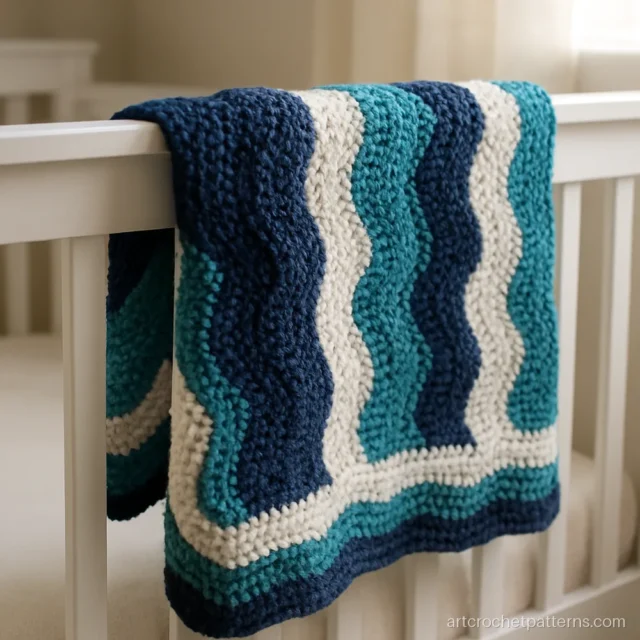 LevelEasyYarnWorsted acrylicHook5.5 mm (I-9)
Ocean blues baby blanket
Navy, aqua and white swap every four rows, like surf rolling in. Soft acrylic makes it easy to machine wash.
Maker note: Keep loose ends under 7 inches and weave them deeply so nothing pulls free on a baby item.
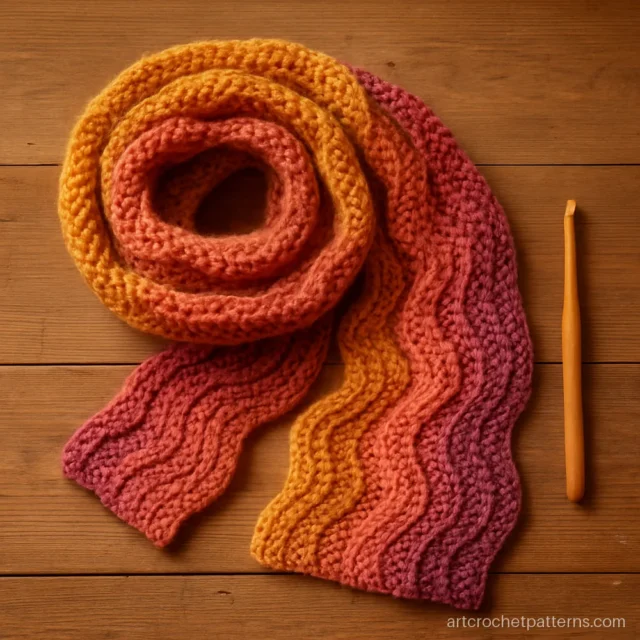 LevelEasyYarnDK woolHook4.5 mm (7)
Sunset gradient wave scarf
A long scarf worked lengthwise in DK wool, fading from gold through coral to plum. Only six rows wide, so it goes fast.
Maker note: Make the long base row of chains with the next hook up, then go back down; tight chains pucker.
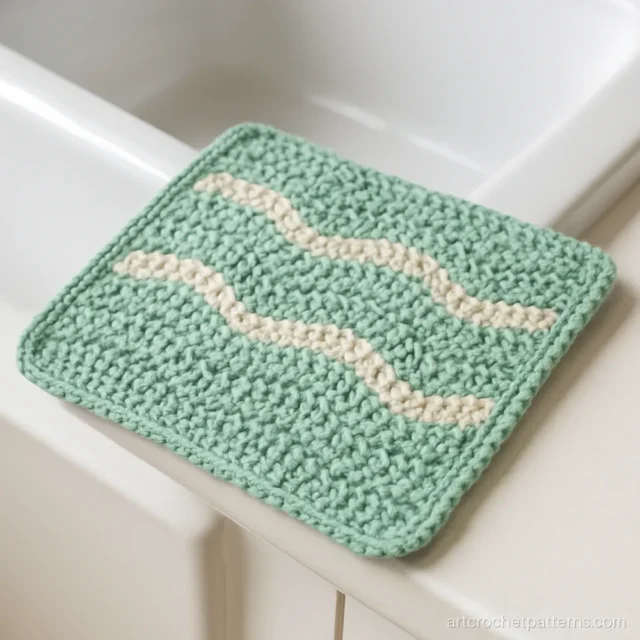 LevelBeginnerYarnWorsted cottonHook5 mm (H-8)
Mint and cream wave dishcloth
The smallest wave project. Two cotton colors, 25 stitches across, and about an evening of work.
Maker note: Cotton makes crisp curves; tug the cloth gently into shape after each wash and lay it flat.
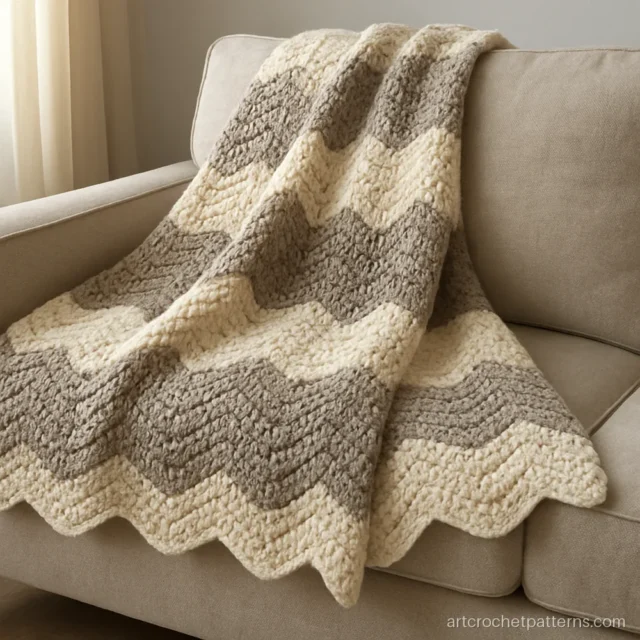 LevelEasyYarnWorsted wool blendHook5.5 mm (I-9)
Neutral oatmeal and gray throw
Quiet neutrals let the texture lead. Wide bands of eight rows per color suit a calm living room.
Maker note: For wider bands, repeat the two sc rows between waves instead of adding more wave rows.
 LevelEasyYarnWorsted acrylicHook5 mm (H-8)
Teal and mustard pillow cover
Two wave panels sewn together make a cover for a 16 inch pillow. Bold colors read clearly from across the room.
Maker note: Stop each panel about half an inch short of the pillow size; a snug cover looks plump.
 LevelIntermediateYarnWorsted cottonHook5 mm (H-8)
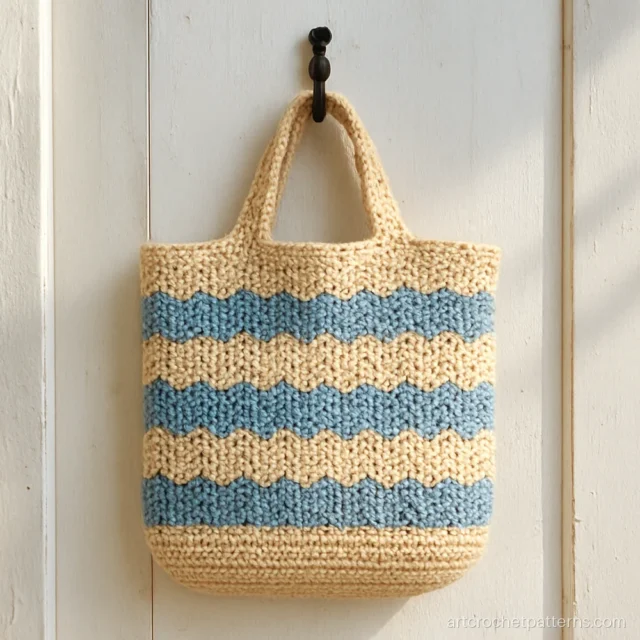
Sand and sea market bag
Waves worked in the round make a sturdy tote. A single crochet base and strap keep it from stretching.
Maker note: In the round, join each wave row with a slip stitch and keep a multiple of 6 around.
How the crochet wave stitch works
Picture one repeat of six stitches: sc, hdc, dc, tr, dc, hdc. Then a single crochet starts the next repeat. The row rises from the short sc up to the tall tr and back down. Worked over a flat row, that leaves a wavy top edge.
The next color does the opposite: a tr goes on top of every sc, and an sc lands on top of every tr. The tall stitches fill the dips, the short ones sit on the crests, and the top is level again. Two plain sc rows after each wave row lock the shape in and give you a calm stripe of color.
Free wave crochet pattern: two color stripe
Materials: medium weight yarn in a main shade, A, and a contrast, B; an H-8 hook (or I-9 if you work tight); a blunt tapestry needle; small scissors.
Gauge: about 14 sc and 16 rows to 4 inches. The swatch below is about 7 inches wide.
Notes: The stitch count is 25 on every row. On sc rows, the opening ch 1 is never counted. Ch 4 at the start of the B wave row counts as a tr.
- With A, ch 26.
- Row 1: Sc in 2nd ch from hook and in each ch across. Turn. (25)
- Row 2 (A wave): Ch 1, sc in first st, *hdc in next st, dc in next st, tr in next st, dc in next st, hdc in next st, sc in next st; rep from * 3 more times. Turn. (25)
- Row 3 (A): Ch 1, sc in each st across. Change to B on the last st. Turn. (25)
- Row 4 (B wave): Ch 4 (counts as tr), *dc in next st, hdc in next st, sc in next st, hdc in next st, dc in next st, tr in next st; rep from * 3 more times. Turn. (25)
- Row 5 (B): Ch 1, sc in each st across, working the last sc in the top of the ch-4. Turn. (25)
- Row 6 (B wave): Ch 1, sc in first st, *hdc in next st, dc in next st, tr in next st, dc in next st, hdc in next st, sc in next st; rep from * 3 more times. Turn. (25)
- Row 7 (B): Ch 1, sc in each st across. Change to A on the last st. Turn. (25)
- Row 8 (A wave): Work as Row 4. (25)
- Row 9 (A): Work as Row 5. (25)
- Rep Rows 2 to 9 for the length you want, ending after a Row 5 or Row 9 so the top edge is level.
- Last row: Ch 1, sc in each st across. Fasten off. (25)
In this layout each color makes one rising wave and one filling wave, so the stripes curve in and out like a ribbon. Weave each end along a stripe of the same color.
Sizing a wave stitch crochet blanket
The repeat is 6 stitches, plus 1 to finish, plus 1 for the turning chain. At about 3.5 stitches per inch in worsted yarn, these numbers get you close. Always measure your own swatch first.
| Item | Width | Repeats | Chain | Stitches |
|---|---|---|---|---|
| Dishcloth | 7 inches | 4 | 26 | 25 |
| Stroller blanket | 30 inches | 17 | 104 | 103 |
| Lapghan | 36 inches | 21 | 128 | 127 |
| Throw | 50 inches | 29 | 176 | 175 |
For more planning sizes, see the crochet blanket guide.
Choosing colors and yarn
High contrast pairs, like navy and white, show the curve best. Close shades, like two greens, give a gentle shimmer instead. Smooth acrylic or cotton keeps the line between stripes crisp; a fluffy wool softens it. Stick to one yarn weight across all colors, or the stripes will pull at different widths. Hand dyed and specialty fibers cost more but can give a watery, shaded look in the tall stitches.
Common problems with a crochet wave pattern
| Issue | Most likely cause | Remedy |
|---|---|---|
| Waves look like steps | Stitch heights jump too fast | Make sure you work hdc and dc between sc and tr |
| Top edge is still wavy after a filling row | Fill order matches the wave order | Put the tr over the sc and the sc over the tr |
| Fabric wider at one end | A stitch added at an edge | Count 25 before each turn |
| Treble crochets look loose | Tall stitches pulled up too far | Keep the first loop of each tr level with the row |
| Color changes look jagged | New color joined at the start of the row | Hook the fresh color during the closing wrap of the stitch that ends the row before |
Finishing and care
A wave fabric has straight sides, so a simple edge is all it needs. Work one round of sc, putting 3 sc in each corner, or choose something from the crochet borders collection. Follow the care symbols on the ball band. Wool should be laid flat to dry; acrylic and cotton blankets usually tolerate a gentle machine cycle. When this one is done, the crochet stitches pages have plenty more to try.
Questions makers ask
What is the difference between the wave stitch and a ripple?
A ripple adds and removes stitches to make points or curves, so its edges zigzag. The wave stitch keeps the same count on every row and changes only stitch height, so the edges stay straight.
Is a wave crochet pattern hard for beginners?
It is easy if you know sc, hdc, dc and tr. The trick is counting the six stitch repeat. Clip a marker into every second repeat on the first few rows; after that, the rise and fall guides your eye.
What starting chain does the crochet wave stitch need?
Take your number of repeats, times six, and add two. One of those extra chains turns, and the other becomes the final sc that closes the last wave.
Can I work the wave stitch with one color?
Yes. The texture still shows as soft ridges, but the curves are much clearer with two or more colors.
Why does my wave blanket have holes near the trebles?
Tall stitches next to short ones can leave small gaps. Snug the yarn as you finish each tr, and keep your hook size modest so the fabric stays solid.
Can I make the waves taller?
Yes. Use a double treble at the crest and add a tr on each side, which makes the repeat wider. Just keep the fill row as the exact mirror.