
Crochet borders frame a piece the way a mat frames a picture: they hide uneven row ends, square up corners and add weight so the edge hangs straight. A plain round of single crochet already does most of that work, and every fancier edge sits on top of it.
This page gathers six edging ideas, from a two round finish you can do in a TV episode to a lacy scallop for a christening shawl. You also get one full shell border pattern with stitch counts for every side and corner.
At a glance
Skill level
Beginner to intermediateYarn
Same yarn as the projectHook
Same size, or a half size smallerStitches used
sc, dc, ch, sl st, picotTime
1 to 4 hours per blanket edgeGood for
Blankets, dishcloths, shawls, collars
6 crochet borders designs to make
Every design lists the skill level, yarn and hook, with a note from the maker.
 LevelEasyYarnDK baby acrylicHook4 mm (G-6)
Cream shell edge on a baby blanket
This blanket shows the counted shell pattern below in a single contrast shade. Shells give a soft wavy line that hides small counting slips.
Maker note: Work the base round of single crochet first and check the count on all four sides first.
 LevelEasyYarnWorsted acrylicHook5 mm (H-8)
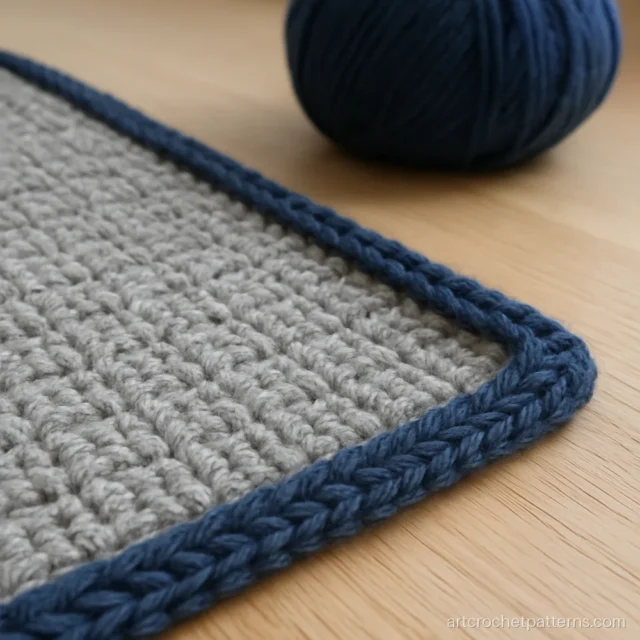
Corded crab stitch edge
Reverse single crochet makes a twisted cord that never curls. It ranks among the toughest crochet edge stitches for blankets that get heavy use.
Maker note: Work left to right if you are right handed. Keep loops loose or the cord will pull the edge in.
 LevelBeginnerYarnWorsted cottonHook4.5 mm (7)
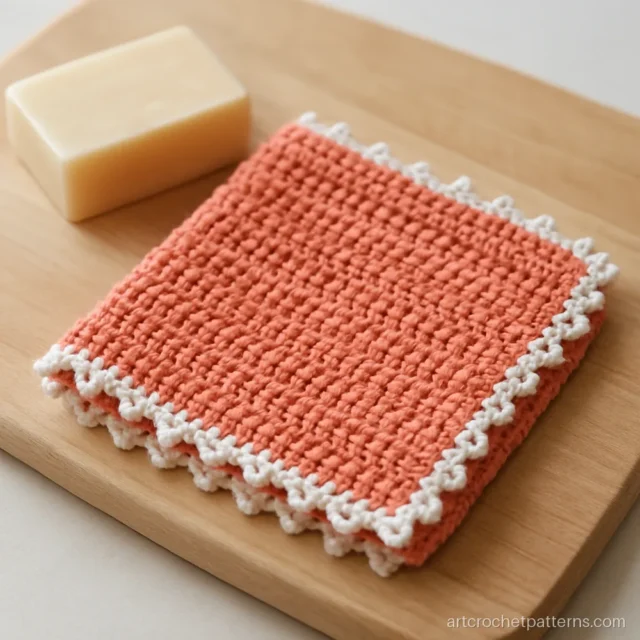
Picot trim on a cotton dishcloth
Three single crochet then a chain 3 picot, all the way around. It is a quick, easy edge that turns a plain cloth into a gift.
Maker note: Close each picot with a slip stitch into the front loop and side bar of the sc so it stands up.
 LevelIntermediateYarnWorsted wool blendHook5.5 mm (I-9)
Bobble row edging on a throw
A row of bobbles spaced every third stitch gives a playful, chunky edge. It suits a modern throw in a solid color.
Maker note: Push each bobble to the right side with a finger as you go so they all face the same way.
 LevelIntermediateYarnFingering merinoHook3.5 mm (E-4)
Lace scallop on an ivory shawl
Chain arches topped with fans of treble crochet make one of the most elegant crochet borders. It takes three rounds and blocks open beautifully.
Maker note: Wet block with pins in every scallop point. Lace edges look crumpled until they are blocked.
 LevelBeginnerYarnWorsted acrylicHook5 mm (H-8)
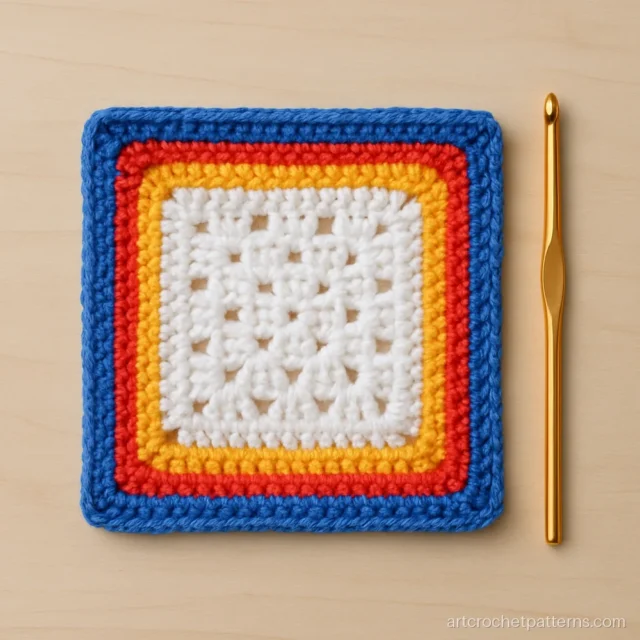
Striped single crochet frame
Five rounds of single crochet in five colors make a bold, flat frame. It is the easiest crochet border ever if you can count to three at each corner.
Maker note: Begin every stripe one corner along from the last, which spreads the joins out and keeps them flat.
Start every crochet border with a base round
Most edge trouble comes from the base, not from the fancy part. Before any shells or picots, work one round of single crochet (US sc = UK double crochet) all the way around.
- Along the top and bottom: one sc into every stitch of the last row.
- Along row ends of sc fabric: about 1 sc per row end.
- Along row ends of dc fabric: about 2 sc per row end, since each dc row is roughly twice as tall.
- At each corner: 3 sc in the corner stitch. The middle sc of that group becomes the corner for whatever round comes next.
Spread the piece on a table once this round is done. A straight base means any edging you add later will lie flat too.
Shell border pattern with full counts
You need: leftover project yarn or a contrast shade, your main hook and a blunt needle. The border adds about 1 inch to every side. The counts below suit a square with 35 stitches on each side between the corner stitches; any side count of 6 times a number, then 5 more, works.
- Rnd 1: Join yarn in any corner. Ch 1, 3 sc in that corner, then sc evenly around with 3 sc in each corner, ending with 35 sc on each side between 4 corner sts. Join with sl st to first sc. (144 sts)
- Rnd 2: Sl st in next st, which is the center sc of the first corner. Ch 3 (counts as dc), 6 dc in same corner st. *Sk 2 sts, sc in next st, [sk 2 sts, 5 dc in next st, sk 2 sts, sc in next st] 5 times, sk 2 sts, 7 dc in next corner st; rep from * twice more, then work the last side the same way, skipping the final corner. Join with sl st to top of beg ch 3. (4 corner shells of 7 dc, 5 shells and 6 sc on each side: 152 sts)
Cut the yarn, then hide the tail inside the back of a shell. If your count is off by one or two on a side, fix it on Rnd 1 by working one extra sc in a row end, or by working 2 sc together. Nobody will see it once the shells sit on top.
Quick easy crochet borders for any project
When time is short, these edges take one or two rounds.
- Single crochet, then slip stitch: a neat, firm line for dishcloths and bags.
- Reverse single crochet: also called crab stitch. It makes a cord; see the full guide to reverse single crochet.
- Picot every fourth stitch: ch 3, sl st back into the base stitch. Our picot crochet stitch page shows three sizes.
- Half double in back loops: one round gives a ridged band that looks like ribbing.
These are also the easy crochet borders to try first, because any slip is easy to rip back and redo.
Crochet blanket border ideas by look
| Look you want | Edge to use | Rounds |
|---|---|---|
| Clean and modern | Striped sc or hdc bands | 3 to 6 |
| Soft and babyish | Shells or small scallops | 2 |
| Rugged, for heavy use | Crab stitch over sc | 2 |
| Playful | Bobbles or pom poms | 2 to 3 |
| Heirloom and lacy | Chain arch fans with picots | 3 to 4 |
For a deeper look at edges sized for big blankets, including how much yarn to set aside, visit our crochet blanket border guide.
How to read a border crochet edging diagram
Many crochet edging patterns come as a chart. Each symbol is one stitch: a small oval is a chain, a plus sign or x is a sc, a tall T with one slash is a dc, and a dot is a slip stitch. The chart shows one repeat between bold lines, plus the corner.
Read the chart from the bottom, the way the rounds grow, and count how many base stitches one repeat needs. That number is your multiple. Crochet edge patterns written as text often state it too, as in "repeat of 6 sts, plus 5". Match your base round to that multiple on each side before you begin.
Wavy, ruffled or tight edges and how to fix them
| The edge | Reason | Try this |
|---|---|---|
| Ruffles like lettuce | The base round is overloaded | Rip back and work fewer sc per row end |
| Pulls in and puckers | Not enough base stitches, or tense hands | Add a few sc along each side, or switch to a bigger hook |
| Corners cup or roll | The corner stitch got fewer than 3 sc | Put three sc into every corner, round after round |
| Shells lean to one side | Skipped 1 st on one side of a shell and 3 on the other | Count the skipped sts around each shell |
Choosing yarn and hook for an edge
Use the same yarn weight as the body. A thinner yarn makes the border look flimsy, and a thicker one flares. A half size smaller hook is a good idea on loose crocheters, since edges stretch with use. Cotton gives crisp crochet trim on kitchen items; wool and acrylic give a softer roll on blankets. For more stitch ideas to pair with an edge, browse the crochet stitches hub, and see the crochet shell stitch page for full shell variations.
Questions makers ask
What is the easiest crochet border ever?
A single round of sc, tripled at every corner, then a round of slip stitch. It takes very little time, stays flat and works on any fabric.
How many stitches do I put in a crochet border corner?
For sc rounds, work 3 sc in the corner stitch. For dc rounds, work 2 dc, ch 2, 2 dc in the corner space, or 5 to 7 dc in one corner stitch for a shell edge.
Should I use a smaller hook for crochet borders?
Often, yes. Going down half a hook size keeps the edge firm. If your edge already pulls in, stay with the same hook or go one size up.
What are the best crochet border stitches for blankets?
Single crochet and half double bands, crab stitch, shells and bobbles all wear well. Avoid long open lace on a blanket that toddlers use, since small fingers catch in the holes.
Will an edging work on a piece made in rows?
Yes. Work the base round into stitches along the top and bottom, and into row ends along the sides. Space the row end stitches so the edge lies flat.
Why does my crochet border ripple?
There are more stitches in the border than the edge can hold. Pull it out and redo the base round with fewer stitches along the side edges.