
The crochet shell stitch fans several double crochets out of a single stitch so they open like a scallop seashell. Rows of shells, each locked in place by a single crochet, make one of the oldest and prettiest textures in crochet.
You will learn the classic 5 dc shell first, with half shells that keep the sides straight. After that comes a scarf you can start tonight, a look at the main types of crochet shell stitches, and the counting slips that make rows wander. You only need to know how to chain, work single crochet and work double crochet.
At a glance
Skill level
EasyStitches used
ch, sc, dcChain multiple
6 plus 2Yarn
Smooth DK or worstedHook
4 mm to 5.5 mmGood for
Blankets, scarves, edgesUK term
Shells of UK trebles
How a shell is built
A shell is a group of tall stitches worked into one stitch or space. The classic version has 5 dc. To leave room for the fan, you skip 2 stitches before and after it. Then a single crochet anchors the fabric between shells. Each repeat uses 6 stitches: sk 2, shell, sk 2, sc.
On the next row, the job swaps. Shells go into the sc of the row below, and the new sc goes into the center dc of each old shell. That swap staggers the scallops like bricks. At the row ends you work a half shell of 3 dc, so the sides come out straight.
Shell stitch crochet, row by row
Your foundation needs 6 chains per shell and 2 extra. A four-shell practice piece therefore starts with 26 chains.
- Row 1 (RS): Sc in 2nd ch from hook, *sk 2 ch, 5 dc in next ch, sk 2 ch, sc in next ch* rep across. Turn. (4 shells, 5 sc)
- Row 2: Ch 3 (counts as dc), 2 dc in first sc, *sk 2 dc, sc in next dc, sk 2 dc, 5 dc in next sc* rep across, ending the last rep with 3 dc in the last sc instead of 5. Turn. (3 shells, 2 half shells, 4 sc)
- Row 3: Ch 1 (does not count), sc in first dc, *sk 2 dc, 5 dc in next sc, sk 2 dc, sc in next dc* rep across, working the last sc in the top of the turning ch. Turn. (4 shells, 5 sc)
- Rep Rows 2 and 3 for the pattern.
In Row 2 the sc goes into the third dc of the shell, the tallest point of the fan. In Row 3 the first sc sits on the edge dc, and the last one goes into the third chain of the ch 3. Miss that final chain and you lose a stitch every two rows.
In pictures
What the work should look like, with the yarn and hook used for each sample.
 LevelEasyYarnWorsted acrylicHook5 mm (H-8)
Classic 5 dc shell swatch
Four shells across and eight rows high. The half shells at each side keep the edges straight instead of scalloped.
Maker note: Each sc lands in the third dc of a shell. Count 1, 2, 3 across the fan before you insert the hook.
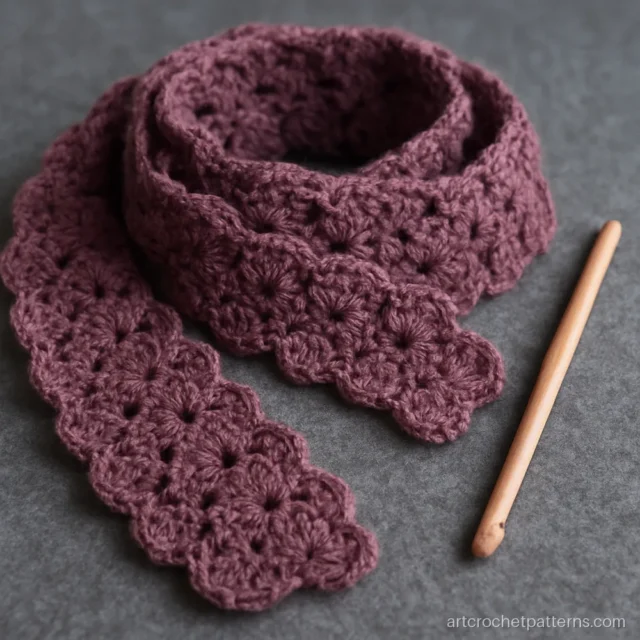 LevelEasyYarnWorsted woolHook5.5 mm (I-9)
Plum shell stitch scarf
Five shells wide is enough for a cozy scarf. Wool shows the scallops crisply and blocks out flat.
Maker note: Tie a contrast thread on the front face. Shells look slightly different from the back and it is easy to lose track.
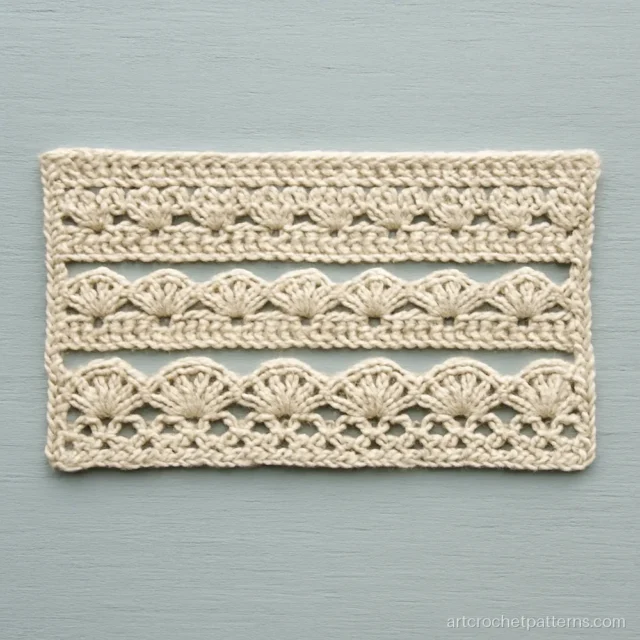 LevelIntermediateYarnDK cottonHook4 mm (G-6)
Shell types sampler strip
From bottom to top: 3 dc shells, 5 dc shells, open shells with chains and big 7 dc fans, all in the same yarn so you can compare.
Maker note: Bigger shells need more skipped stitches. A 7 dc shell over a 6-stitch repeat will ruffle.
A first crochet shell stitch pattern: easy scarf
Blocked, it comes to roughly 7 by 60 inches. Gauge: about 1.5 shells over 4 inches.
Gather: close to 330 yards of springy worsted wool, a 5.5 mm hook (US I-9) plus a needle for the tails.
- Ch 32.
- Row 1 (RS): Sc in 2nd ch from hook, *sk 2 ch, 5 dc in next ch, sk 2 ch, sc in next ch* rep across. Turn. (5 shells, 6 sc)
- Row 2: Ch 3, 2 dc in first sc, *sk 2 dc, sc in next dc, sk 2 dc, 5 dc in next sc* rep across, ending with 3 dc in the last sc. Turn. (4 shells, 2 half shells, 5 sc)
- Row 3: Ch 1, sc in first dc, *sk 2 dc, 5 dc in next sc, sk 2 dc, sc in next dc* rep across, last sc in top of turning ch. Turn. (5 shells, 6 sc)
- Rep Rows 2 and 3 until the scarf is 60 inches long, ending after a Row 3. Fasten off.
Ending on a Row 3 makes both short ends scalloped, so they match. Weave the tails into the shell posts and block flat. More scarf shapes are in our crochet scarf collection.
Types of crochet shell stitches
| Shell | How it is written | Look and use |
|---|---|---|
| Small shell | 3 dc in one st, sk 1 on each side | Tight scallops for baby clothes and edges |
| Classic shell | 5 dc in one st, sk 2 on each side | The everyday blanket and scarf texture |
| Fan | 7 dc in one st, sk 3 on each side | Deep scallops for shawls and hems |
| Open shell | (dc, ch 1) 4 times, dc in one st | Lacy and light, for summer wraps |
| Granny shell | Two 3 dc groups split by ch 2, in one space | Chunky clusters that echo a granny square |
| Tall shell | 5 tr in one st | Long, airy fans that grow fast |
The airy little sister of the shell is the V, which opens just two dc around a single chain. If shells feel busy, try our V stitch crochet guide for a calmer texture with the same quick rows.
Shells at a crooked angle: what went wrong
| You see | The reason | Put it right |
|---|---|---|
| One side is wavy, the other straight | Half shell left off one end | Start Row 2 with ch 3 plus 2 dc and end it with 3 dc |
| Shells drift sideways | Sc placed in the 2nd or 4th dc of a shell | Aim for the center, the third of five |
| Fabric ruffles | Too many dc per shell for the skip | Match the shell to the repeat: 5 dc with sk 2 |
| Last shell will not fit | Foundation not a multiple of 6 plus 2 | Count the chain again in groups of six, or start on foundation sc |
| Gaps beside each sc | Loose single crochet | Snug the sc, or drop half a hook size |
Yarn that shows off scallops
Shells need crisp stitch definition. Smooth plied cotton, wool and acrylic show every fan. Fuzzy mohair or chenille blur the shape into a bumpy mass. Pale and mid tones read better than black or deep navy in photos and in low light.
For a blanket, worsted acrylic with an I-9 or J-10 hook gives a soft fabric that does not weigh too much. For a summer shawl, a DK cotton with a G-6 makes lighter, more open fans. Self-striping yarn works well too, because each shell row takes about the same length of yarn and the colors band evenly.
Using shells as an edge
A single row of shells is the easiest way to finish a blanket, collar or hem. Work a base round of sc, then repeat skip two, five dc in the following stitch, skip two, one sc, all the way around. The side count needs to fit the 6-stitch repeat, so plan it before the round starts. Our crochet blanket border page walks through the corner math, and the crochet borders gallery has shell edges for other items.
Questions makers ask
What chain count works for a shell stitch row?
For the classic 5 dc shell with sc between, the foundation is six times the shell count, plus 2. So 26, 32 or 38 chains all work. A different shell size changes the multiple.
Where does the single crochet go in a shell row?
Into the center stitch of the shell below. For a 5 dc shell, that is the third dc. Putting it there keeps every row lined up.
Is the crochet shell stitch hard for beginners?
Not if you can make dc and sc. The tricky part is counting the skips and remembering the half shells at the row ends. Most makers have it down after one practice swatch.
Can I work shell stitch in the round?
Yes. Seal each round by slip stitching to where it began, turn if you want the same look as flat rows, and keep the shell count the same so the tube stays even. Hats and cowls often use it this way.
Will a shell blanket need extra yarn?
A bit, compared with plain dc, because of the fans, but less than dense stitches like the puff or bobble. A shell blanket needs roughly the same yarn as a dc blanket of the same size, plus about 10 percent.
Are shells and clusters the same thing?
A shell spreads its stitches apart at the top from one base stitch. A cluster does the opposite, joining several stitches together at the top. Our cluster stitch page shows the difference.