
A crochet blanket border frames your work, hides uneven row ends and adds a little weight that helps the blanket hang flat. Below you will find six border designs, a complete shell edge pattern with exact corner counts, and the fixes for the two problems every maker meets: edges that ruffle and edges that pull in.
Most borders start the same way: one round of single crochet worked evenly around the whole piece with extra stitches at each corner. Get that first round right and almost any edge you add later will sit well. If you want a wider library of edgings for scarves, shawls and dishcloths too, browse our crochet borders gallery.
At a glance
Skill level
Beginner to intermediateYarn
Same weight as the blanketHook
Blanket hook, or one size smallerTime
2 to 5 hours for a throwStitches used
sc, hdc, dc, sl stYarn needed
About 10 to 15 percent of the blanket
6 crochet blanket border designs to make
Every design lists the skill level, yarn and hook, with a note from the maker.
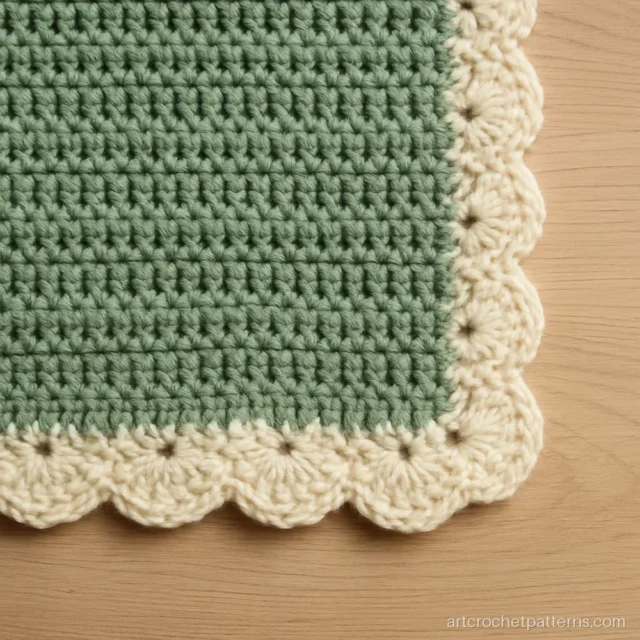 LevelEasyYarnWorsted acrylicHook5 mm (H-8)
Classic shell scallop border
Five double crochet shells give a soft wave that suits almost any throw. It is the pattern written out on this page.
Maker note: Count your side stitches before the shell round. One stitch off and the last shell lands crooked at the corner.
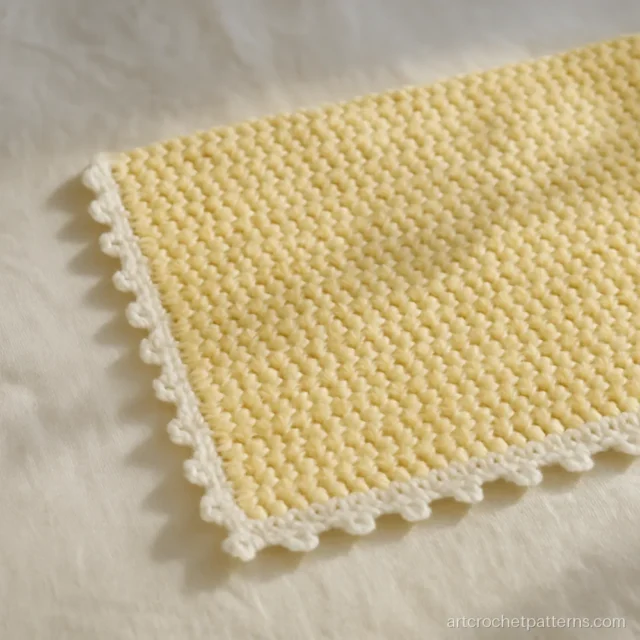 LevelEasyYarnDK cottonHook4 mm (G-6)
Tiny picot edge for a baby blanket
Small picots every third stitch add a delicate finish without loops big enough to catch little fingers.
Maker note: Keep picots to chain 3. Longer chains make loops that snag on buttons and small toes.
 LevelEasyYarnWorsted woolHook5 mm (H-8)
Rope-like crab stitch finish
Reverse single crochet makes a firm, twisted cord along the edge. It works well on plain or striped blankets meant for older kids and adults.
Maker note: Work from left to right and keep the loops loose. Tight crab stitch makes the edge cup.
 LevelIntermediateYarnBulky acrylicHook6.5 mm (K-10.5)
Chunky bobble border
One round of five double crochet bobbles, spaced with single crochet, gives a playful edge on a chunky blanket.
Maker note: Space bobbles every fourth stitch on the sides and put one right in each corner stitch.
 LevelEasyYarnWorsted acrylic scrapsHook5 mm (H-8)
Granny cluster stripe border
Three rounds of granny clusters in scrap colors widen the blanket and tie a multicolor center together.
Maker note: Corner spaces each hold a pair of 3 dc clusters and a ch 2 bridge, so the rounds turn without a gap.
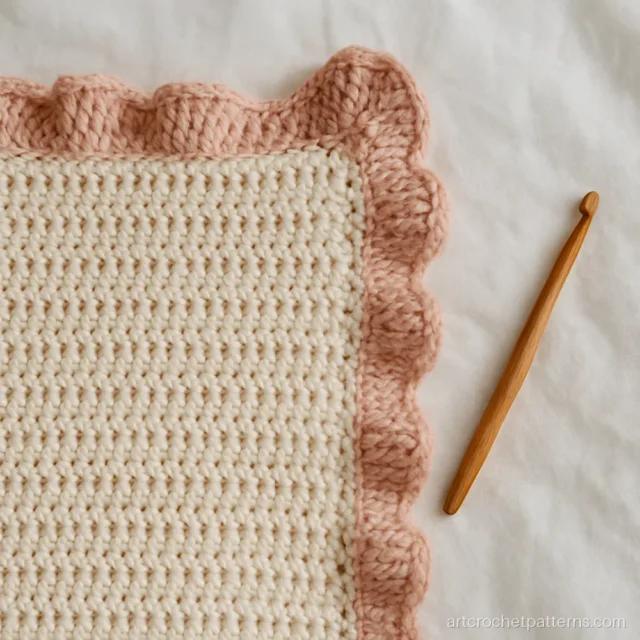 LevelEasyYarnBaby weight acrylicHook4.5 mm (7)
Soft ruffle for a nursery blanket
Two double crochet in every stitch of the last round makes a gentle ruffle. It turns a simple baby blanket into a keepsake.
Maker note: A ruffle takes almost twice the yarn of a flat round, so buy an extra ball before you start.
Choosing a crochet blanket border for your project
Match the border to how the blanket will be used. A blanket that gets dragged around the house needs a firm edge such as single crochet plus crab stitch. A throw for the back of the sofa can carry lacy shells or a deep ruffle. For crochet borders for baby blankets, pick tight stitches with no long loops and use the same washable yarn as the body.
| Border | Width added | Best for |
|---|---|---|
| Single crochet, 2 to 3 rounds | About 1 inch | Any blanket, a neat frame |
| Crab stitch | Under half an inch | Heavy use, stripes, teen rooms |
| Shell scallop | 1 to 1.5 inches | Throws and baby blankets |
| Picot | Under half an inch | Delicate cotton baby blankets |
| Granny cluster rounds | 2 to 4 inches | Making a blanket bigger |
| Ruffle | 1 to 2 inches | Nursery keepsakes |
Planning a border to reach a set size? Check the finished measurements on our blanket size chart and subtract the border width from each side before you start the body.
Getting the first round even on every side
The base round decides whether the edge lies flat. Work it in single crochet with the right side facing you.
- Along the top and bottom (the stitch edges), work 1 sc in each stitch.
- Along the row ends, the ratio depends on the stitch height. For rows of single crochet, work 1 sc in each row end. For half double rows, work 3 sc in every 2 rows. For double crochet rows, work 2 sc in each row end.
- At each corner, work 3 sc into the corner stitch. The middle one becomes the corner center for the next round.
- Lay the blanket flat after one side. If the edge waves, you added too many stitches; if it pulls in, add more.
Written pattern: simple shell crochet blanket border
This three-round edge suits a throw or a baby blanket in worsted or DK yarn. It adds about 1.5 inches to each side.
Materials: yarn in the same weight as your blanket (about 150 yards of worsted for a 36 by 48 inch lapghan), the hook you used for the body, a yarn needle, 4 stitch markers.
Stitch count rule: in Rnd 1, each side between the corner groups needs a count that is 3 more than a multiple of 4. The counts in brackets use an example blanket with 119 sc on each short side and 159 sc on each long side. Use your own totals if they differ; the side counts are what matter.
- Rnd 1 (RS): Join yarn with a sl st in any corner. Ch 1 (does not count), 3 sc in the corner, sc evenly along the side, *3 sc in the next corner, sc evenly along the side* 3 times, join with a sl st to the first sc. (568: 119 and 159 sc on the sides plus 12 corner sc)
- Rnd 2: Sl st into the center sc of the corner. Ch 2 (does not count), 3 hdc in the same st, hdc in each st to the next corner center, *3 hdc in the corner center, hdc in each st to the next corner center* 3 times, join with a sl st to the first hdc. (576)
- Rnd 3: Sl st into the next hdc, the corner center. Ch 3 (counts as dc), 6 dc in the same st for the first corner shell. Short side: (sk 1, sc in next, sk 1, 5 dc in next) 30 times, sk 1, sc in next, sk 1, 7 dc in the corner center. Long side: (sk 1, sc in next, sk 1, 5 dc in next) 40 times, sk 1, sc in next, sk 1, 7 dc in the corner center. Work the second short side as the first, then the second long side, but end with sk 1 instead of a corner shell and join with a sl st to the top of the beginning ch 3. (4 corner shells, 140 side shells, 144 sc)
Finishing: Fasten off and weave the tail back through the shells for 3 inches in two directions. Our guide to weaving in ends shows a method that stays put through washing. Pin the corners square and mist with water if the shells curl.
Simple crochet borders for blankets when time is short
Not every blanket needs a fancy finish. These quick options take one or two rounds:
- Two rounds of sc in a contrast color. Clean, modern and almost impossible to get wrong.
- One round of sc, one round of crab stitch. The reverse round twists into a cord that resists stretching.
- Sc with a picot every 4 stitches: sc in 3 sts, ch 3, sl st in the third chain from the hook, sc in next. Repeat around.
- Hdc in the back loop only on the last round. The front loops form a fine ridge on the right side, a trick explained on our back loop only page.
These simple edges work best on dense fabrics. A loose lacy body may still want a shell or cluster round to give it some weight.
Fixing wavy, tight or crooked blanket borders
| Problem | Why it happens | Fix |
|---|---|---|
| Edge ruffles like lettuce | Too many stitches along the row ends | Rip back and skip a row end every 8 to 10 rows |
| Sides pull in, blanket cups | Too few stitches or a tight hand | Add stitches, or go up one hook size for the border only |
| Corners curl up | Only 1 or 2 stitches in each corner | Use 3 sc in each corner on every round, worked into the center stitch |
| Corners look pointy and stretched | 5 or more stitches crammed in | Drop back to 3 stitches per corner |
| Shell round ends with a half shell | Side count was not a multiple that fits the repeat | Add or skip one stitch on the round below near the corner |
| Joining seam shows | Ch and sl st join sits on top of the stitches | Use an invisible join with a needle on the last round |
A full blocking after the last round cures small waves. Our blocking guide covers wet and steam methods for acrylic, cotton and wool.
Blanket border crochet tips for colors and yarn
Use the same fiber as the body so the edge shrinks and softens at the same rate in the wash. A cotton border on an acrylic blanket will stiffen and may pucker after drying. Pick a border color that already appears in the blanket, or go one shade darker than the main color to make the shape stand out. Pale borders show dirt first, so a darker frame is wise on a blanket that will live on the floor.
Work the border with the right side facing on every round so the stitches lean the same way. If you change colors between rounds, join each new color at a different corner so the joins do not stack up in one spot. Need a blanket to put an edge on? Start with our crochet blanket patterns or see more edge stitches on the crochet stitches hub.
Questions makers ask
What share of my yarn will the crochet blanket border eat?
Plan on 10 to 15 percent of the yarn used in the blanket for a border of 2 or 3 rounds. Wide granny rounds or ruffles can take 25 percent. Weigh the blanket before and after one round to estimate the rest.
What hook size should I use for a blanket edging?
Start with the hook you used for the body. If your border tends to pull in, go up half a size. Some makers drop a size for the first sc round to firm up loose row ends.
What is the right corner stitch count on a blanket edge?
Three stitches in the corner stitch is the standard for sc, hdc and dc rounds. On each following round, work the 3 stitches into the middle stitch of the previous corner group. Granny rounds instead fill each corner space with a cluster pair and a ch 2 bridge.
What are good crochet borders for baby blankets?
Shells, small picots and two rounds of single crochet all work well. Avoid big open loops and long chains that can catch tiny fingers. Keep any loose strands shorter than about 7 inches and weave every end in securely.
Should I crochet a border on a granny square blanket?
Yes, a border hides the bumpy edges where squares meet and helps the blanket keep its shape. Join the squares first, then work at least one round of sc or granny clusters. Our square joining guide covers that first step.
Will these edges work on a knitted or fleece blanket?
Yes. On knitting, work sc into the edge stitches with a hook a size smaller. On fleece or cotton fabric, punch evenly spaced holes about half an inch from the edge, or buy fabric with a pre-cut edge, then sc into the holes.