
Crab stitch crochet is a border stitch that moves backward along an edge, from left to right for right handed makers, and leaves a firm twisted cord. It got its name from that sideways crab walk.
It is really a single crochet worked in the wrong direction, so it is also written as reverse single crochet or rev sc. This page is about using the crochet crab stitch as a finish: where it looks best, how to handle corners and joins, and how to keep the edge flat. For a slow breakdown of the hand motion itself, the reverse single crochet page goes loop by loop.
At a glance
Skill level
Easy to intermediateAlso called
Reverse single crochet, rev scUK term
Reverse double crochetWorked into
A round of sc or hdcDirection
Left to right (right handed)Good for
Blanket edges, hat brims, cuffs
How to work the crochet crab stitch along an edge
Finish the last round or row of your piece with single crochet. Do not turn.
- Chain 1. Your hook now points left, the way you were working.
- Twist your wrist so the hook points right. Insert it into the next stitch to the right, from front to back.
- Catch the yarn and pull up a loop. Dip the hook down as you pull so the loop comes through under the stitch top. Two loops now ride on the shaft.
- Wrap and draw through the pair of loops to finish one crab stitch.
- Keep moving right one stitch at a time. After five or six stitches, the twisted cord shows.
The first few stitches feel awkward because your hands are used to moving the other way. Hold the work so the edge is level, and keep the loops a little looser than your usual sc.
Turning corners with crab stitch
Corners are where most crab edges go wrong. The backward stitch pulls tighter than regular sc, so a corner needs extra room.
- In the round below: work 3 sc into each corner stitch of the sc round.
- In the crab round: work 1 crab stitch in the stitch before the corner, 3 crab stitches in the center corner stitch, then 1 in the stitch after.
- Rounded corners: for a soft look, work 2 crab stitches in each of the three corner stitches.
If a corner still cups, pull it out and add one more crab stitch there.
In pictures
What the work should look like, with the yarn and hook used for each sample.
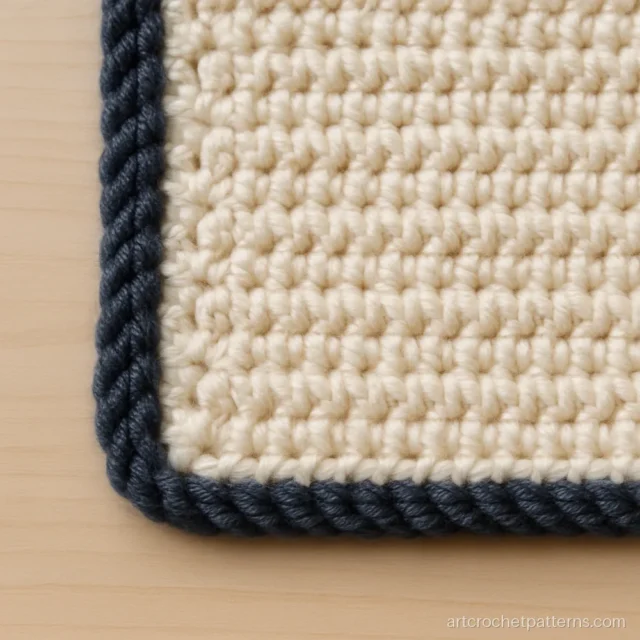 LevelEasyYarnWorsted acrylicHook5 mm (H-8)
Navy crab edge on a cream blanket
A contrast color shows off the corded twist. One round of sc plus one round of crab stitch frames the whole blanket.
Maker note: Work 3 crab stitches into each corner sc so the edge turns without pulling tight.
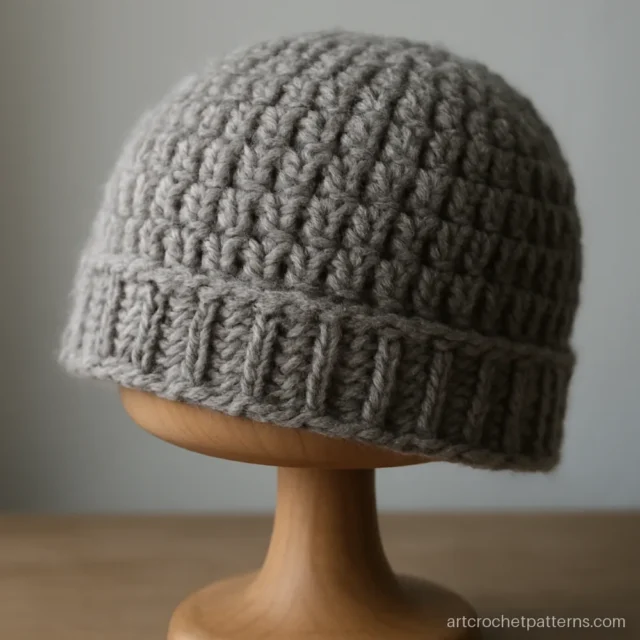 LevelEasyYarnWorsted wool blendHook5 mm (H-8)
Crab stitch edge on a beanie brim
On a hat, the crab stitch stops the brim from rolling and adds a neat finished line.
Maker note: Pick a brim hook 0.5 mm finer than the body hook; the brim edge then stays snug instead of flaring.
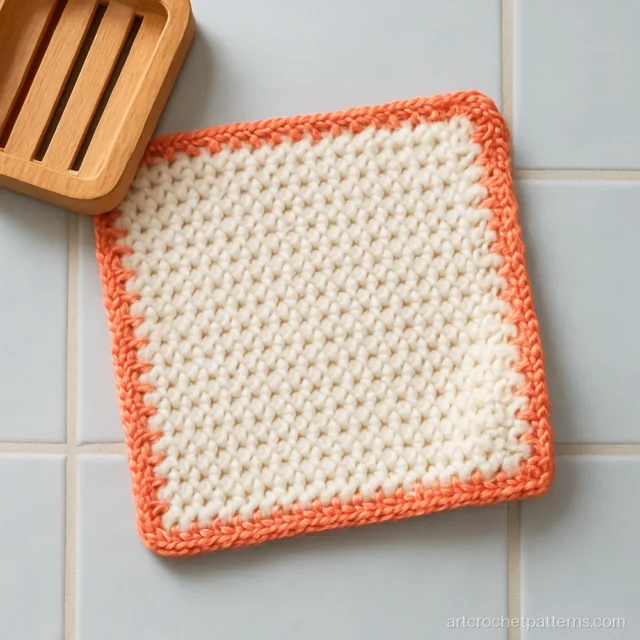 LevelEasyYarnWorsted cottonHook4.5 mm (7)
Coral cotton dishcloth with crab edge
In cotton the edge is firm and keeps a dishcloth square after many washes.
Maker note: Cotton has no stretch, so skip a stitch every 8 or so if the edge starts to ruffle.
Crab stitch crochet border for a dishcloth or blanket
This edge fits any square or rectangle. Hold the piece RS out to start.
- Rnd 1: join yarn in any corner, ch 1, 3 sc in corner st, sc evenly along each side (1 sc per sc row end, 2 sc per dc row end), working 3 sc in each corner; join with sl st to first sc.
- Rnd 2: ch 1, do not turn. Working from left to right, crab st in each st around, working 3 crab st in the center st of each corner.
- Join with sl st to the base of the first crab st. Fasten off and weave in the tail.
Using a second color for Rnd 2 makes the cord stand out. Change color by joining the new yarn in Rnd 1's last sl st. See the blanket border page for larger edge ideas.
Joining the round neatly
The end of a crab round meets the start, and a bulky slip stitch can break the twist. For a smoother finish, cut the yarn after the last crab stitch, leaving 6 inches. Thread it on a needle, pass it beneath the top of crab stitch one, then return it down through the middle of the final crab stitch. Pull until the join matches the size of the other stitches. The fastening off guide shows this invisible join.
Fixing ruffles, gaps and tight edges
| Edge trouble | Cause behind it | Cure |
|---|---|---|
| Edge ripples like a ruffle | Too many stitches for the base | Work crab st in 7 of every 8 sts, or use a smaller hook |
| Edge pulls in | Tight crab stitches | Size the hook up, or add ch 1 between crab stitches |
| Cord looks flat | Loop pulled straight through, not dipped | Point the hook down as you draw the loop |
| Stitches look like plain sc | Accidentally working left again | Check that each new stitch is to the right of the last |
Yarn and hook for crab stitch edges
| Yarn | Hook | Edge look |
|---|---|---|
| Worsted acrylic | 5 mm | Round, springy cord |
| Worsted cotton | 4.5 mm | Crisp, firm edge |
| DK wool | 4 mm | Fine rope for baby items |
| Bulky | 6.5 mm | Chunky twisted rim |
Smooth, plied yarns give the clearest twist. Fuzzy yarn hides it.
Where the crab stitch shines
Use it on blankets, washcloths, coasters, hat brims, mitten cuffs, and the edges of bags. It is firm, so it keeps the edge of a coaster from curling. Avoid it on very lacy edges, where a picot edge or a shell fits better. More finishing ideas live on the crochet borders page.
Questions makers ask
Is crab stitch the same as reverse single crochet?
Yes. Both names describe a single crochet worked backward along the edge. Patterns may also write it as rev sc.
Do left handed crocheters work crab stitch the same way?
No. Left handed makers usually crochet from left to right, so their crab stitch travels from right to left. The rule is simple: always move against your normal direction.
Why does my crochet crab stitch look messy?
Usually the loops are pulled straight through instead of dipping under the stitch top. Point the hook down as you draw up each loop, and keep tension even.
Can I work crab stitch on a double crochet edge?
It works best on sc or hdc. Work a round of sc first, then the crab stitch round on top.
How much yarn does a crab stitch border take?
About the same as one round of sc, sometimes a little more. Note how much yarn your sc round used and keep at least that much, plus a few yards, for the crab round.