
Reverse single crochet is an ordinary single crochet made while traveling backward along the row, so each stitch twists as it forms and the edge rolls into a rope. Patterns shorten it to rev sc, and many call it crab stitch.
Most people find the motion strange for the first ten stitches. Your wrist wants to go the usual way, and the loop wants to slip off. This guide slows the reverse single crochet stitch down into small hand movements, explains why it twists, and gives a short strip to practice on. When you are ready to put it around a blanket or a hat, the crab stitch crochet page covers corners and joins.
At a glance
Skill level
Easy, awkward at firstAbbreviation
rev scAlso called
Crab stitch, corded edgeUK term
Reverse double crochetDirection
Opposite to your normal rowsBase needed
A finished row of sc or hdc
Why the reverse single crochet twists
In a normal single crochet, each new stitch leans on the one before it and the tops line up into a flat chain of Vs. Going backward, you build each stitch beyond its neighbor rather than ahead of it. Its top wraps over the previous top instead of sitting beside it. Repeat that along the row and the tops spiral, giving a rounded cord that hides the plain edge below.
This is also why the stitch is firm. Every top is twisted, so the edge resists stretching. It is great on cuffs and brims and a poor choice anywhere that must stretch a lot, like the neck of a pullover with no opening.
Reverse single crochet stitch, right handed
Finish a row of sc and keep the same side facing you. Do not turn.
- Ch 1. This gives a little height for the first stitch.
- Turn your palm down. Rotate the hook so its throat faces the floor. This is the move most people skip.
- Go right. Enter the stitch that sits to the right of your hook, going in at the front and out the back. Both top loops sit over the hook.
- Dip and catch. With the hook head pointing slightly down, catch the working yarn from above it, and draw it forward through the stitch. Keep the loop long. There should be 2 loops on the hook now.
- Close it. Wrap the yarn and pull through both loops. Rotate the hook back to its normal position as you pull.
- Step right again into the next stitch and repeat.
Look at the edge after six stitches. You should see small diagonal bumps, like a twisted cord.
In pictures
What the work should look like, with the yarn and hook used for each sample.
 LevelBeginnerYarnWorsted acrylicHook5 mm (H-8)
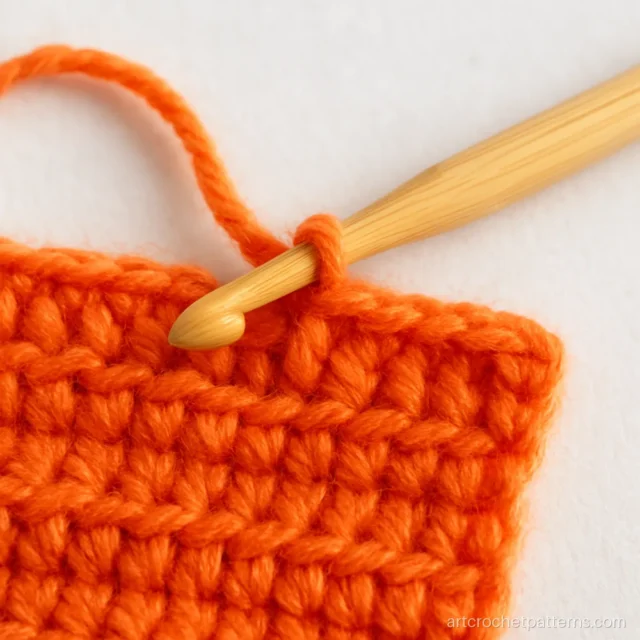
Hook dipping under the stitch
The hook points down and right as it catches the yarn. That dip is what makes the stitch twist.
Maker note: Turn your palm down before you insert the hook. The rest of the motion follows from that.
 LevelBeginnerYarnWorsted acrylicHook5 mm (H-8)
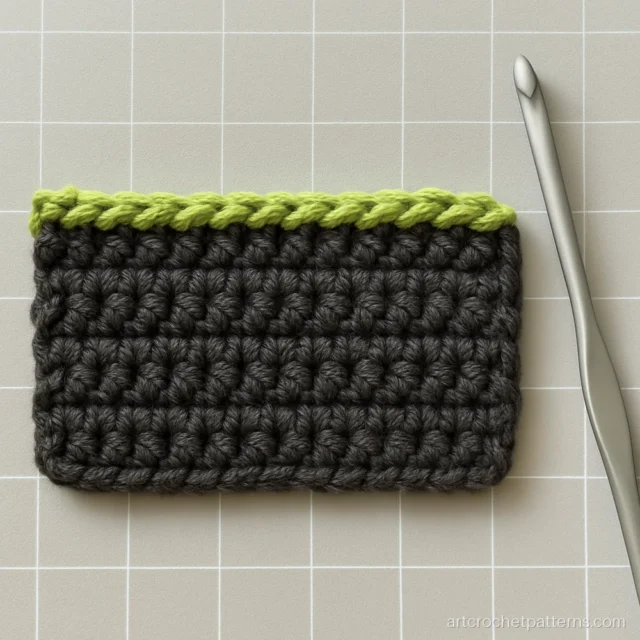
Two tone practice strip
A gray strip of sc topped with one row of rev sc in lime. The bright color shows each little twist.
Maker note: Practice on a strip of 15 stitches. Short rows let you rip back and try again fast.
 LevelEasyYarnDK woolHook4 mm (G-6)
Corded cuff on a lavender mitten
One round of rev sc on a cuff keeps it from stretching out and adds a finished, firm rim.
Maker note: Work the round fairly loose. A tight corded cuff is hard to pull over a hand.
Left handed directions
If you crochet left handed, your normal rows travel from left to right. Your reverse single crochet goes the other way, from right to left. Every step above mirrors: palm down, hook into the stitch on your left, dip, catch, draw through, close. Patterns written for right handers still work, as long as you read every left as right and every right as left.
Practice strip in rev sc
A short strip lets you repeat the motion without the stress of a real project. Each twist shows up best in pale worsted, worked with a 5 mm hook.
- Ch 16.
- Row 1: sc in 2nd ch from hook and in each ch across. Ch 1, turn. (15 sc)
- Rows 2 to 4: sc in each st across. Ch 1, turn. (15 sc)
- Row 5: do not turn after the ch 1. Working back toward the start of the row, rev sc in each st across. (15 rev sc)
- Fasten off.
Rip out Row 5 and work it again two or three times. By the third try, most hands have the motion.
Reverse single crochet compared with plain sc
| Feature | Single crochet | Rev sc |
|---|---|---|
| Direction | Usual row direction | Backward along the same row |
| Turning | Turn each row | Do not turn |
| Top of stitch | Flat V you can work into | Twisted cord, rarely worked into |
| Stretch | Moderate | Low |
| Main use | Fabric and edges | Final finishing row |
Because the top is twisted, you almost never work another row on top of rev sc. It is meant to be the last row.
When the stitch fights back
| Rev sc snag | Root of it | Next attempt |
|---|---|---|
| Loop slides off the hook | Hook throat facing up while you pull | Rotate the throat down before drawing the yarn through |
| No twist, looks like plain sc | Working in the normal direction by habit | Watch that every new stitch lands on the right hand side of its neighbor |
| Hook gets stuck going in | The base row is too tight | Work the base sc row with a larger hook |
| Gaps between bumps | Skipping stitches while reaching right | Move only one stitch at a time |
| Edge wavy | Loops pulled too long | Snug each loop to the hook shaft |
Where to use it
Use rev sc as the last row on washcloths, mitten and sock cuffs, bag openings, and the brim of a bucket hat, where a firm rim helps the brim keep its shape. It also works as the final round of a blanket border. For a softer, lacy finish, look at the crochet borders page instead.
Questions makers ask
Is reverse single crochet the same as crab stitch?
Yes. They are one stitch under two names: sc made in the backward direction, which twists into a cord.
Why is reverse single crochet so hard?
Your hands are trained to move the other way, and the hook has to point downward to catch the yarn. Turning your palm down before each stitch makes it much easier.
Do I turn my work before rev sc?
No. Make a ch 1 and head back the way you came, the same face still toward you.
How is reverse single crochet written in patterns?
Usually as rev sc, sometimes as crab st. The pattern notes should say which edge to work it on and whether to ch 1 first.
Can I work reverse single crochet on double crochet?
It looks best on a row of sc or hdc. On a dc edge, work a row of sc first, then the rev sc row on top.