
Basic crochet stitches are a short list: the chain, the slip stitch, single crochet, half double crochet, double crochet and treble crochet. Almost every pattern you will ever read, from a dishcloth to a lace shawl, is a mix of these six with a few skips and chain spaces added.
The tall ones are all built the same way. Each step up the ladder adds one more wrap of yarn up front, and the extra loops come off in pairs. Learn that logic once and the whole family makes sense. This page compares the stitches side by side, gives the turning chain for each and ends with a sampler that lets you practice them in order on one strip.
At a glance
Skill level
BeginnerStitches covered
ch, sl st, sc, hdc, dc, trYarn to learn with
Light worsted acrylicHook to learn with
5 mm (H-8) or 5.5 mm (I-9)Time
An afternoon for the samplerUK note
US sc = UK dc, US dc = UK tr
The basic crochet stitches at a glance
| Stitch (US) | Abbr. | Yarn overs first | Rough height | Turning chain |
|---|---|---|---|---|
| Chain | ch | None | Base only | None |
| Slip stitch | sl st | None | Almost flat | Usually none |
| Single crochet | sc | None | 1 unit | Ch 1, not counted |
| Half double | hdc | 1 | About 1.5 units | Ch 2, often not counted |
| Double crochet | dc | 1 | 2 units | Ch 3, counted as a dc |
| Treble | tr | 2 | 3 units | Ch 4, counted as a tr |
Turning chain rules differ a little between designers, so the pattern notes are always the final word on whether the chain counts as a stitch.
Chain and slip stitch: the two that hold it together
Everything begins from a slip knot. For a chain, catch the yarn with the hook tip and draw it through the one loop you hold; that is one link. Make each new link match the last in size. The chain is your foundation row, and chains also make spaces and loops inside patterns.
A slip stitch is the shortest stitch there is: hook in, catch the yarn, then one smooth pull carries the new loop through both the stitch and your working loop. Use it to close rounds, to travel along an edge with no added height and to draw lines on the surface.
In pictures
What the work should look like, with the yarn and hook used for each sample.
 LevelBeginnerYarnWorsted acrylicHook5 mm (H-8)
Four-band stitch sampler
Each color band is a different stitch, from short sc at the bottom to tall tr at the top. Seeing them stacked shows how height changes the fabric.
Maker note: Change colors with each new stitch. It makes the heights easy to compare and the rows easy to count.
 LevelBeginnerYarnWorsted cottonHook5.5 mm (I-9)
First chain and slip knot
Every project opens this way, with one slip knot followed by a run of even chains, each a small V.
Maker note: Make chains loose enough that the hook slides back into them easily. Tight chains are the first thing beginners fight.
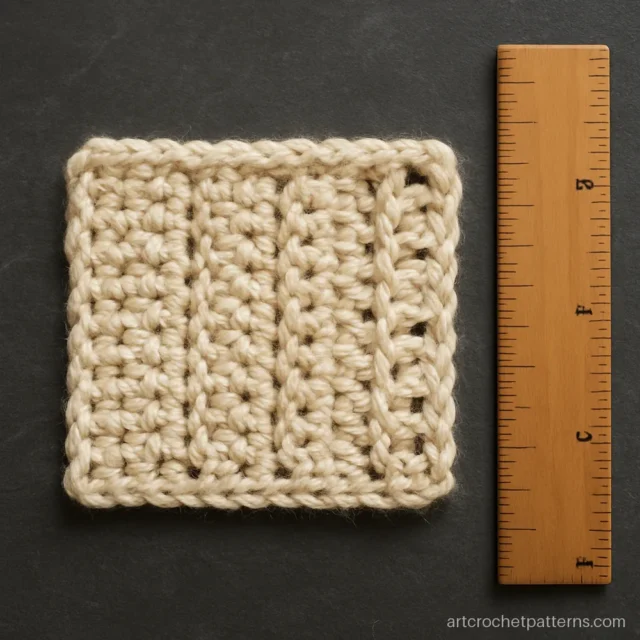 LevelBeginnerYarnWorsted cottonHook5 mm (H-8)
Stitch height comparison
Side by side columns of sc, hdc, dc and tr worked from the same chain show the step up in height each yarn over adds.
Maker note: Lay a ruler beside your swatch. Knowing that a dc row is about twice an sc row helps you plan sizes.
The short pair: sc and hdc
Single crochet (sc) makes a dense, firm fabric with little stretch, the backbone of amigurumi, baskets and washcloths. Hook in, catch the yarn, bring up a loop so 2 sit on the hook, then catch again and clear them both.
Half double crochet (hdc) sits between sc and dc in height. Wrap once before going in and draw up a loop, which leaves 3 on the hook; one more wrap clears the lot in a single pull. That single pull-through is what makes it a "half" stitch, and it gives a soft fabric with a ridge on the back that many makers love for hats.
The tall pair: dc and tr
Double crochet (dc) is the stitch most blankets and granny squares rely on. Wrap once, go in and draw up a loop for 3 on the hook. Clear them in two passes, two loops each time. It is twice the height of sc, so pieces grow quickly and drape more.
Treble crochet (tr) starts with two wraps. Once the new loop is up, 4 wait on the hook, and three passes of two loops each finish it. Trebles show up in lace, shells and open shawls. Once you have the tr, an even taller stitch, the double treble, simply adds one more wrap.
Beginner crochet stitches sampler
Work this strip to practice each stitch and its turning chain in turn. A light-colored worsted acrylic and an H-8 hook suit it well. Changing color at each new stitch makes the bands easy to see.
- Ch 16.
- Row 1: Sc in 2nd ch from hook and in each ch across. Turn. (15)
- Rows 2 to 4: Ch 1 (does not count), sc in each st across. Turn. (15)
- Row 5: Ch 2 (does not count), hdc in each st across. Turn. (15)
- Rows 6 to 8: Rep Row 5. (15)
- Row 9: Ch 3 (counts as dc), sk first st, dc in each st across. Turn. (15)
- Row 10: Ch 3 (counts as dc), sk first st, dc in each st across, working the last dc in the top of the turning ch. Turn. (15)
- Row 11: Ch 4 (counts as tr), sk first st, tr in each st across, working the last tr in the top of the turning ch. Turn. (15)
- Row 12: Rep Row 11. (15)
- Row 13: Ch 1 (does not count), sc in each st across, working the last sc in the top of the turning ch. (15) Fasten off.
Count to 15 on every row. If you end with 14 or 16, the turning chain is the usual suspect: either you worked into the first stitch when the chain already counted, or you missed the top of the old turning chain.
Crochet stitches for beginners: US and UK names
The same stitch has a different name in UK patterns, which trips up a lot of new makers.
- US single crochet (sc) = UK double crochet (dc)
- US half double (hdc) = UK half treble (htr)
- US double crochet (dc) = UK treble (tr)
- US treble (tr) = UK double treble (dtr)
- Chain and slip stitch keep the same names
A quick test: if the pattern uses sc anywhere, it is in US terms. UK patterns have no sc. Keep our crochet abbreviations chart close while you read.
Mistakes new crocheters make with basic stitches
| Snag | Where it comes from | Next time |
|---|---|---|
| Rows get wider | An extra stitch in the first or last st | Clip markers at both row edges so you always know where to stop |
| Rows get narrower | Last stitch missed, often hidden by the turning chain | Find the old turning chain's top link and put the last stitch there |
| Fabric too stiff | Tight hands or a small hook | Size the hook up and let the yarn run more freely through your fingers |
| Uneven heights | Loops pulled up to different lengths | Lift each first loop to match the hook shaft |
| Foundation chain twists | Links made too small | Chain the base using the next size up, and switch back for row 1 |
Where to go after the basics
With these six stitches you can already make most beginner projects. Try a flat circle starting from a magic ring, a simple scarf, or a classic granny square. When you want new textures, combine them: alternating sc and ch 1 makes moss stitch, and working dc around posts makes ribbing. Our crochet patterns for beginners list is sorted by the stitches each project uses, and the full lesson on how to crochet covers holding the hook and yarn.
Questions makers ask
What are the basic crochet stitches?
The chain, slip stitch, single crochet, half double crochet, double crochet and treble crochet. Most patterns are built from these six, plus increases, decreases and skips.
Which crochet stitch should a beginner learn first?
Learn the chain first, because every project starts with one. Then single crochet, which teaches you to read stitch tops and count. Double crochet usually comes next.
Which of these is simplest?
The chain takes the least effort, and sc is the gentlest way to make actual fabric. Many beginners find half double crochet quick to learn once sc feels natural.
How quickly will I pick up all six?
Most people can make a chain and single crochet in the first hour. Getting even tension across all six stitches takes a few weeks of regular practice, often over two or three small projects.
Why are US and UK crochet stitch names different?
The two systems name stitches by different counts. Broadly, the US names track how the stitch is finished off, and the UK names track how many loops are waiting once the first loop is drawn up. The stitches themselves are the same.
Is a fancy hook worth it while learning?
Not at first. A plain H-8 or I-9 with worsted yarn teaches everything here. If your hand cramps, a hook with a thick cushioned handle is the first upgrade to try.