
Here is how to change colors in crochet so the new shade starts exactly where you want it, with no half stitch of the old color peeking out. The secret is timing. You bring in the new yarn while you finish the last loops of the stitch before, not after it.
This lesson covers the color change for single, half double and double crochet, swapping shades on a row's final stitch for stripes, joining a new color in rounds, and what to do with all those tails. If you still need the basic stitches, the how to crochet lessons cover them first.
At a glance
Skill level
Advanced beginnerYou need
Two colors of the same weight and fiberHook
The size on your yarn labelTime to learn
About 20 minutes of practiceGood for
Stripes, granny squares, amigurumi, tapestry
How to change colors in crochet: the last loop method
Every neat color change follows one rule. Work the last stitch in the old color until only the final yarn over is left. Then make that final yarn over with the new color. The loop that sits on your hook afterward is the new color, so the next stitch is clean from its very top.
- Stop one step early. Begin the last old color stitch as normal and stop when you have the final loops left on the hook (two loops for single crochet).
- Drop the old strand. Let it hang at the back of the work. Do not cut it yet.
- Grab the new color. Leave a 6 inch tail, lay it over the hook and pull it through all the loops on the hook.
- Check the top. The loop on your hook should be the new shade only. The stitch below it is fully the old shade.
- Snug the tails. Give both ends a gentle tug, then keep working with the new yarn.
Where the switch happens in each stitch
The rule is the same, but the point where you swap depends on how tall the stitch is. Use this table while you practice.
| Stitch (US) | Loops left when you swap | What you pull the new color through |
|---|---|---|
| Single crochet (UK double crochet) | 2 | Both loops |
| Half double crochet | 3 | All three loops |
| Double crochet (UK treble) | 2, after the first pull through | The last two loops |
| Treble crochet | 2, after two pull throughs | The last two loops |
| Slip stitch | 1 plus the new loop | Use the new color for the slip stitch itself |
For a refresher on how each stitch is built, the crochet stitches guide shows them one at a time.
In pictures
What the work should look like, with the yarn and hook used for each sample.
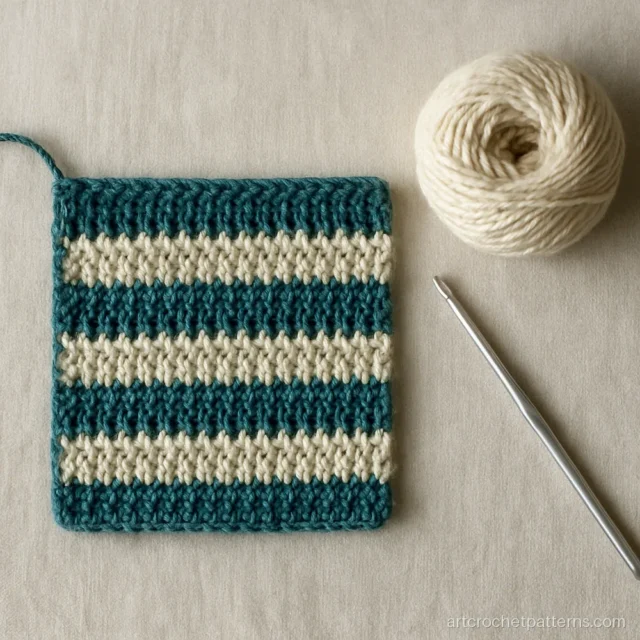 LevelBeginnerYarnWorsted cottonHook5 mm (H-8)
Single crochet stripe swatch in teal and cream
Each stripe is two rows tall, so the unused color is carried up the side instead of cut. The edge stays neat if you keep the carried strand loose.
Maker note: Change on the final yarn over of the last stitch, then chain 1 and turn with the new color already on your hook.
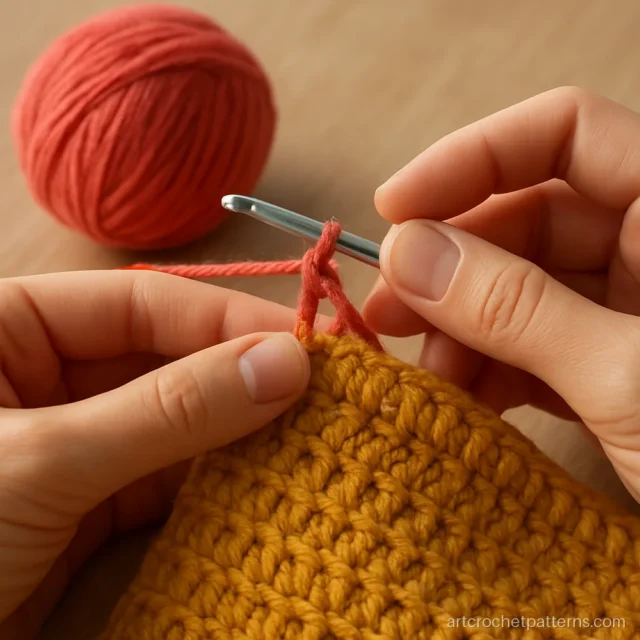 LevelBeginnerYarnWorsted acrylicHook5.5 mm (I-9)
Hands finishing a double crochet in a new color
Two loops of mustard sit on the hook while the coral strand is pulled through. That final pull is the moment the color change happens.
Maker note: Hold both tails against the back of the work with your middle finger so the first new stitch stays snug.
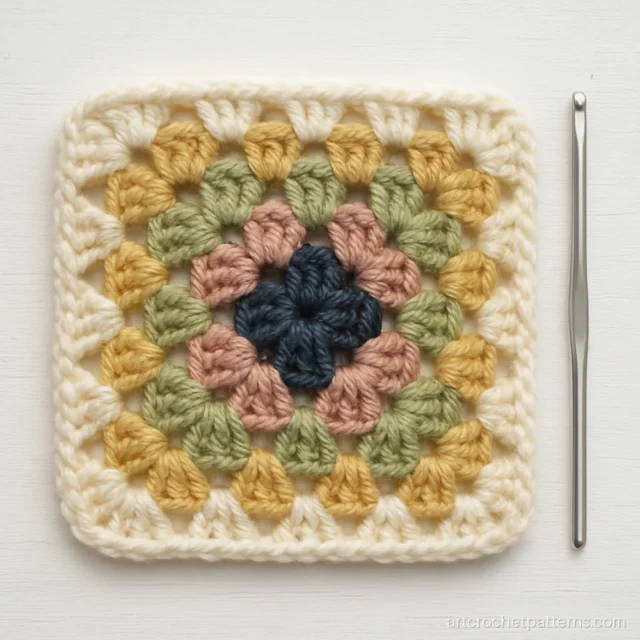 LevelEasyYarnDK acrylicHook4.5 mm (7)
Granny square with a new color each round
Every round of this square starts in a fresh corner, so no seam lines up across the square. It is a simple trick that makes a colorful square look tidy.
Maker note: Start each new color with a standing double crochet in a corner space and you can skip the chain 3 entirely.
Stripes: switching colors at the row edge
Stripes are the friendliest way to practice changing colors in crochet. Make the swap in the last stitch of the row, before the turning chain. Then the chain is already in the new color and the edge stays straight.
- Even number of rows per stripe: you always arrive back at the same edge, so you can carry the resting color up the side. Twist the two strands once at the start of each stripe to trap it.
- Odd number of rows: the next stripe begins at the far edge, so cut the old color and leave a tail to weave in.
- Long carries: if a color rests for more than about 1 inch of rows, cut it. Long loops along the side snag on fingers and buttons.
Striped blankets use exactly this move hundreds of times, so it pays to get it smooth on a small swatch first.
Practice swatch: two row stripes
Work this small swatch to learn the rhythm. You need two colors of worsted weight yarn and a hook of 5 mm (H-8). Totals in brackets skip the turning ch 1.
- With color A, ch 16.
- Row 1: sc in 2nd ch from hook and in each ch across (15).
- Row 2: ch 1, turn, sc in each st across, changing to color B on the final yarn over of the last sc (15).
- Rows 3 and 4: with color B, ch 1, turn, sc in each st across; on row 4 change to color A on the last sc (15).
- Rows 5 to 16: continue the stripes, working 2 rows in A and 2 rows in B, changing on the last sc of every second row and carrying the unused color up the side (15).
- Fasten off and weave in the ends.
When you finish, look at the right edge. The carried strands should lie flat, with no loops sticking out.
Invisible color change in crochet rounds
Rounds need a different approach because you join at the end of each one. For joined rounds, finish the last stitch in the old color, drop it, and work the joining slip stitch with the new color. The join then belongs to the new round.
For the cleanest start of all, fasten off the old color and begin the new one with a standing stitch. Tie a slip knot, place it on your hook, then work a single or double crochet straight into the stitch without chaining. It sits like any other stitch, so the seam nearly disappears.
Spiral rounds in amigurumi
In spiral rounds, a stripe ends in a small step where the last round meets the first. To soften it, change color in the last stitch, then work the first stitch of the new color as a slip stitch instead of a single crochet. On the next round, work a single crochet into that slip stitch as usual. Many amigurumi patterns also tell you where to place the change so it sits at the back of the toy.
When a color switch goes wrong
| Snag | Reason | Remedy |
|---|---|---|
| A dot of the old color on the first new stitch | The change was made after the stitch was complete | Swap on the final yarn over of the previous stitch |
| A loose, gappy first stitch | The new tail was not held | Pinch both tails at the back for the first two stitches |
| Puckered edge on a striped blanket | The carried strand is pulled too tight | Let the carried yarn lie flat, then stretch the edge gently |
| Joins all stacked in one line | Every round starts in the same place | Rotate the starting point for every new shade |
| The new color bleeds in the wash | Strong reds and navies can release dye | Wash a test swatch first, following the yarn label |
Handling the tails after switching yarn colors
Each color change leaves two tails. You can save a lot of finishing time by working over them. After the switch, lay both tails along the tops of the next stitches and crochet around them for 6 to 8 stitches. Trim what is left. On a reversible piece, or with slippery cotton, also weave the ends through by needle.
Avoid tying the two colors in a tight knot. Knots work loose over time and leave a hard lump. The weaving in ends lesson shows how to hide tails so they stay put, and fastening off explains how to end a color you will not use again.
Questions makers ask
How do you change colors in crochet neatly?
Pick up the new strand for the closing yarn over of the stitch just ahead of where it should show. Hold both tails at the back for the first few stitches, then work over them or weave them in. That timing gives a straight, clean line.
Do I need to tie a knot when I change yarn color?
No. A knot is not needed and often makes a bump. Working over the tails or weaving them in through several stitches holds the color securely.
What is an invisible color change in crochet?
It usually means a join where you cannot see where the round began. A standing stitch worked from a slip knot, or a color change made on the joining slip stitch, gives that seamless look in rounds.
Can I switch colors partway across a row?
Yes. It works the same way: swap strands for the closing yarn over of the stitch just ahead of the new shade. For picture work, rest the idle strand across the row and trap it inside each new stitch, as in tapestry crochet.
How long should the yarn tails be?
Leave about 6 inches. That is long enough to thread on a tapestry needle and weave in, and short enough not to tangle while you work.
Should I cut the yarn each time I change colors?
Only when the old color will not be used again soon. For stripes of two or four rows, carry it up the side. Cut it if it would rest for more than about an inch of fabric.