
A crochet scarf is the project most of us finish first, and this page gives you six design ideas plus a full written pattern you can start tonight. The pattern uses one stitch, half double crochet, worked back and forth in rows until the scarf is as long as you want.
Scarves are forgiving. There is no shaping, no seaming and no fit to worry about, so all your attention goes to even tension and straight edges. Once you have one done, the same row method opens the door to ribbed, striped, triangle and Tunisian versions.
New to the hook? Practice the chain, single crochet and half double with our beginner lessons before you cast on this scarf.
At a glance
Skill level
BeginnerYarn
Worsted (4) acrylic or wool blend, about 400 yardsHook
6 mm (J-10)Time
6 to 10 hoursStitches used
ch, hdc, sl stFinished size
About 7 by 60 inches
6 crochet scarf designs to make
Every design lists the skill level, yarn and hook, with a note from the maker.
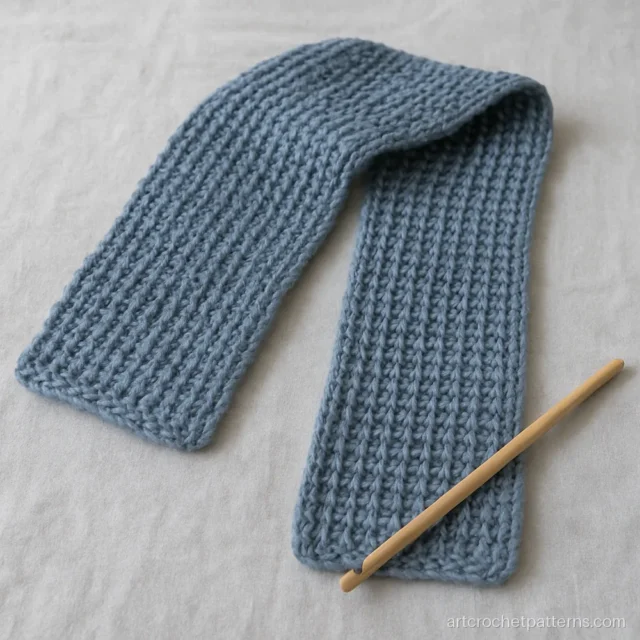
 LevelEasyYarnBulky (5) woolHook9 mm (M/N-13)
Chunky ribbed scarf in mustard
Hdc worked through just the far loop gives soft ridges that look knitted. Bulky wool on a 9 mm hook finishes in a weekend.
Maker note: Work the ribs lengthwise: chain the full scarf length and crochet short rows so the ridges run from end to end.
 LevelIntermediateYarnWorsted (4) merinoHook6.5 mm Tunisian hook
Tunisian simple stitch scarf
Tunisian simple stitch makes a firm fabric that looks woven. It suits a crocheter who wants a neat, flat scarf with a tailored feel.
Maker note: Tunisian fabric curls toward you, so size the hook up well past the label, often a full 6.5 mm with worsted merino.
 LevelBeginnerYarnWorsted (4) wool blendHook5.5 mm (I-9)
Two color striped scarf for men
Wide stripes in dark neutrals keep the look plain and classic. Single crochet gives a dense, wind blocking fabric.
Maker note: Swap shades during the closing yarn over of each stripe's final sc, then float the idle strand up the side edge.
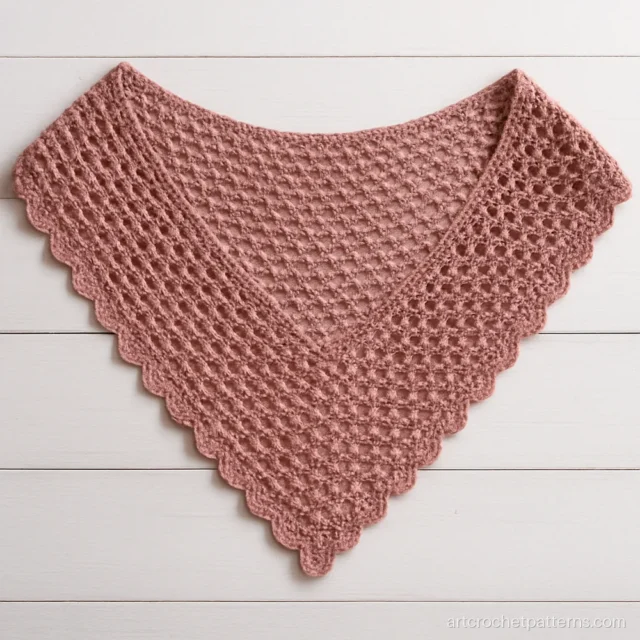 LevelEasyYarnLight (3) DK cotton blendHook5 mm (H-8)
Lacy triangle scarf
A triangle scarf starts at one point and grows two stitches each row. Wear it knotted at the front like a kerchief.
Maker note: Clip a bright ring onto the middle stitch of each row; that is where the increase goes.
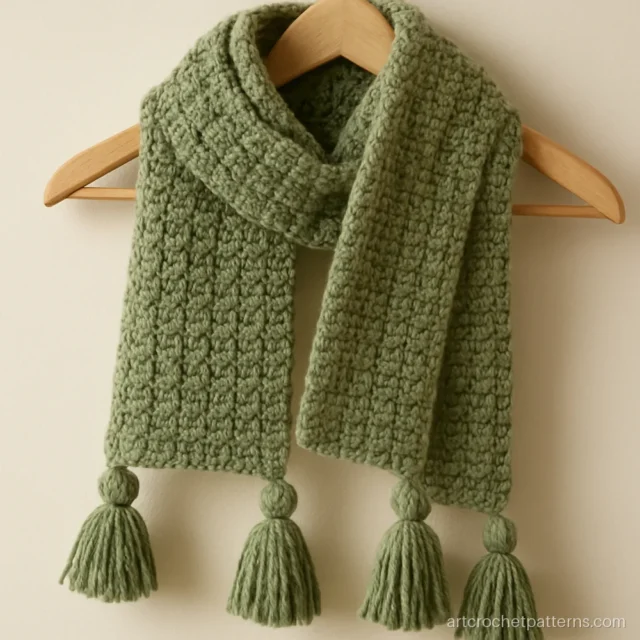 LevelBeginnerYarnWorsted (4) acrylicHook5.5 mm (I-9)
Moss stitch scarf with tassels
Moss stitch alternates single crochet and chain one, so the fabric lies flat and drapes well. Corner tassels add a modern touch.
Maker note: Each sc lands in the ch 1 gap of the row below, not on top of a stitch, or the moss grid will slant.
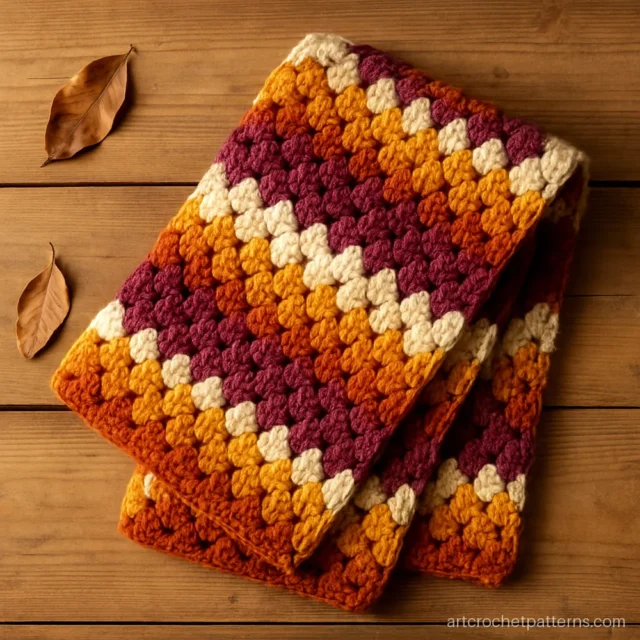 LevelEasyYarnWorsted (4) wool scrapsHook5 mm (H-8)
Granny stripe scrap scarf
Granny stripes nest each 3 dc group in the gap between two groups of the previous row. Every two rows is a good place to change color.
Maker note: Sew in tails every two stripes, so the finishing does not pile up when the scarf is long.
Easy crochet scarf pattern in half double crochet
This is the scarf to make if you have never finished a project. Half double crochet is taller than single crochet, so the scarf grows faster, but it is still dense enough to keep wind off your neck.
Materials
- Around 400 yards of medium (4) scarf yarn; soft acrylic or an acrylic and wool blend washes easily
- 6 mm (J-10) hook
- Yarn needle and scissors
Scarf gauge
Fourteen hdc across and ten rows up fill a 4 inch square. That gives a scarf roughly 7 by 60 inches, fringe not included. A scarf does not need exact gauge, though a looser or tighter hand changes how much yarn you use.
- Foundation: ch 26.
- Row 1: hdc in the 3rd ch from the hook and in each ch across. The skipped 2 ch do not count as a stitch. (24)
- Row 2: ch 2 (does not count as a stitch), turn. Hdc in the first st and in each st across, ending in the last hdc of the row below. (24)
- Rows 3 to 150: repeat Row 2. Count your stitches every 10 rows. (24)
- Finish: ch 1, sl st in each st across the last row for a firm end. Fasten off. (24 sl st)
Weave in the two tails by running them along the inside of the end rows for at least 3 inches, then back the other way. If you want fringe, cut 48 pieces of yarn 10 inches long and knot two pieces through every other stitch at each end.
How to crochet a scarf for beginners: the habits that matter
Most first scarves go wrong in the same two places: the edges and the tension. These habits fix both.
- Find the last stitch. The final hdc of each row sits right next to the ch 2. It is small and easy to miss, so look for it before you turn.
- Do not work into the turning chain. In this pattern the ch 2 does not count, so skipping it keeps the count at 24.
- Mark the first stitch. Clip a stitch marker into the first hdc of each row. When you reach the end of the next row, the marker shows you exactly where to stop.
- Hold the yarn the same way each time. Loop the working strand once around your pinkie, then lay it over your pointer finger. Steady tension keeps the scarf the same width from end to end.
- Measure flat. Lay the scarf on a table to check width and length, not hanging from the hook, where it stretches.
Want a different look with the same skills? Swap hdc for single crochet for a tighter fabric, which is what a single crochet scarf is, or try the stitches on our crochet stitches page.
Choosing yarn and hook for scarf patterns
A scarf sits against the neck and chin, so softness matters more than on a bag or a blanket. Rub the yarn on the inside of your wrist before you buy it.
| Scarf yarn | Hook that suits it | What the scarf feels like |
|---|---|---|
| DK, weight 3 | H-8 (5 mm) or a 4.5 | Thin, drapey scarf for fall; takes longer |
| Worsted, weight 4 | J-10 (6 mm) or a 5.5 | Classic all season weight; the best place to start |
| Bulky, weight 5 | L-11 (8 mm) or M/N-13 (9 mm) | Thick, cozy, quick; about half the rows of worsted |
| Super bulky, weight 6 | Anything from 10 mm up | Very chunky wrap scarf in a few evenings |
Wool is the warmest and blocks flat beautifully. Acrylic is washable and gentle on a beginner budget. Fuzzy and chenille yarns feel lovely but hide your stitches, so save them for your second or third scarf.
Scarf troubleshooting
| Scarf symptom | Usual cause | Cure |
|---|---|---|
| Scarf gets narrower | The final hdc beside the turning chain keeps getting missed | Count every 10 rows; a marker in the first hdc shows the row start |
| Scarf gets wider | Working into the turning chain as an extra stitch | Skip the ch 2 when the pattern says it does not count |
| Wavy or rippled sides | Tension changes as you relax into the project | Check the width every evening and frog back to where it changed |
| Foundation end is tight and puckered | The starting chain was made too tight | Chain the 26 loosely on a 6.5 mm, then switch to the J-10 for Row 1 |
| Fabric is stiff like cardboard | The hook runs small for this yarn | Swatch again on a 6.5 mm and compare the drape |
More scarf ideas: triangle, Tunisian, modern and hooded
When the plain row scarf feels easy, try one of these.
- Crochet triangle scarf. Start with a few chains, then increase at both edges or at a center point every row. A light DK cotton makes a kerchief style scarf for spring.
- Tunisian crochet scarf. You pick up a row of loops onto a long hook, then work them off. The fabric is thick and even. Expect some curl and block it flat when done.
- Modern crochet scarf patterns. Think oversized, color blocked panels, long tassels or a ribbed texture in one muted shade. Bulky yarn and simple stitches read as current.
- Crochet hooded scarf. A hood sewn into the middle of a long scarf keeps ears warm without a hat. Our hooded scarf crochet pattern shows the folding and seaming.
- A loop instead of ends. Join the two short ends and you have a cowl or infinity scarf. See the infinity scarf crochet page and the shorter crochet cowl.
For something to wear with your new scarf, work a crochet beanie from whatever is left of your scarf skeins. All our wearable gift ideas live in crochet accessories.
Scarf lengths and widths
There is no single right size. These numbers are common starting points; measure the person who will wear it if you can.
| Wearer | Width | Length |
|---|---|---|
| Small kid | 4 to 5 inches | 32 to 42 inches |
| Older kid and teen | 5 to 6 inches | 45 to 55 inches |
| Adult | 6 to 8 inches | 60 to 72 inches |
| Men's wrap around twice | 7 to 9 inches | 70 to 80 inches |
A rough rule: a finished scarf is long enough when it reaches from the floor to the top of the wearer's head. To change the width of the pattern above, chain any number you like plus 2; each extra stitch adds about a quarter inch.
Questions makers ask
How many hours will my first scarf take?
A worsted scarf in half double crochet takes most beginners 6 to 10 hours. Bulky yarn on a 9 mm hook can be done in 3 or 4 hours. Taller stitches such as double crochet are faster than single crochet.
How many yards go into an adult scarf?
Plan on 350 to 450 yards of worsted yarn for an adult scarf about 7 by 60 inches. Add about 50 yards for fringe. Bulky yarn has fewer yards per ball, so check the yardage rather than the number of balls.
What is the easiest stitch for a crochet scarf?
Half double crochet is the easiest balance of speed and neat fabric. Single crochet is simpler to learn but makes a slower, stiffer scarf. Double crochet is quick but leaves small gaps that let wind through.
Why is my scarf curling at the edges?
Single crochet and Tunisian stitches often curl when the hook is too small. Go up a hook size, or wet block the finished scarf by soaking it, pressing out the water and pinning it flat to dry.
Should a men's scarf crochet pattern be different?
Usually it is just wider and longer, about 8 by 75 inches, in darker or neutral colors. Keep the texture simple, such as ribbing or wide stripes, and skip the fringe unless he asks for it.
Can I use a crochet blanket pattern stitch for a scarf?
Yes. Any stitch pattern worked in rows can become a scarf. Find the stitch multiple in the blanket pattern, chain a number that fits it and gives about 7 inches, and work until the scarf is long enough.