
A chevron crochet pattern turns straight rows into sharp zigzags by stacking increases at the peaks and decreases in the valleys. Every row follows the same short repeat, so once you have worked two rows you can crochet the rest while you chat or watch a show.
Below you will find six original chevron ideas, then a complete chevron crochet blanket pattern in double crochet with stitch counts on every row, a size chart from stroller to twin, and the mistakes that make zigzags go flat.
At a glance
Skill level
EasyYarn
Worsted acrylic or cotton blendHook
5 mm (H-8)Stitches used
Ch, dc, dc2togRepeat
Multiple of 12 stitchesTime
20 to 30 hours for a baby blanket
6 chevron crochet pattern designs to make
Every design lists the skill level, yarn and hook, with a note from the maker.
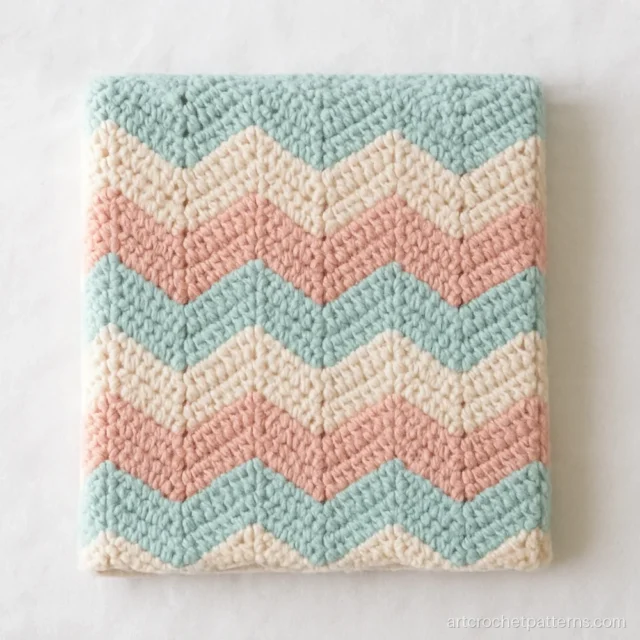 LevelEasyYarnDK acrylicHook4.5 mm (7)
Pastel stripe baby blanket
Four row stripes in three soft colors keep the zigzag gentle. A stroller size uses nine waves across.
Maker note: Carry no strands up the side on baby items; cut and weave each color so nothing snags.
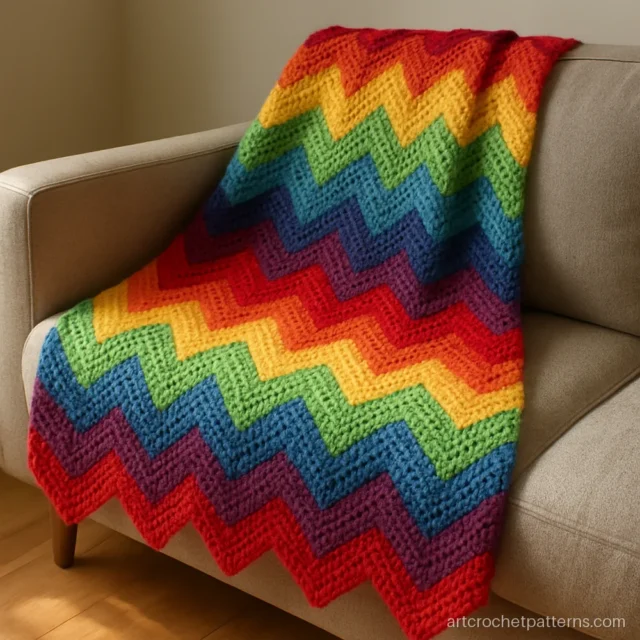 LevelEasyYarnWorsted acrylicHook5 mm (H-8)
Bold rainbow chevron throw
Two rows per color give quick, punchy bands. Seven colors repeat cleanly on a throw size.
Maker note: Lay all seven balls in order on the floor before you start so the color sequence never slips.
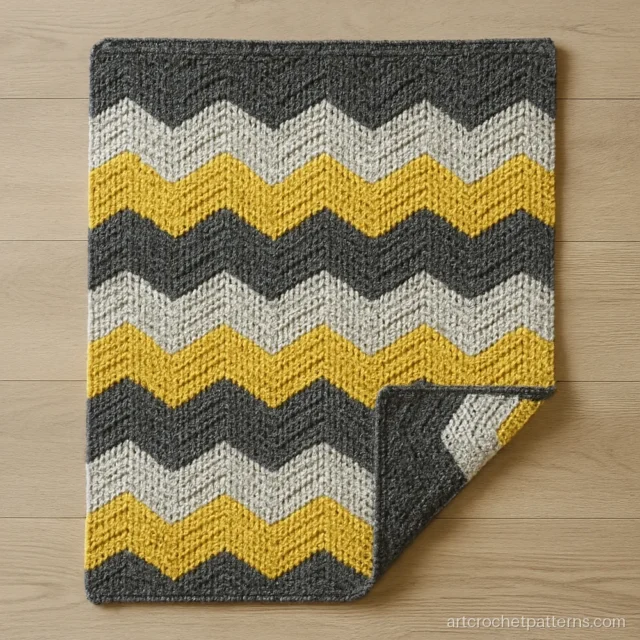 LevelEasyYarnWorsted wool blendHook5.5 mm (I-9)
Modern gray and mustard blanket
A neutral palette with one warm accent suits a living room. Wide gray bands frame a thin mustard stripe.
Maker note: Wool blends block beautifully, so pin each peak to a point and let it dry flat.
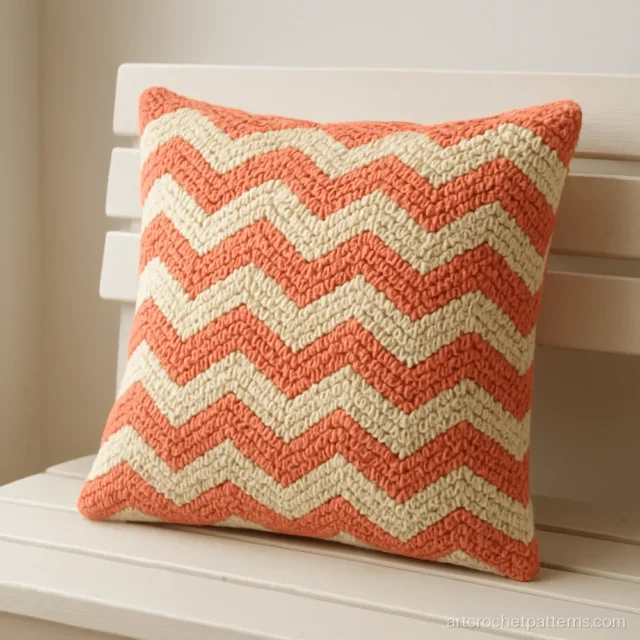 LevelEasyYarnWorsted cottonHook5 mm (H-8)
Coral and white cushion cover
Two matching panels sewn on three sides make a simple pillow. Cotton keeps the zigzags crisp.
Maker note: Make the panel a little smaller than the insert so the fabric stretches tight and the stripes stay straight.
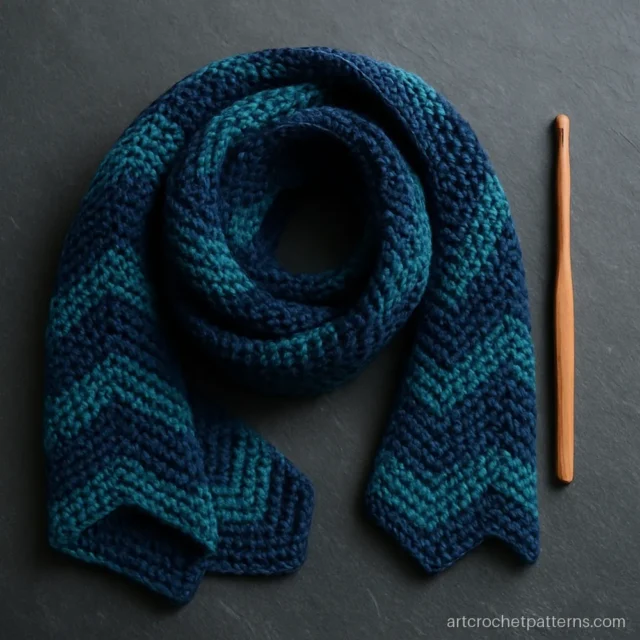 LevelEasyYarnAran acrylicHook5.5 mm (I-9)
Narrow chevron scarf
Just two waves wide, worked lengthwise in short rows. A good second project after a dishcloth.
Maker note: Use 24 stitches for two waves and stripe every six rows for a scarf that looks planned.
 LevelEasyYarnWorsted cottonHook4.5 mm (7)
Single crochet chevron dishcloth
Single crochet makes a tight, scrubby zigzag that holds up to daily washing.
Maker note: Work in the back loop for ridges that grab crumbs better on the scrubbing side.
How a chevron crochet pattern makes its points
Each repeat in a crochet chevron pattern has four parts: plain stitches climbing up, two increases at the peak, plain stitches going down, and two decreases at the valley. The increases add 2 stitches and the decreases remove 2, so the count never changes from row to row.
The repeat on this page is 12 stitches wide. The edges start and end on half a peak, which keeps the sides of the blanket straight. A ripple uses the same idea with softer, rounded curves; see the ripple crochet pattern and the wave crochet pattern for gentler shapes.
Free chevron crochet blanket pattern (stroller size)
Finished size: about 30 by 35 inches before border.
Yarn: about 1,000 yards of worsted acrylic in 3 colors (A, B, C).
Hook: 5 mm (H-8). Notions: tapestry needle, scissors.
Gauge: 14 dc and 7 rows = 4 inches in plain dc.
Special stitch: dc2tog = (yo, insert in next st, pull up a loop, yo, pull through 2) twice, yo, pull through all 3 loops.
- With A, ch 110.
- Row 1: Dc in 4th ch from hook and in each ch across. The skipped 3 ch count as the first dc. (108)
- Row 2: Ch 3 (counts as dc), turn. Dc in first st. *Dc in next 3 sts, [dc2tog] twice, dc in next 3 sts, 2 dc in each of next 2 sts; rep from * 7 more times. Dc in next 3 sts, [dc2tog] twice, dc in next 3 sts, 2 dc in top of turning ch. (108)
- Rows 3 and 4: Rep Row 2. (108)
- Rows 5 to 8: Change to B and rep Row 2. (108)
- Rows 9 to 12: Change to C and rep Row 2. (108)
- Continue repeating Row 2, changing color every 4 rows in the order A, B, C, until the blanket measures about 35 inches from the point of a peak. End after a full stripe.
- Fasten off and weave in all ends.
Finishing: work a round of sc along the two straight sides only, putting 2 sc around each dc post. Leave the zigzag top and bottom as they are, or follow one of the blanket borders that follow the points. Let the fresh shade make the final pull through of the closing dc of a row so each stripe starts clean; the guide to changing colors shows the move.
Sizing the chevron crochet blanket for any bed
Keep the stitch count a multiple of 12 and chain 2 more than the stitch count. Widths below assume the gauge above and include the slight pull in from the zigzag. Row 2 repeat counts are for the starred section.
| Size | Chain | Stitches | Waves | Rep * total | About wide |
|---|---|---|---|---|---|
| Stroller | 110 | 108 | 9 | 8 | 30 in |
| Crib | 158 | 156 | 13 | 12 | 44 in |
| Throw | 170 | 168 | 14 | 13 | 48 in |
| Twin | 230 | 228 | 19 | 18 | 64 in |
Check the blanket sizes chart for lengths, and swatch first. Your own tension decides the real width.
Yarn, hook and color planning
| Yarn | Hook | Result |
|---|---|---|
| DK acrylic | 4.5 mm | Soft baby blanket with fine, light points |
| Worsted acrylic | 5 mm | Classic washable blanket |
| Worsted cotton | 5 mm | Crisp, heavy pillow or summer throw |
| Chunky wool blend | 6.5 mm | Fast, thick throw with bold zigzags |
Stripes of 2 rows look busy and modern; 4 to 6 rows look calm. Pick one light shade to break up darker bands so the points read from across the room. Solid or lightly heathered yarn shows the chevron best. Variegated yarn can fight the zigzag.
When the zigzag goes wrong
| What you see | Cause | Repair |
|---|---|---|
| Points flatten out over several rows | Increases or decreases were moved one stitch off | Count the 3 plain stitches before each peak and valley |
| Blanket gets wider | An extra stitch slipped in at the edge | Finish each row with exactly 2 dc into the ch 3 you turned with on the row below |
| Sides look ragged | Turning chain worked too loose | Snug the ch 3, or use a stacked first dc |
| Holes in the valleys | Loose dc2tog | Pull the final loop firmly through all 3 loops |
Ideas for a crochet chevron blanket and more
Try an ombre in five shades of one color, stepping lighter every six rows. Work a single crochet version for a tighter fabric: use the same 12 stitch repeat with sc and sc2tog. For texture, alternate one row in the back loop only. Scraps also work well, since a chevron hides small color jumps better than plain stripes. For more blanket stitches to mix in, browse all crochet stitches.
Questions makers ask
Is a chevron crochet pattern good for beginners?
The zigzag asks only for dc and dc2tog, so a newer maker who has finished a scarf or two can manage it. The repeat is short and every row is the same. Count each repeat for the first few rows until the rhythm feels natural.
What is the difference between chevron and ripple crochet?
A chevron has sharp points made with stacked increases and decreases. A ripple has rounded curves, often made with clusters or graded stitch heights. Plenty of makers swap the two words freely.
How do I make my chevron blanket wider?
Add 12 stitches, which means 12 more chains, for each extra wave. Add one more starred repeat in Row 2 for every 12 stitches you add.
How much yarn does a chevron crochet blanket need?
A stroller size in worsted uses about 1,000 yards. A throw needs roughly 2,500 to 3,000 yards. Buy all of one color from the same dye lot.
Why are my chevron points not sharp?
Loose stitches at the peaks and valleys soften the shape. Pull decreases snug and block the finished blanket, pinning each peak to a point.
Should I carry yarn up the side between stripes?
On 2 row stripes you can carry yarn up the edge and cover it with a border. On baby blankets, cut the yarn and weave in ends so there are no long loops.