
The crochet meaning is simple: crochet is a way of making fabric by pulling loops of yarn or thread through other loops with a single hook. The word itself comes from French, where crochet means a small hook. This page covers the definition, the spelling and sound of the word, and what we know about where the craft began.
The history is less certain than the word. Hooked needlework has many possible roots, and crochet as most people know it took shape in Europe in the early nineteenth century.
At a glance
Definition
Fabric made with one hook, one loop at a timeSay it
kroh SHAYWord origin
French for small hookBecame popular
Europe, early nineteenth centuryVerb forms
crochet, crocheted, crocheting
Crochet meaning in one sentence
Crochet is a needlecraft in which you make fabric by drawing yarn through loops already made, using a hooked tool. Only one loop stays live at a time. That is what sets it apart from knitting, which keeps a whole row of loops on its needles.
The word works as both a noun and a verb. You can admire a piece of crochet, and you can crochet a hat. Someone who crochets is a crocheter.
How to spell and say crochet
| Form | Spelling | Say it |
|---|---|---|
| Base word | crochet | kroh SHAY |
| Past tense | crocheted | kroh SHAYD |
| Present participle | crocheting | kroh SHAY ing |
| Person | crocheter | kroh SHAY er |
The t at the end is silent, as in many words borrowed from French such as ballet and bouquet. A common misspelling is crotchet, which is a different word. In British music, a crotchet is a quarter note. Its spelling has a t before the ch, and it is said KROTCH it.
In pictures
What the work should look like, with the yarn and hook used for each sample.
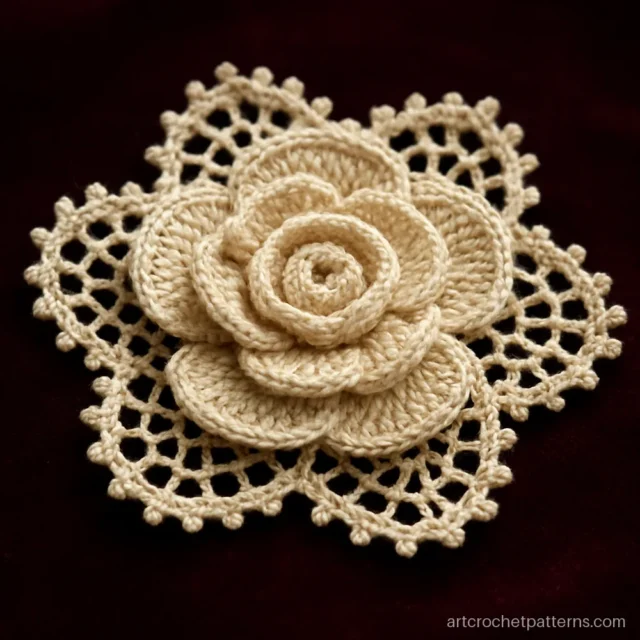 LevelAdvancedYarnSize 20 cotton threadHookSteel 10 (1.3 mm)
Irish crochet rose motif
Layered petals over a padded cord, in the style of Irish crochet lace. This kind of work once helped many families earn a living.
Maker note: Work each petal layer behind the last so the rose stands up off the background.
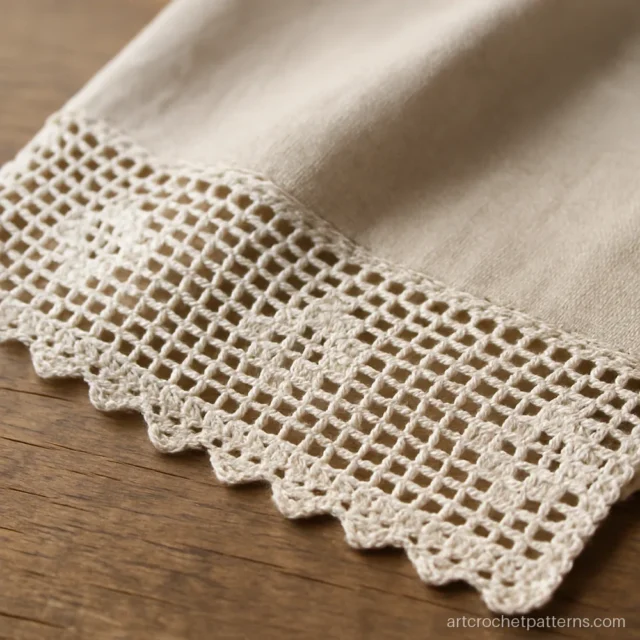 LevelIntermediateYarnSize 10 cotton threadHookSteel 7 (1.65 mm)
Filet crochet edging on linen
Filet crochet builds pictures from open and filled squares. It was a common way to trim household linens.
Maker note: Each square is a double crochet and two chains, or three double crochet for a filled block.
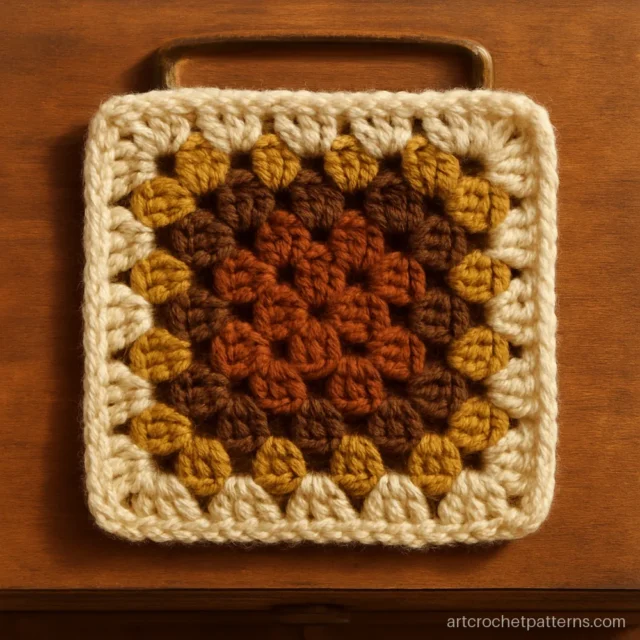 LevelEasyYarnWorsted acrylicHook5 mm (H-8)
Retro granny square
The granny square became a symbol of home crochet in the twentieth century. Three dc clusters and chain corners have barely changed since.
Maker note: Start every new shade inside a corner gap; the cluster hides the join.
Where the word crochet comes from
English borrowed crochet from French, where it means a small hook. It is the diminutive of an older French word for hook, croc, which likely came into French from an early Norse word for a hook or a bend. The same root likely gave English the word crook, as in a shepherd's hooked staff, and crotchet, a musical note whose name also traces back to a hook.
French speakers once called the craft crochet work, or work done with a little hook. English kept just the tool's name for the whole craft.
Where did crochet originate?
Nobody knows for certain, because yarn rots and early crochet left few traces. There are several ideas:
- Tambour work. In this older embroidery, a fine hook pulls chain stitches through fabric stretched on a frame. Some historians think crocheters simply dropped the fabric and kept making chains in the air.
- Shepherd's knitting. In parts of Scotland and northern Europe, people made warm fabric with a hooked tool using what we would now call slip stitch.
- Nun's work. Convents in Europe are said to have made lace with hooks for church linens.
- Older roots elsewhere. Some writers point to Arabia, South America or China, but the evidence is thin.
What is clear is that by the early nineteenth century, printed crochet patterns were appearing in European magazines.
A short history of crochet
- Early nineteenth century: crochet spreads in Europe as a cheaper way to make lace that looked like costly needle lace. Patterns appear in print.
- Mid nineteenth century: during the Irish famine, families made and sold Irish crochet lace for income. Schools and cooperatives taught it, and the lace was sold across Europe and America.
- Late nineteenth century: fine thread crochet trims collars, cuffs and household linens. Filet crochet is used for pictures and lettering in lace.
- Twentieth century: thicker yarns and larger hooks arrive. The granny square becomes a home crafting staple, then a fashion piece in bright colors.
- Recent decades: amigurumi, the Japanese term for small crocheted or knitted stuffed toys, spreads worldwide. Garments, bags and bucket hats bring crochet back into fashion.
When was crochet invented? There is no single date. It grew out of older hook techniques and took its familiar form slowly.
What crochet means for makers now
Crochet needs only a hook and yarn, and it can be picked up and put down in a moment. That is a large part of why it has lasted. It handles shapes that are hard to knit, from circles and squares to three dimensional toys. If the history has you curious to try, start with how to crochet, read how it compares in knitting vs crochet, and pick a tool from the crochet hook guide.
Questions makers ask
What does crochet mean in English?
It means a needlecraft that makes fabric from loops of yarn using one hook. The word was borrowed from French, where it means a small hook.
How do you spell crochet?
C, r, o, c, h, e, t. The final t is silent, so it sounds like kroh SHAY. Crotchet with a t before the ch is a different word for a musical note.
When was crochet invented?
There is no clear invention date. Hooked techniques are old, but crochet as we know it became widespread in Europe in the early nineteenth century, when printed patterns began to appear.
Where did crochet originate?
The most likely roots are in Europe, from tambour embroidery and slip stitch fabric made by shepherds. Other theories point to Arabia, South America or China, but there is little firm evidence.
Is crochet a type of knitting?
No. Both make fabric from yarn loops, but knitting holds many live loops on needles while crochet holds one on a hook. The fabric and the tools are different.