
Irish crochet is a lace built from separate raised motifs, such as roses, leaves and shamrocks, that are later joined with a background of chain mesh. Each flower stands up from the fabric in layers, which gives the lace a carved, three dimensional look that flat filet or doily work does not have.
On this page you will find how the lace is put together, a short history, six original design ideas, and a complete pattern for the classic layered Irish rose with counts for every round.
At a glance
Skill level
Intermediate to advancedYarn
Cotton thread size 10 to 20, or DK cotton to learnHook
Steel hook 1.25 to 1.75 mm, or 3.5 mm for DKStitches used
Ch, sl st, sc, hdc, dcTime
30 to 60 minutes per roseAlso called
Irish lace crochet
6 irish crochet designs to make
Every design lists the skill level, yarn and hook, with a note from the maker.
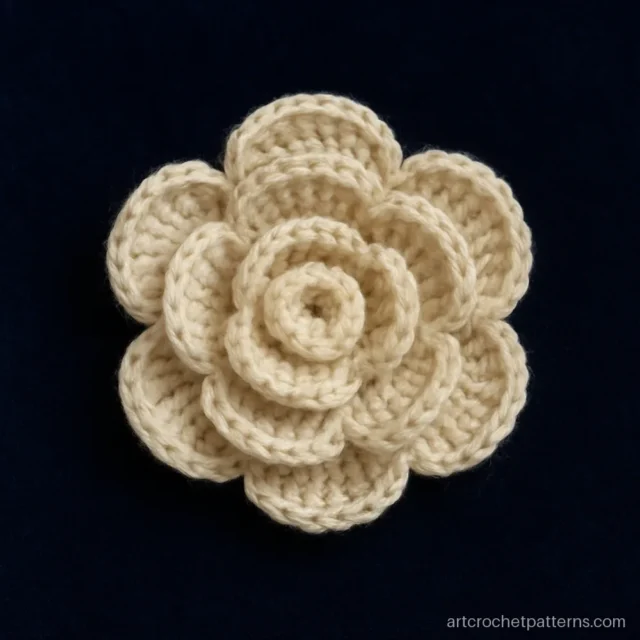 LevelIntermediateYarnSize 10 cotton threadHook1.5 mm steel
Ivory rose brooch
One three layer rose with a pin sewn on the back makes a quick first project in fine thread.
Maker note: Starch lightly and dry the petals cupped over a fingertip so they stand up.
 LevelAdvancedYarnSize 20 cotton threadHook1.25 mm steel
Ecru lace collar
Roses and leaves joined with a picot mesh make a detachable collar for a plain dress.
Maker note: Pin the motifs face down on a paper template, then fill the gaps with mesh.
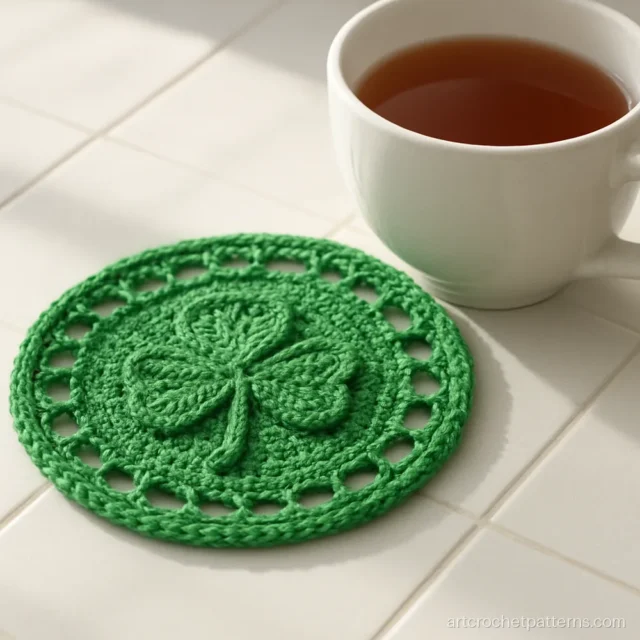 LevelIntermediateYarnDK cottonHook3.5 mm (E-4)
Shamrock coaster in green
A larger shamrock in DK cotton, set into a round of mesh, works as a coaster and a lace sampler.
Maker note: Learning in DK first makes the motif shapes far easier to see and count.
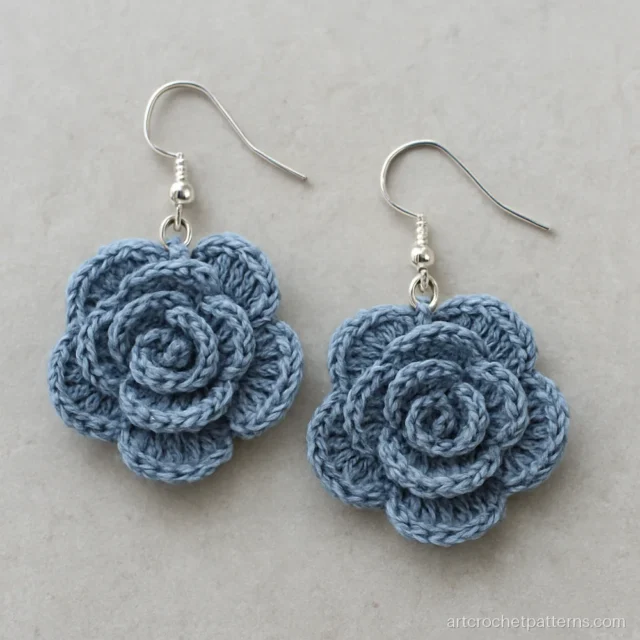 LevelIntermediateYarnSize 20 cotton threadHook1.25 mm steel
Dusty blue mini rose earrings
Two layer roses in fine thread are light enough to wear as earrings.
Maker note: Stop after the second petal round so each rose stays under an inch.
 LevelAdvancedYarnSize 10 cotton threadHook1.5 mm steel
White oval table mat
Five roses and a ring of leaves set into mesh form an oval mat for a side table.
Maker note: Make every motif before any mesh so you can arrange and swap them freely.
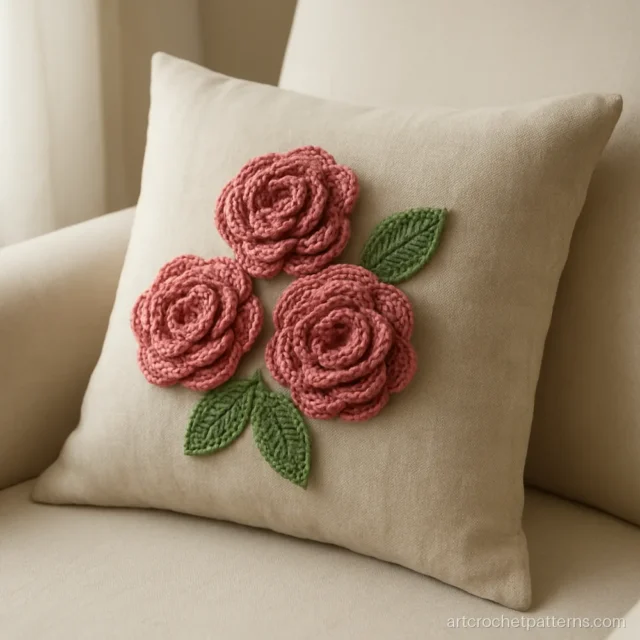 LevelIntermediateYarnDK cottonHook3.5 mm (E-4)
Rose pink motif cushion panel
Motifs in DK cotton appliqued on a linen cover give the look without a full mesh background.
Maker note: Sew motifs on with matching sewing thread and tiny stitches behind the petals.
How Irish crochet lace is made
This lace has three building blocks. First come the motifs: roses, leaves, buds, shamrocks and scrolls, each made on its own. Many are worked over a padding cord, a bundle of thread you crochet around, which lifts the edges and gives the raised look. Last comes the filling: a mesh of chain loops, often studded with picots or small knots, that joins the motifs into one fabric.
Traditionally the motifs are basted face down onto a fabric or paper template in the final shape of a collar or panel. The mesh is then worked across the gaps, catching each motif as it goes. Once the basting is snipped, the lace lifts away in one piece.
A short history of Irish crochet
The lace grew up in Ireland during the nineteenth century, when crocheters copied the look of costly needle lace from Europe using only a fine hook and cotton thread. Convent schools taught it, and it spread from house to house.
During the famine years it became a lifeline. Families in poor rural areas made motifs and lace at home and sold them through local schemes and merchants, and that income kept many households going. Different districts developed their own styles. One town became known for a small, firm knot used in the mesh, now called the Clones knot. The lace was later prized in fashion for collars, cuffs, blouses and wedding pieces, and it is still made by hand today.
Free Irish rose pattern
To learn: Practice roses in DK cotton come out near 3.5 inches wide when worked tight on an E-4 hook. Traditional: size 10 thread and a 1.5 mm steel hook, about 2 inches. US terms are used; a dc is a UK treble.
- Ch 6, sl st in first ch to form a ring.
- Rnd 1: Ch 6 (counts as dc and ch 3). *Dc in ring, ch 3; rep from * 4 more times. Sl st in 3rd ch of beg ch 6. (6 dc, 6 ch-3 sps)
- Rnd 2: In each ch-3 sp work (sc, hdc, 3 dc, hdc, sc). Sl st in first sc. (6 petals of 7 sts)
- Rnd 3: Fold the petals toward you. Working behind them, sl st around the back of the post of the first dc of Rnd 1. *Ch 5, sl st around the back of the post of the next dc of Rnd 1; rep from * 4 more times. Ch 5, sl st in first sl st. (6 ch-5 loops)
- Rnd 4: In each ch-5 loop work (sc, hdc, 5 dc, hdc, sc). Sl st in first sc. (6 petals of 9 sts)
- Rnd 5: Working behind the petals, sl st into the back of the first sl st of Rnd 3. *Ch 7, sl st into the back of the next sl st of Rnd 3; rep from * 4 more times. Ch 7, sl st in first sl st. (6 ch-7 loops)
- Rnd 6: In each ch-7 loop work (sc, hdc, 7 dc, hdc, sc). Sl st in first sc. (6 petals of 11 sts)
- Fasten off, leaving a 6 inch tail for sewing.
Finishing: hide the beginning tail inside the ring stitches. Shape each petal with your fingers so the layers cup upward. For thread roses, dip in a light starch and dry flat with petals lifted. Stop after Rnd 4 for a smaller two layer rose.
Irish lace crochet materials
| Material | Hook | Use |
|---|---|---|
| Size 30 or 40 cotton thread | 1 mm steel or smaller | Heirloom collars and very fine lace |
| Size 10 or 20 cotton thread | 1.25 to 1.75 mm steel | Most modern lace, jewelry, mats |
| Fingering cotton | 2.25 mm (B-1) | Light lace scarves, tops |
| DK cotton | E-4, which is 3.5 mm | Learning motifs, coasters, appliques |
Mercerized cotton thread is the classic choice. It has a slight sheen, holds a crisp shape and takes starch well. Padding cord can be 3 or 4 strands of the same thread held together. Steel hooks use their own numbering, so match hooks by the millimeter size.
Tips for your first Irish crochet patterns
- Learn each motif in DK cotton before moving to thread. The shapes are the same, only smaller.
- Use good light and a plain dark cloth on your lap so fine stitches stand out.
- Make a stack of motifs in one go. Repeating a rose ten times teaches it better than reading the pattern twice.
- Keep the mesh loose and even. Tight mesh puckers the motifs around it.
- Wash your hands before working with white thread, and store lace flat in tissue.
If thread lace appeals to you, try filet crochet and doily patterns next. For more open fabrics, see crochet lace, and the picot stitch guide for the little points used in the mesh. The crochet rose page has simpler roses in yarn.
Caring for Irish crochet
Hand wash thread lace in cool water with a mild soap. Do not wring or twist it. Blot it inside a folded towel, then spread the piece on a pinning board and pin each edge and picot into place. Ease each rose upward with a fingertip while damp. Light starch restores crispness on collars and mats. For older or inherited pieces, test a hidden spot first and handle the lace as little as possible.
Questions makers ask
What makes Irish crochet different from other lace?
The motifs are made separately and stand up in raised layers, often over a padding cord. They are then joined with a mesh background. Most other crochet lace is worked as one flat piece.
Is Irish crochet hard for beginners?
The motifs use only basic stitches, so a confident beginner can make a rose. Working with fine thread and building a full lace piece with mesh takes more practice.
What thread is used for Irish lace crochet?
Mercerized cotton thread, usually size 10 to 40, with a steel hook. To learn, a DK cotton yarn and a 3.5 mm hook work well.
What is a Clones knot?
It is a small, firm knot made by chaining a little, wrapping the yarn over and under the hook a dozen or so times, then drawing one loop through all the wraps. It is used in the mesh of one regional style of Irish lace.
How do I join Irish crochet motifs?
Baste the motifs face down on a template, then work a chain mesh across the gaps, joining into each motif with a slip stitch or sc. Remove the basting at the end.
Can I use Irish crochet motifs on their own?
Yes. Single roses and leaves make brooches, earrings, hair clips and appliques for bags or cushions.