
Crochet doily patterns turn fine cotton thread into lace you can set under a vase or a lamp, and here is a small scalloped doily with every round written out, plus six designs to try next. Doilies look hard, but most are just rounds of double crochet, chain loops and little picots repeated around a ring.
Our pattern has seven rounds and finishes about 5 inches across in size 10 thread. It is a good first doily because each round has 16 repeats, so you always know where you are. Once it is starched flat, it looks far more complex than it was to make.
New to lace? Start with the crochet lace basics, or try a few rounds of the pattern in sport weight cotton first where every stitch shows clearly.
At a glance
Skill level
Easy to intermediateYarn
Size 10 cotton crochet threadHook
1.75 mm steel hookStitches used
ch, sl st, sc, hdc, dc, picotSize
About 5 inches across, blockedTime
2 to 3 hours
6 crochet doily patterns designs to make
Every design lists the skill level, yarn and hook, with a note from the maker.
 LevelEasyYarnSize 10 cotton threadHook1.75 mm steel
Small white picot scallop doily
The seven round pattern on this page. Sixteen scallops with picots make a crisp edge once starched.
Maker note: Pull the center ring closed snug before Rnd 2. A loose ring leaves a floppy middle.
 LevelAdvancedYarnSize 20 cotton threadHook1.25 mm steel
Large ecru pineapple doily
The classic pineapple motif in eight wedges. A centerpiece for a round table and a satisfying long project.
Maker note: Mark the first repeat of every round. Pineapple rounds change stitch count, so check each wedge.
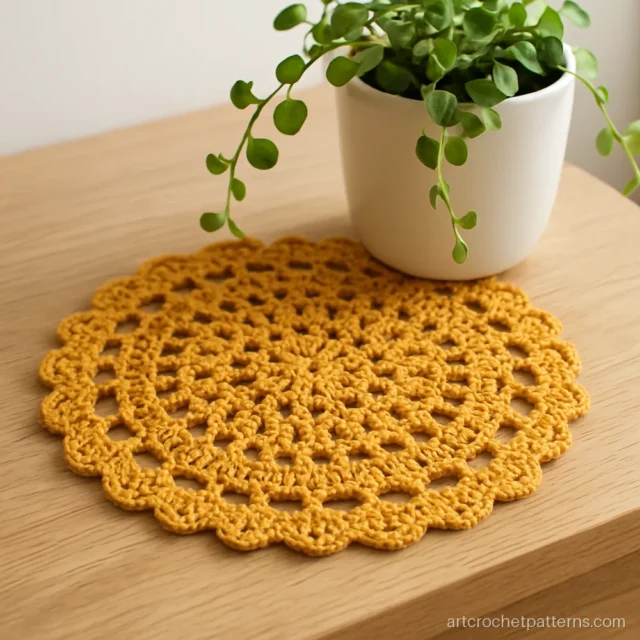 LevelEasyYarnSport cottonHook3 mm
Modern mustard doily in sport cotton
Bigger cotton and a bold color make a doily feel modern. Use it under a plant pot or as a table mat.
Maker note: The same written rounds in sport cotton give a doily about 9 inches wide.
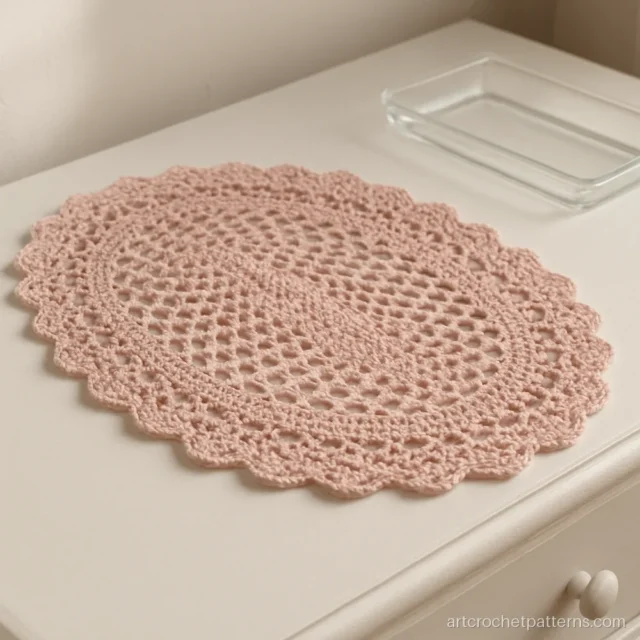 LevelIntermediateYarnSize 10 cotton threadHook1.75 mm steel
Blush oval dresser doily
Oval doilies grow from a short foundation chain rather than a ring. Soft pink suits a bedroom dresser or a vanity tray.
Maker note: Add two more stitches at both curved ends in every round, or the ends will cup.
 LevelIntermediateYarnSize 10 cotton threadHook1.75 mm steel
Two color star center doily
A navy star in the middle and white lace around it. Two colors show each round clearly.
Maker note: Finish each navy round, cut, and start the white with a standing sc so no knot shows.
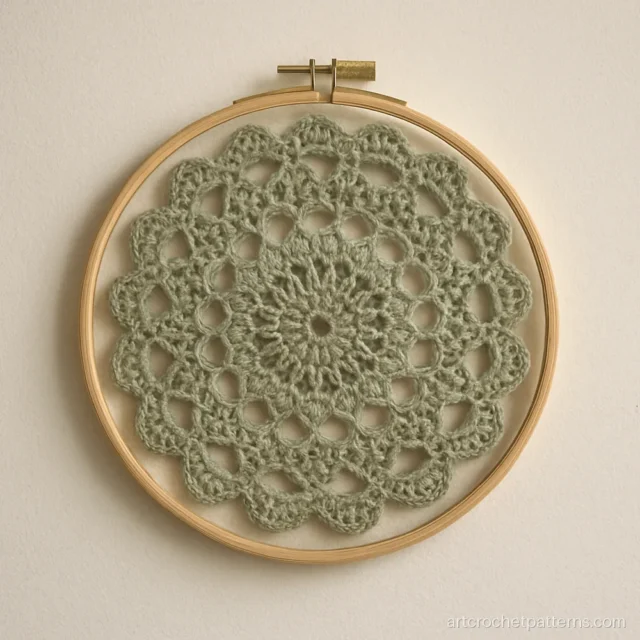 LevelEasyYarnSize 3 cotton threadHook2.25 mm
Doily mounted in an embroidery hoop
Stretch a finished doily across a wooden hoop and hang it as art. A great use for a doily that would not lie flat.
Maker note: Choose a hoop an inch or so narrower than the doily and tie each scallop to the ring with thread.
Small scallop doily: a free crochet doily pattern with written instructions
Materials: about 50 yards of size 10 cotton crochet thread, a steel hook of 1.75 mm, a fine eyed tapestry needle, and spray starch.
Size: roughly 5 inches wide once starched and pinned.
Notes: The ch 3 at the start of a round counts as a dc. Picot: chain 3, then slip stitch back into the first of those chains. Every round has 16 repeats.
- Rnd 1: ch 6, join with sl st to form a ring. Ch 3, 15 dc in ring, join with sl st to top of ch 3 (16 dc)
- Rnd 2: ch 5 (counts as dc and ch 2), *dc in next dc, ch 2; rep from * 14 more times, join with sl st to 3rd ch of ch 5 (16 dc, 16 ch-2 sps)
- Rnd 3: sl st in next ch-2 sp, ch 3, 2 dc in same sp, ch 1, *3 dc in next ch-2 sp, ch 1; rep from * around, join to top of ch 3 (16 groups of 3 dc, 16 ch-1 sps)
- Rnd 4: sl st in next 2 dc and in next ch-1 sp, ch 1, sc in same sp, *ch 5, sc in next ch-1 sp; rep from * 14 more times, ch 5, join with sl st to first sc (16 ch-5 loops)
- Rnd 5: sl st in next 2 ch, ch 1, sc in same loop, *ch 6, sc in next ch-5 loop; rep from * 14 more times, ch 6, join to first sc (16 ch-6 loops)
- Rnd 6: sl st in next 3 ch, ch 1, sc in same loop, *ch 7, sc in next ch-6 loop; rep from * 14 more times, ch 7, join to first sc (16 ch-7 loops)
- Rnd 7: sl st in next ch-7 loop, ch 1, (sc, hdc, 3 dc, picot, 3 dc, hdc, sc) in same loop and in each loop around, join to first sc (16 scallops). Fasten off.
Weave the tail in along the back of the last round, following the path of the stitches. Leave it until after starching to trim, so it does not pop out.
Thread and hook sizes for doilies
| Thread | Hook | Our doily comes out |
|---|---|---|
| Size 20 thread | 1.25 mm steel | About 4 inches, very fine |
| Size 10 thread | steel, 1.5 mm or 1.75 mm | About 5 inches, the classic look |
| Size 3 thread | 2.25 mm | About 7 inches, quicker and bolder |
| Sport cotton | 3 mm | About 9 inches, a modern mat |
Thread numbers run backwards, so size 20 is finer than size 10. Steel hooks use their own numbers too, so go by millimeters. Mercerized cotton thread has a gentle shine and holds starch well. Linen thread is lovely but stiffer to work.
How to read doily patterns
- Repeats: the steps after the * are the repeat. In this doily, "rep from * 14 more times" means 15 starred repeats in all; the opening chains or the closing chain and join make the 16th.
- Moving to the next round: the opening sl sts of a round shift your hook to the right spot without adding height.
- Loops and spaces: "in next loop" means your hook slides under the whole arch of chains, never through one chain.
- Charts: many doilies come as symbol charts. Each round is a ring of symbols read counterclockwise. Our crochet symbols page decodes them.
Starching and blocking a crochet doily
- Hand wash the doily in cool water with a drop of mild soap, then rinse.
- Wrap it inside a dry towel and press, never twist, to remove water.
- Lay it on a foam board or folded towel. Pin the center first, then pin each scallop and picot outward so the rounds sit evenly.
- Spray with starch until damp. For a stiff doily, dip it in a mix of white school glue and water instead.
- Unpin only once every picot feels fully dry, then trim the tail.
Rustproof pins matter, since a damp doily will pick up rust marks. The blocking crochet guide covers boards and pins.
Doily problems and fixes
| Doily trouble | Why | What helps |
|---|---|---|
| Center cups like a bowl | Chains or stitches too tight | Go up to a 2 mm hook and let the chain loops form more loosely |
| Edges ruffle | Chains too loose for the round | Drop to a 1.5 mm hook for the chain loop rounds |
| Uneven loops | Changing tension mid round | Keep the thread over the same fingers and count each ch out loud |
| Hard to see stitches | Fine white thread | Work over a dark cloth in good light, or start in a pastel thread |
Most minor cupping and rippling vanish with blocking, so finish and starch before you rip anything out.
Ways to use crochet doilies
Doilies protect wood from vases and lamps, but they also make art when stretched in a hoop, sweet gift toppers, or a center for a larger piece. Join several into a crochet table runner, or try a mandala crochet pattern for a bolder, colorful round. A doily also teaches the stitches used in snowflakes, so the crochet snowflake pattern is a natural next step. Browse the wider blankets and home hub for related makes.
Questions makers ask
What thread is used for crochet doilies?
Most doilies use size 10 mercerized cotton thread, worked on a fine steel hook (1.5 mm or 1.75 mm). Finer size 20 or 30 thread gives delicate lace, and size 3 is easier for learning.
Are crochet doilies hard to make?
Small ones are not. They use the same basic stitches as any project, only smaller. The challenge is seeing fine thread, so start with a short pattern and good light.
Why does my doily curl or ruffle?
Curling means the stitches or chains are too tight for the size; ruffling means they are too loose. Change hook size first, and block before you judge.
How do I make a doily stiff?
Spray starch gives a light hold. For a firm finish, soak it in a half glue, half water bath, squeeze gently, and pin it flat to set overnight.
Can I make a doily with yarn instead of thread?
Yes. Sport or DK cotton on a 3, 3.5 or 4 mm hook follows the same rounds and makes a bigger, bolder doily. Many makers learn a doily this way first.
How do I wash an old crochet doily?
Soak an old doily in cool, lightly soapy water, rinse until the water runs clear, then pin it out on a towel. Avoid bleach on old thread, since it weakens the fibers.