
This crochet snowflake pattern makes a classic six point flake in just four rounds: a ring of double crochet, six pairs of spokes, six fans, and a last round of long chain points with picots on either side. Worked in fine cotton thread it measures about 3 inches across, and in worsted cotton it grows to about 5.
Snowflakes only look delicate. Each round is short and repeats six times, so once the first sixth makes sense, the rest follows. The real secret is the finish: a stiff starch and careful pinning turn a floppy circle of lace into a crisp crochet snowflake ornament.
At a glance
Skill level
Easy to intermediateYarn
Size 10 cotton thread or worsted cottonHook
1.75 mm steel for thread, 4 mm (G-6) for worstedFinished size
About 3 inches (thread) or 5 inches (worsted)Time
30 to 45 minutes, plus dryingStitches used
MR, ch, sl st, sc, dcUK terms
US dc = UK tr; US sc = UK dc
6 crochet snowflake pattern designs to make
Every design lists the skill level, yarn and hook, with a note from the maker.
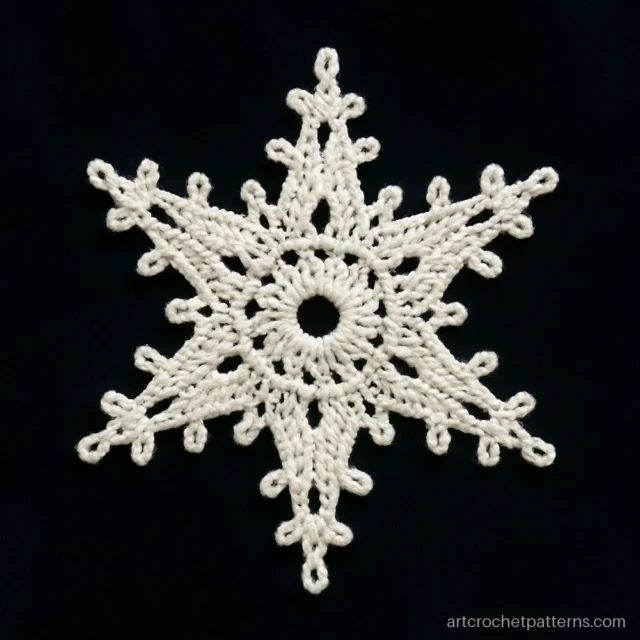 LevelIntermediateYarnSize 10 cotton threadHook1.75 mm steel
Classic white thread snowflake
The pattern below in size 10 white thread, starched stiff. Small and light enough to hang from the thinnest twig.
Maker note: Thread is slippery. Pinch the work just below the hook to stop the stitches from rolling.
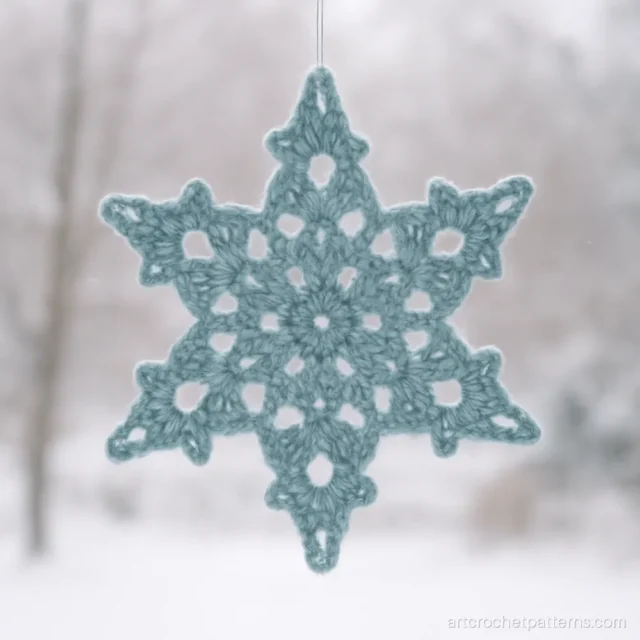 LevelEasyYarnWorsted cottonHook4 mm (G-6)
Icy blue worsted snowflake
The same four rounds in worsted cotton. Learning on thick yarn pays off, since every stitch is plain to see.
Maker note: Make your first snowflake in worsted, then move to thread once the rounds feel familiar.
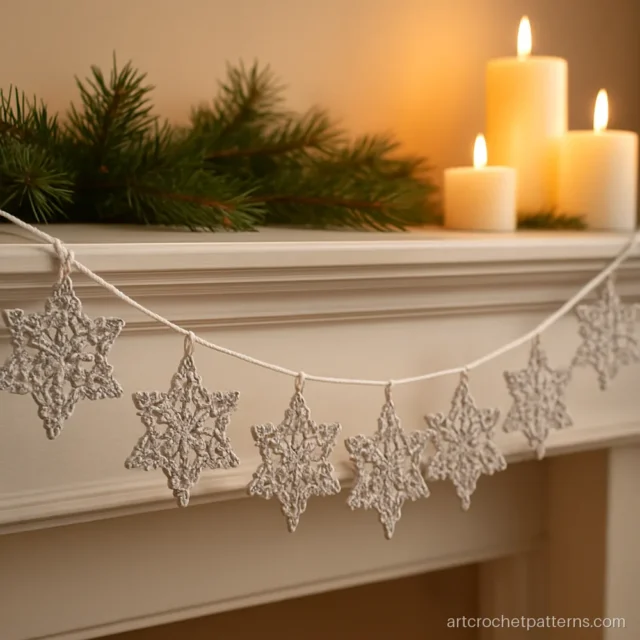 LevelIntermediateYarnMetallic crochet threadHook1.5 mm steel
Silver snowflake garland
A dozen small flakes in metallic thread, tied along a white cord. They catch candlelight and turn slowly.
Maker note: Metallic thread will not hold starch well. Use a glue and water mix for these instead.
 LevelEasyYarnDK cottonHook3 mm
Red snowflake gift topper
One flake in DK cotton is a reusable gift tag. Tie it on with the ribbon and it becomes a tree ornament later.
Maker note: A flake on a gift does not need hard starch. A light spray keeps it flat but soft.
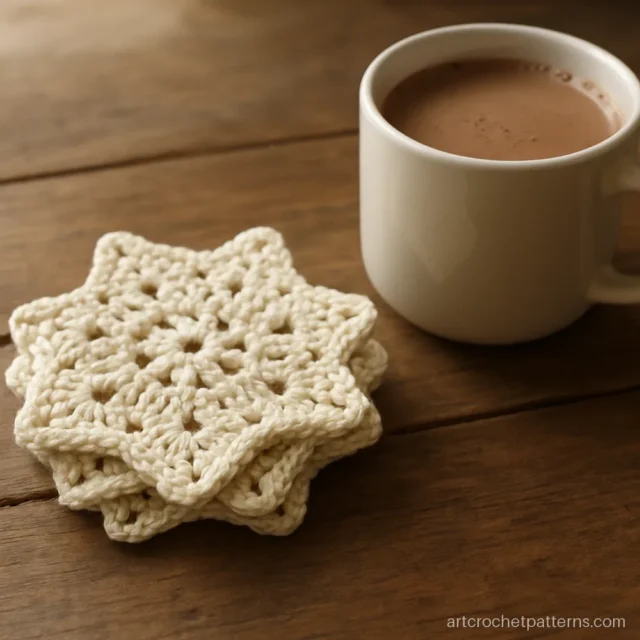 LevelEasyYarnWorsted cottonHook4 mm (G-6)
Snowflake coaster set
Work Rnds 1 to 3 only, then add a round of sc to fill the gaps. The flake becomes a sturdy winter coaster.
Maker note: For a coaster, skip the long ch 7 points. They catch on cups and spoons.
 LevelIntermediateYarnBulky acrylicHook6.5 mm (K-10.5)
Giant snowflake wall piece
Bulky acrylic and a K-10.5 hook stretch the flake to roughly 9 inches. Stretch it over a wire ring so it keeps its points.
Maker note: Bulky yarn will not hold points with starch alone. Stitch each tip to a 9 inch wire hoop.
Simple crochet snowflake pattern, free in four rounds
You need: either 12 yards or so of number 10 thread with a fine steel hook (1.75 mm), or roughly 20 yards of worsted weight cotton with a G-6; a yarn or tapestry needle; starch and rustproof pins for finishing. Each round is joined, not worked in a spiral.
- Rnd 1: make a MR. Ch 3 (counts as dc), 11 dc in the ring, join with a sl st to the top of beg ch 3. Pull the ring closed (12 dc).
- Rnd 2: ch 3 (counts as dc), dc in next st, ch 3, *dc in each of next 2 sts, ch 3; rep from * 4 more times, join to top of beg ch 3 (12 dc, 6 ch-3 sps).
- Rnd 3: sl st in next dc and into the first ch-3 sp. Ch 3 (counts as dc), work (dc, ch 5, 2 dc) in the same sp, ch 1. *Work (2 dc, ch 5, 2 dc) in next ch-3 sp, ch 1; rep from * 4 more times, join to top of beg ch 3 (24 dc, 6 ch-5 sps, 6 ch-1 sps).
- Rnd 4: sl st in next dc and into the ch-5 sp. Ch 1, work (sc, ch 3, sc, ch 7, sc, ch 3, sc) in the same sp, ch 3, sc in next ch-1 sp, ch 3. *Work (sc, ch 3, sc, ch 7, sc, ch 3, sc) in next ch-5 sp, ch 3, sc in next ch-1 sp, ch 3; rep from * 4 more times, join to first sc (30 sc, 6 ch-7 points). Fasten off.
The ch 7 loops become the six main points, and the ch 3 loops on either side of them act as picots. The plain ch 3 loops between the arms form the little dips that make the outline read as a snowflake.
Starching a crochet snowflake so it stays crisp
- Mix the stiffener. Use a fabric stiffener, a thick spray starch, or school glue cut one to one with water.
- Soak the flake until it is fully wet, then squeeze it gently in a paper towel. It should be damp, not dripping, or glue will dry in the holes.
- Pin the center first. On a foam board covered with plastic wrap, put one pin through the middle ring.
- Pin the six points next, pulling each ch 7 loop out straight like the spokes of a wheel. Then pin each picot outward.
- Dry overnight. Lift it off only when it feels hard. If the points droop later, dip just the tips and pin again.
Rustproof pins matter. Ordinary steel pins can leave orange marks on white cotton when they sit in a wet flake for a night.
Thread and hook choices for crochet snowflakes
| Material | Hook | Snowflake size | Good for |
|---|---|---|---|
| Size 20 thread | Steel, about 1.25 mm | About 2.5 in | Card fronts, tiny ornaments |
| Number 10 thread | Fine steel hook | About 3 in | Classic tree flakes |
| Heavier number 3 thread | B-1 hook | About 3.75 in | Window hangings |
| DK cotton | 3 mm | About 4 in | Gift toppers |
| Worsted cotton | G-6 | About 5 in | Learning the pattern |
Mercerized cotton gives the sharpest points and a slight shine. Acrylic is softer and will not hold starch as well, so it suits flakes that will be sewn on rather than hung.
Snowflake troubles, round by round
| Round | What goes wrong | How to correct it |
|---|---|---|
| Rnd 1 | Center hole will not close | Pull the MR tail before you join, not after |
| Rnd 2 | Only five spokes | Count the ch-3 spaces before joining; there must be 6 |
| Rnd 3 | The flake cups like a bowl | Chains too tight; loosen the ch 5 and ch 1 |
| Rnd 4 | Flake ruffles | Chains too long for your thread; try ch 6 points |
| Finishing | Points curl after drying | The flake was too wet; blot it more before pinning |
Ways to use crochet snowflakes
A handful of snowflakes goes a long way through the season. Tie them to the tree with clear thread, stitch them to a cushion cover, or hang a column of five in a window from a single line. A garland of flakes looks lovely across a mantel, and the crochet garland page shows how to space motifs on a cord.
Thread flakes also make a quiet gift. Tuck one in a card, or make six for a set of crochet Christmas ornaments. Bigger round lace in a similar spirit is on the mandala page. For more seasonal makes browse the Christmas crochet patterns collection.
Questions makers ask
Is a crochet snowflake hard for a beginner?
The stitches are only chain, slip stitch, single and double crochet. The hard part is fine thread, so practice first with worsted cotton on a G-6, then switch to thread once the four rounds make sense.
What should I soak a crochet snowflake in to stiffen it?
Soak it in fabric stiffener, heavy starch, or white glue mixed half and half with water. Blot it, pin it out on a covered foam board, and let it dry fully overnight.
What is the best thread for crochet snowflakes?
Mercerized cotton in size 10 is the classic choice. It holds starch well, shows each stitch clearly, and gives a slight sheen in tree lights.
Can I wash a starched snowflake?
Washing removes the stiffener. Rinse it in cool water if it gets dusty, then starch and pin it again. Store snowflakes flat between sheets of paper.
Where should the hanging loop go on a crochet snowflake ornament?
Tie a loop of clear thread, metallic cord or thin ribbon through one of the ch 7 points. Hanging from a point, not a dip, keeps the flake straight.
Why does my snowflake not lie flat?
A bowl shape means the chains are too tight, and a wavy edge means they are too long for your thread. Change the chain lengths by one and try again.