
This mandala crochet pattern builds a 7 inch circle in seven rounds, with a color change on almost every round and a picot edge to finish. It is a good first crochet mandala because each round uses one simple idea: a ring of dc, a ring of chain loops, a ring of small shells.
A mandala is a round design that grows out from the center in repeating sections. In crochet, that usually means 12 or 6 matching sections, set by the stitch count of the early rounds. Because each round is short, you see the pattern take shape fast, which makes mandalas a great way to use up small amounts of cotton.
You will need a magic ring, chains, single crochet and double crochet. Six more designs follow, ranging from a coaster to a floor rug.
At a glance
Skill level
Easy to intermediateYarn
DK (3) mercerized cotton, 4 colorsHook
4 mm (G-6)Size
About 7 inches acrossStitches used
MR, ch, sl st, sc, dc, picotTime
2 to 3 hours
6 mandala crochet pattern designs to make
Every design lists the skill level, yarn and hook, with a note from the maker.
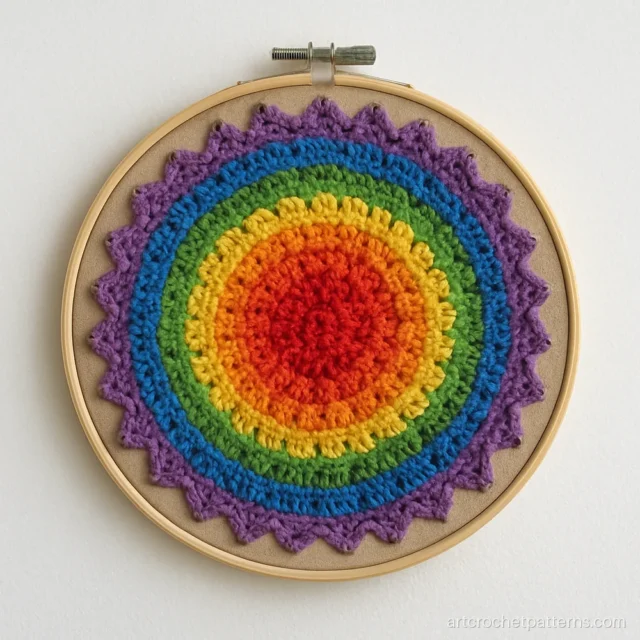 LevelEasyYarnDK mercerized cottonHook4 mm (G-6)
Rainbow mandala in a wooden hoop
The pattern on this page, worked in rainbow order and stitched to a 7 inch hoop. A quick piece of wall art for a bright room.
Maker note: Pin it flat and let it dry first; a damp or wavy mandala will pucker inside the hoop.
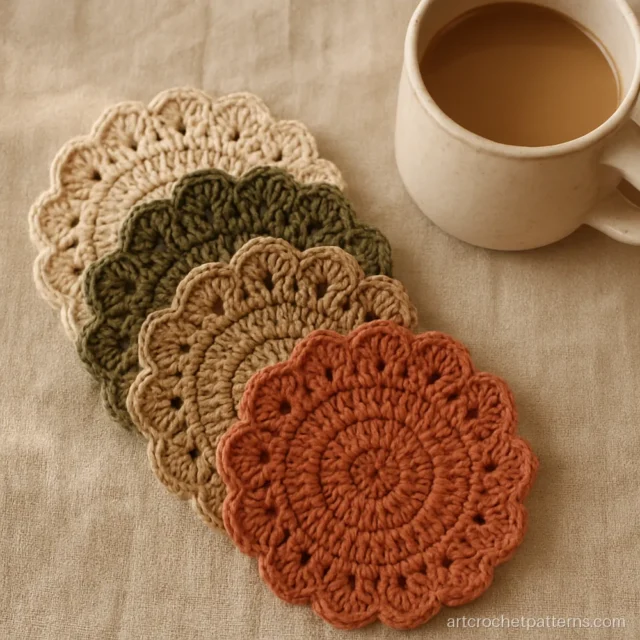 LevelEasyYarnWorsted cottonHook4.5 mm (7)
Earth tone mandala coasters
Stop after Round 4 for a coaster about 4 inches across. Make a set of four in shifted color orders.
Maker note: Add one round of sc after Round 4 so the shells sit flat under a mug.
 LevelIntermediateYarnSuper bulky cotton cordHook10 mm (N/P-15)
Chunky mandala floor rug
The same round plan, scaled up in thick cotton cord and a 10 mm hook, makes a rug about 30 inches across.
Maker note: Put a non slip rug pad under it. Cotton rugs slide easily on wood.
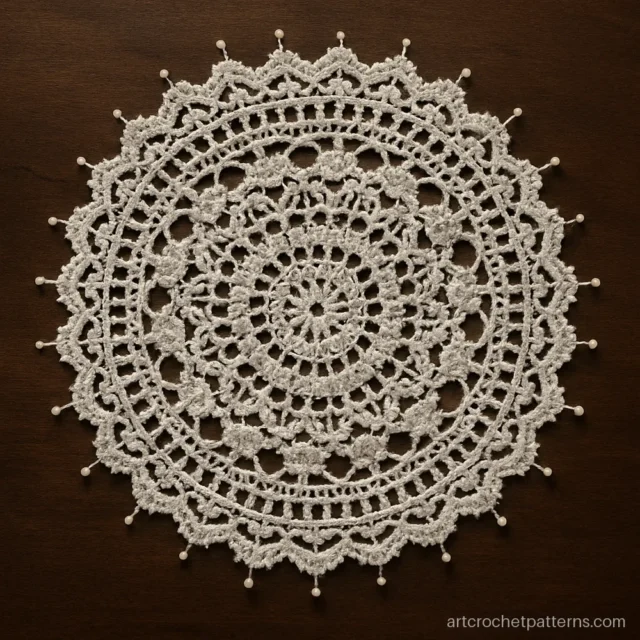 LevelIntermediateYarnSize 10 cotton threadHook1.5 mm steel
Fine thread mandala doily
In thread, a mandala turns into a lace doily. Extra chain loop rounds make it airy and open.
Maker note: Starch lightly and pin every picot while it dries for crisp points.
 LevelAdvancedYarnDK acrylicHook3.5 mm (E-4)
Overlay mandala in jewel tones
Overlay mandalas work tall stitches over earlier rounds to build a raised, layered look. A slower, more detailed project.
Maker note: Read each round twice before starting. Overlay stitches skip rounds and land in specific spots.
 LevelIntermediateYarnDK cotton blendHook4 mm (G-6)
Pastel mandala pillow front
Work the mandala to 14 inches, then sew it to a round pillow cover in a matching fabric.
Maker note: Repeat Rounds 5 and 6 with longer chain loops and more dc to grow the circle.
Free crochet mandala pattern in seven rounds
Materials: DK mercerized cotton in four colors (A, B, C, D), about 15 yards each; 4 mm (G-6) hook; yarn needle; scissors. Size: about 7 inches across after blocking. Gauge is not critical, but tight stitches keep the circle flat.
Treat each starting ch 3 as one dc. To close a round, sl st into the top of that ch 3 or first sc. When a round starts in a new color, fasten off the old one and join the new yarn with a sl st in the stitch or space named.
- Rnd 1 (A): MR, ch 3, 11 dc in ring, pull ring closed, join. (12 dc)
- Rnd 2 (A): ch 3, dc in same st, 2 dc in each st around, join. (24 dc)
- Rnd 3 (B): join B in any st, ch 1, sc in same st, ch 3, sk next st, *sc in next st, ch 3, sk next st; rep from * around, join to first sc. (12 sc, 12 ch-3 sps)
- Rnd 4 (C): join C in any ch-3 sp, ch 3, (dc, ch 1, 2 dc) in same sp, (2 dc, ch 1, 2 dc) in each ch-3 sp around, join. (48 dc, 12 ch-1 sps)
- Rnd 5 (D): join D in any ch-1 sp, ch 1, sc in same sp, ch 5, *sc in next ch-1 sp, ch 5; rep from * around, join to first sc. (12 sc, 12 ch-5 sps)
- Rnd 6 (A): join A in any ch-5 sp, ch 3, 5 dc in same sp, 6 dc in each ch-5 sp around, join. (72 dc)
- Rnd 7 (B): join B in any st, ch 1, sc in same st and in next 2 sts, picot (ch 3, sl st in 3rd ch from hook), *sc in next 3 sts, picot; rep from * around, join to first sc. (72 sc, 24 picots)
- Fasten off and weave in all ends.
Finishing: wet the mandala, press it flat on a towel, and pin it into a circle on a foam mat. Pin each picot if you want sharp points. Let it dry fully. The picot stitch guide shows the edge in close detail.
Why a mandala crochet pattern lies flat, or not
A flat circle in dc adds about 12 stitches each round. Round 2 has 24 and Round 6 has 72, which keeps this crochet mandala pattern close to that rule. The chain loop rounds (3 and 5) act like breathing space. They let the shells and fans spread without crowding.
If your mandala cups like a bowl, it has too few stitches or your loops are too short; try ch 6 instead of ch 5 on Round 5. If it ruffles, it has too many; try 5 dc in each loop on Round 6 instead of 6. Small changes like these fix most mandalas without starting over.
Choosing yarn for a crochet mandala
| Fiber and weight | Hook | Finished piece |
|---|---|---|
| Size 10 cotton thread | 1.5 mm steel | Lace doily about 5 inches |
| DK mercerized cotton | 4 mm | Wall mandala about 7 inches |
| Worsted cotton | 4.5 mm | Coaster or 9 inch mat |
| Super bulky cord | 10 mm | Rug 24 to 30 inches |
Mercerized cotton has a soft shine and crisp stitch definition, which shows off color changes. Acrylic works too and comes in more shades, but it relaxes more and may need steam blocking to lie flat.
Planning mandala colors
Mandalas look best when neighboring rounds contrast. Put a light round next to a dark one, or a warm color next to a cool one. Repeating a color two or three rounds apart, as this pattern does with A and B, ties the design together.
- Rainbow: red to violet from the center out.
- Ombre: four shades of one color, dark in the middle.
- Two color: alternate cream and one bold shade.
- Scrap: any colors, with white on every chain loop round to calm it down.
For cleaner joins, see the color change guide.
Mandala mistakes and quick repairs
| What you see | Most likely reason | Repair |
|---|---|---|
| Center hole will not close | Ring was not pulled before joining | Pull the tail of the magic ring hard before Rnd 1 join |
| Sections uneven | A ch-3 space was skipped on Rnd 3 | Count 12 spaces before Rnd 4 |
| Join seams climb diagonally | Each round starts in the same spot | Start new colors in a different section each time |
| Picots lean | Picot pulled tight | Keep the ch 3 loose and sl st into the 3rd ch, not the sc |
| Edges wave after blocking | Too many sts on Rnd 6 | Rework Rnd 6 with 5 dc per loop |
More crochet mandala ideas
Coasters: stop after Round 4 and add one round of sc. Pair them with the crochet coasters page for more shapes.
Wall art: sew a finished mandala inside a wooden hoop, or hang a group of three in graded sizes. The crochet wall art page has more ideas for displays.
Doilies: switch to thread and add chain loop rounds. The doily patterns page goes further into lace.
Bigger mandalas: after Round 7, alternate chain loop rounds and solid rounds, adding about 12 stitches per dc round, to grow it into a table mat or a blanket center.
Questions makers ask
Is a mandala crochet pattern hard for a beginner?
A simple one like this suits anyone comfortable with a magic ring and double crochet. The hardest part is counting the spaces on the chain loop rounds, so count before you move on.
How do I stop my crochet mandala from curling?
Curling up like a bowl means too few stitches. Add a stitch or two per section, or lengthen the chain loops. Wet blocking also helps a lot with cotton.
Which fiber suits a crochet mandala?
Mercerized cotton in DK or sport weight is the favorite. It is smooth, has bright colors and holds its shape after blocking.
How do I hang a crochet mandala on the wall?
Sew it into a wooden embroidery hoop with small stitches around the edge, or stiffen it with fabric stiffener and hang it from a nail by one picot.
Can I turn this mandala into a blanket?
Yes. Keep adding rounds in the same rhythm, solid then chain loops. For a square blanket, work corners into the last few rounds, or use the mandala as a center and build a square around it.
Why does my mandala have a seam line?
Each round joins in the same place, so joins stack up. Start every new color in a different section, or use an invisible join, to hide it.