
This crochet octopus is worked in one piece, with all eight curly legs crocheted straight off the head, so you finish with no limbs to sew, and the page also shows six octopus ideas from tiny to plush. The curl happens on its own: working two single crochet into every chain makes the leg twist like a spring.
It is one of the fastest toys in the amigurumi section, about two hours from start to finish, and a good first animal if you have made a ball before.
At a glance
Skill level
EasyYarn
Worsted cotton or acrylic, about 50 yardsHook
3.5 mm (E-4)Size
Head about 3 inches wide; legs about 3 inchesTime
About 2 hoursStitches used
MR, sc, inc, dec, FLO, BLO, ch, sl st
6 crochet octopus designs to make
Every design lists the skill level, yarn and hook, with a note from the maker.
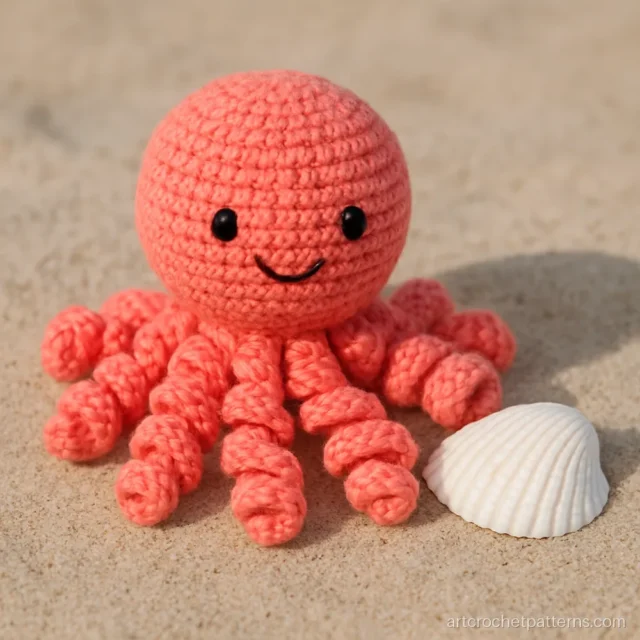 LevelEasyYarnWorsted cottonHook3.5 mm (E-4)
Coral octopus with curly legs
Worked exactly as written, in a warm coral cotton. Cotton gives the tightest, springiest curls.
Maker note: If the curls look loose, work 3 sc in each chain instead of 2. The leg will twist much more.
 LevelEasyYarnFingering cottonHook2.25 mm (B-1)
Mini octopus keychain
Rounds up to 18 stitches and legs of 8 chains in fingering cotton. About 1 1/2 inches, perfect on a backpack zip.
Maker note: Six legs fit better than eight on an 18 stitch head; nobody counts at this size.
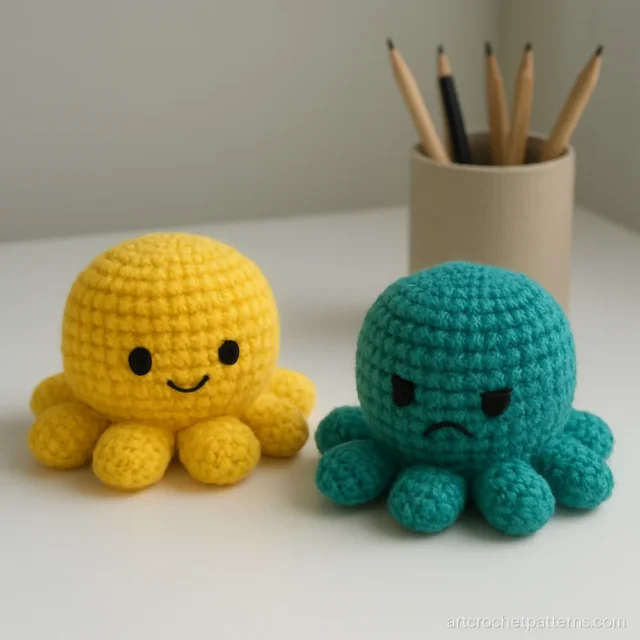 LevelIntermediateYarnWorsted acrylicHook3.5 mm (E-4)
Flip mood octopus
Two half octopuses joined at the legs flip inside out to show a happy or grumpy face. Popular as a fidget toy.
Maker note: Work both halves to the same count and join the leg edges with sc through both layers.
 LevelEasyYarnBulky chenilleHook6 mm (J-10)
Giant navy plush octopus
Bulky chenille and long tube legs instead of curls make a floor cushion sized cuddle toy.
Maker note: Stuff tube legs only halfway so they bend and drape instead of sticking straight out.
 LevelIntermediateYarnDK cottonHook2.75 mm (C-2)
Sea life mobile
A small pastel octopus hangs at the center with tiny fish and shells around it. For display above a crib, never inside it.
Maker note: Hang the mobile well out of reach and check the cords and knots every few weeks.
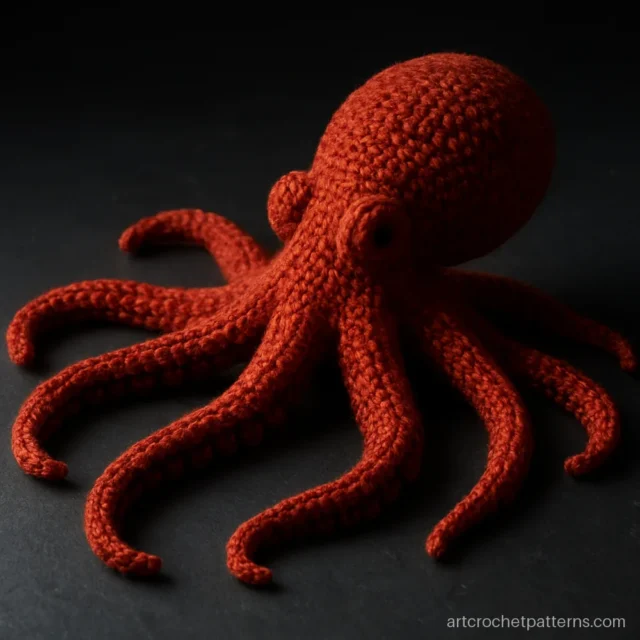 LevelAdvancedYarnDK wool, speckledHook3 mm
Speckled red octopus
Tapered tube legs with small sc bobbles along the underside suggest suckers. A shelf piece for older makers.
Maker note: Bend a pipe cleaner inside each leg for posing, and keep this one as a display piece only.
Free crochet octopus pattern with curly legs
The legs are worked into the front loops of one round. The back loops of that same round stay free, and you carry on into them to close the bottom.
Materials: worsted cotton or acrylic, about 50 yards; 3.5 mm (E-4) hook; black yarn for eyes (or 9 mm safety eyes for older kids); fiberfill; stitch marker; tapestry needle. Spiral rounds for the head.
- Rnd 1: 6 sc in MR (6).
- Rnd 2: inc in each st (12).
- Rnd 3: (sc, inc) x6 (18).
- Rnd 4: (2 sc, inc) x6 (24).
- Rnd 5: (3 sc, inc) x6 (30).
- Rnd 6: (4 sc, inc) x6 (36).
- Rnds 7 to 14: sc in each st (36).
- Eyes between Rnds 11 and 12, 6 sts apart.
- Rnd 15: (4 sc, dec) x6 (30).
- Rnd 16: (3 sc, dec) x6 (24). Stuff the head firmly.
- Rnd 17, legs, front loops only: *sl st in next st, ch 16, 2 sc in 2nd ch from hook and in each of the remaining 14 ch (30 sc on the leg), sl st in front loop of the same st at the leg base, sl st in front loop of next 2 sts; rep from * 7 more times (8 legs, all 24 front loops used).
- Rnd 18, back loops of Rnd 16: (2 sc, dec) x6 (18). Top up the stuffing.
- Rnd 19: (sc, dec) x6 (12).
- Rnd 20: dec x6 (6). Fasten off and close.
Each leg twists as you work back along the chain. Do not untwist it; let it curl and give it a little tug when done so the spring evens out. Embroider a small smile two rounds below the eyes and add pink cheek stitches if you like.
How to crochet an octopus: what each step should look like
- The head after Rnd 14 is a deep cup, a little taller than it is wide.
- After Rnd 16 the opening is about 1 1/2 inches wide. Stuff now while you can still shape the dome.
- The first leg starts as a straight chain. By the tenth chain worked back, it begins to spiral.
- Between legs you should see two neat slip stitches and the free back loops below them.
- After the last leg you are back where the round started. Rnd 18 goes into the back loops that face the inside of the skirt of legs.
- Closing: the base sits slightly inside the legs, so the octopus balances on its curls.
Octopus crochet yarn and hook choices
| Material | Hook | What you get |
|---|---|---|
| Fingering cotton | B-1 | Mini octopus, legs of 8 to 10 chains |
| Worsted cotton | E-4 | Tight springy curls, holds up in the wash |
| Worsted acrylic | E-4 | Softer curls that relax over time |
| Bulky chenille | J-10 | Long plush legs; tubes work better than curls |
Variegated or self striping yarn looks great on the legs, since each leg pulls a different part of the color run.
Ideas for your next octopus
- Tentacle length: ch 21 instead of 16 for longer curls (40 sc per leg).
- Stripes on the head, changed every two rounds.
- A hat or bow sewn on top makes a sweet gift.
- Sea friends: add a jellyfish, a whale or a small fish for a set.
- Fidget version: two half octopuses joined at the rim flip from happy to grumpy.
Some hospital newborn units accept crocheted octopuses for premature babies, but only under their own strict rules on fiber, leg length and washing. Ask the unit for its guidelines before making one for that purpose.
Fixing a tangled or tippy octopus
| Looks like | Comes from | Sort it out |
|---|---|---|
| Legs barely curl | Loose stitches on the chain | Use 3 sc per chain or a hook one size smaller |
| Gaps between legs | Legs worked into back loops by mistake | Use front loops only for Rnd 17 |
| Octopus falls over | Head stuffed lopsided | Mold the head round before closing and add filling to the low side |
| Only seven legs | A repeat was skipped | Mark every third stitch of Rnd 16 before starting legs |
| Closing hole puckers | Decreases worked too tightly | Use the invisible decrease and pull the last tail gently |
Questions makers ask
How quickly can I finish a crochet octopus?
About two hours for the worsted size here. The head takes under an hour, and each leg takes three or four minutes once you have the rhythm.
How do I make octopus legs curly?
Put 2 sc into each chain along a long foundation. With twice as many stitches as chains, one edge grows longer than the other and the strip winds into a spiral. Three sc per chain gives an even tighter curl.
Can I make a mini octopus crochet pattern from this one?
Yes. Stop increasing at 18 or 24 stitches, work fewer straight rounds, and use shorter chains for the legs, like 8 or 10. Thin cotton on a small hook keeps it neat.
Can a crochet octopus go to an infant?
It can, with yarn embroidered eyes; this design has no separate parts to come off. Pull each leg firmly to check it holds. For hospital donations, follow the unit's own rules, which may limit leg length.
Why does my octopus have a gap in the middle of the legs?
The bottom has not been closed. After the leg round, continue into the free back loops of the round before and decrease down to 6 stitches.
Which fiber gives a crochet octopus the bounciest legs?
Worsted cotton for tight curls and easy washing. Acrylic is softer to cuddle. Avoid fuzzy yarn, which hides the curl.