
Crochet socks are thicker and less stretchy than knitted ones, so the trick is a snug fit, a fine yarn and a stitch that lies flat inside a shoe. This page gives you six sock designs and a complete toe up pattern to cast on this evening.
The written pattern uses single crochet in a spiral, an afterthought heel and a ribbed cuff. It is sized by your own foot, so you measure as you go instead of guessing. If you have never worked in rounds, practice a magic ring first, then come back.
At a glance
Skill level
Easy to intermediateYarn
DK or fingering with some wool or nylonHook
3.5 mm to 4 mmStitches used
MR, sc, sc2tog, FPdc, BPdcTime
6 to 8 hours per pair in DKUK term
US sc = UK double crochet
6 crochet socks designs to make
Every design lists the skill level, yarn and hook, with a note from the maker.
 LevelEasyYarnDK wool and nylonHook4 mm (G-6)
Sage ankle socks with ribbed cuff
The basic toe up pattern below, stopped two inches above the heel. A quick first pair that fits under boots.
Maker note: Try the sock on after the toe. If it gapes, change to an F-5 before you go further.
 LevelIntermediateYarnSport merinoHook3.75 mm (F-5)
Thigh high socks in cream
A long leg with gentle increases for the calf and thigh. The mock cable is a strip of front post stitches.
Maker note: Add 2 stitches every 6 rounds from the knee up, and try the sock on often.
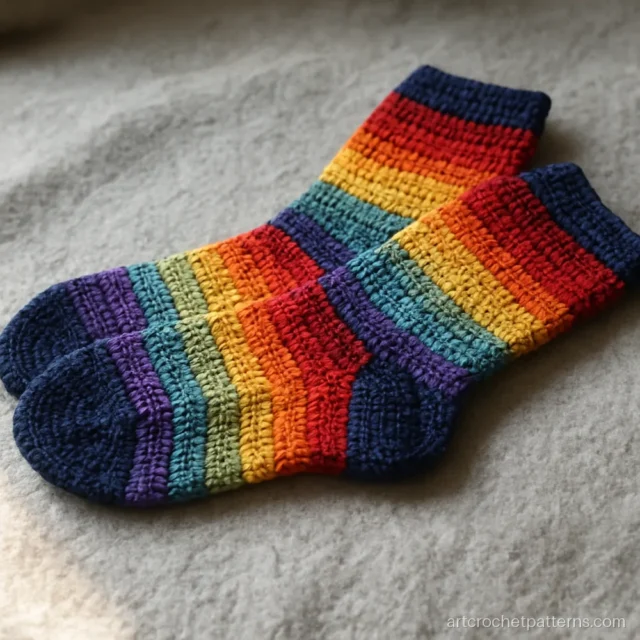 LevelEasyYarnFingering wool scrapsHook3.25 mm (D-3)
Scrap stripe crew socks
Change color every four rounds to use up leftover sock yarn. Keep the toe and heel one solid shade.
Maker note: Switch shades where the round begins and carry nothing inside the sock, or your toes catch the floats.
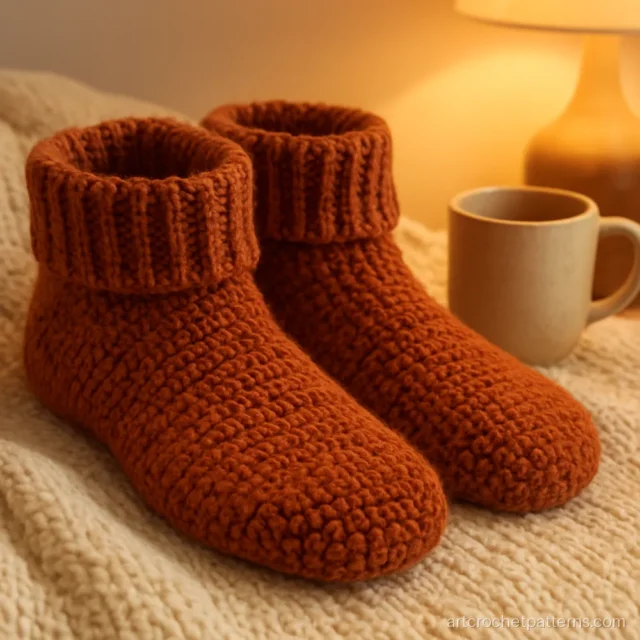 LevelEasyYarnWorsted wool blendHook5 mm (H-8)
Slouchy bed socks in rust
Thick, loose and warm, made for sleeping rather than shoes. Worsted yarn and half double crochet make them quick.
Maker note: Dot fabric paint on the soles in a grid and let it cure for a non slip grip on wood floors.
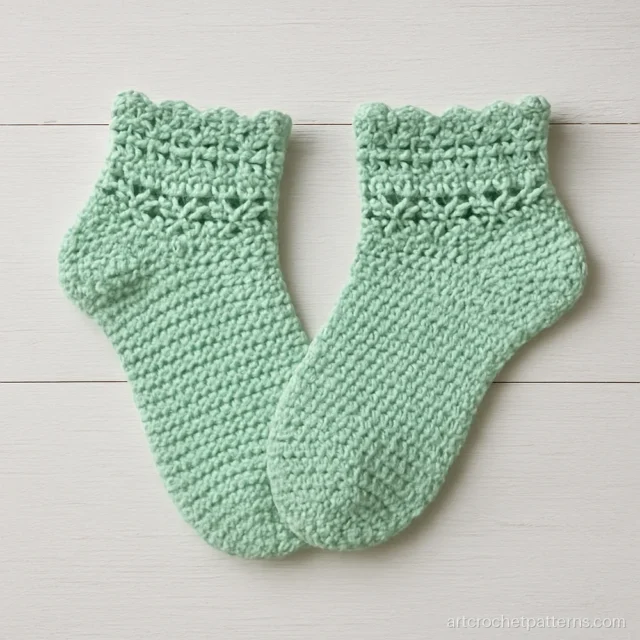 LevelIntermediateYarnFingering cotton blendHook3.5 mm (E-4)
Mint lace socks with shell cuff
Solid sole and toe, a lace band over the top of the foot. Cotton keeps them cool for spring flats.
Maker note: Keep the sole in plain single crochet. Lace under the foot wears through fast.
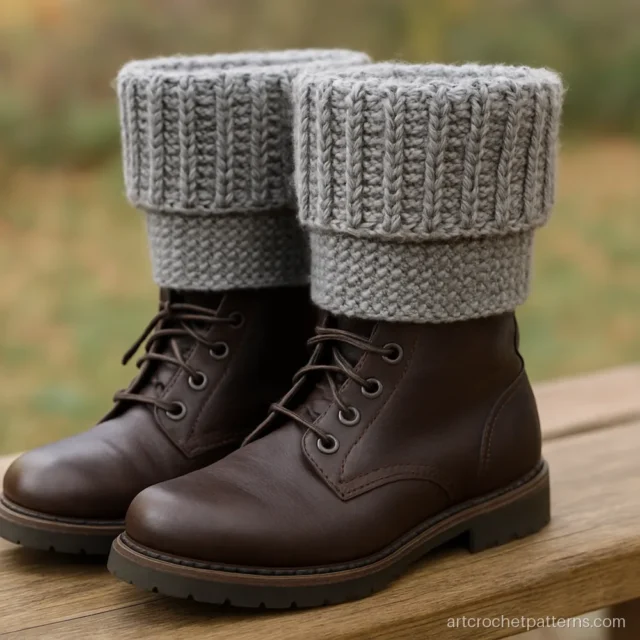 LevelEasyYarnDK woolHook4 mm (G-6)
Heather gray boot socks
A taller leg in ribbing that peeks over a boot. The same toe and heel as the basic pattern.
Maker note: Post stitch ribbing pulls in, so give the leg an H-8 instead of the G-6.
How to crochet socks that fit
Socks fail for two reasons: they are too loose and slide down, or the fabric is so thick that shoes feel tight. Fix both before you start.
- Measure your foot. Wrap a tape around the widest part, across the ball of the foot. Note the length from the back of the heel to the tip of the longest toe.
- Aim for negative ease. Make the sock about 10 percent smaller around than your foot. A 9 inch foot wants a sock about 8 inches around.
- Use a fine yarn. DK is the thickest yarn that still fits in most shoes. Fingering weight makes a thinner sock but takes about twice as many rounds.
- Pick a yarn with memory. Wool or a wool and nylon blend springs back. Pure cotton and acrylic stretch out and bag at the ankle by lunchtime.
Working toe up means you can try the sock on at every stage, which matters more in crochet than in knitting because the fabric does not stretch much.
Free crochet sock pattern: toe up DK sock
This crochet sock pattern makes an adult medium with a foot about 8.5 to 9 inches around. See the sizing table after it for other feet. US terms are used, and the spiral rounds are not joined unless the round says so.
Materials: about 220 yards of DK wool and nylon blend per pair, a G-6 (4 mm) hook, one stitch marker, a yarn needle, a few yards of waste yarn in a contrast color.
Gauge: 20 sc and 22 rounds = 4 inches in a spiral. Check it on the toe: after Rnd 7 the toe should measure about 2.6 inches across when flat.
- Toe. Rnd 1: 6 sc in MR (6). Place a marker in the last st and move it up each round.
- Rnd 2: inc in each st (12).
- Rnd 3: (sc, inc) x6 (18).
- Rnd 4: (2 sc, inc) x6 (24).
- Rnd 5: (3 sc, inc) x6 (30).
- Rnd 6: (4 sc, inc) x6 (36).
- Rnd 7: (8 sc, inc) x4 (40).
- Foot. Rnd 8 and on: sc in each st around (40). Keep going until the sock covers your foot to 1.5 inches short of the back of your heel. Try it on to check.
- Heel opening. Next rnd: sc in next 20 sts, ch 20 loosely, sk next 20 sts (40). The skipped stitches should sit under your heel.
- Next rnd: sc in next 20 sts, sc in each of the 20 ch (40).
- Leg. Sc in each st around (40) for 3 inches for a crew sock, or 1 inch for an ankle sock. Sl st in next st to finish the spiral.
- Cuff. Rnd 1: ch 2 (does not count), dc in each st around, join with sl st to first dc (40).
- Rnds 2 to 7: ch 2 (does not count), (FPdc, BPdc) x20, join (40). Fasten off loosely.
- Heel. Join yarn at one corner of the heel opening. Rnd 1: sc in each of the 20 skipped sts, sc in each of the 20 loops on the other side of the chain (40).
- Rnd 2: sc in each st around (40).
- Rnd 3: (8 sc, sc2tog) x4 (36).
- Rnd 4: (4 sc, sc2tog) x6 (30).
- Rnd 5: (3 sc, sc2tog) x6 (24).
- Rnd 6: (2 sc, sc2tog) x6 (18).
- Rnd 7: (sc, sc2tog) x6 (12).
- Rnd 8: sc2tog x6 (6). Fasten off, thread the tail through the front loops and pull closed.
Finishing: weave in the ends on the inside, then make the second sock to match. Count the foot rounds of the first sock and write the number down so both socks are the same length.
Sizing your crochet socks pattern
The sock is worked on a multiple of 4 stitches. Adjust the total on the last toe round, then follow the same steps. The heel opening is always half the stitches.
| Foot around | Stitches | Last toe round | Heel chain |
|---|---|---|---|
| 7 to 7.5 in (child or small) | 32 | After Rnd 5, work (14 sc, inc) x2 | 16 |
| 8 to 8.5 in (adult small) | 36 | Stop after Rnd 6 | 18 |
| 8.5 to 9 in (adult medium) | 40 | Rnd 7 as written | 20 |
| 9.5 to 10 in (adult large) | 44 | After Rnd 7, work (9 sc, inc) x4 | 22 |
For the heel, work Rnds 1 and 2 on your stitch count, then decrease evenly to the nearest count in the heel list (36, 30 or 24) and follow the heel from there. On 32 stitches, for example, work (14 sc, sc2tog) x2 to reach 30, then go on with heel Rnd 5.
Thigh high socks and other leg lengths
Crochet thigh high socks use the same foot and heel. The difference is shaping: your leg gets wider from ankle to calf and again from knee to thigh. Measure around your leg every 3 inches and write the numbers down.
- From the heel to the calf, add 2 stitches every 5 or 6 rounds until the sock matches your calf measurement less 10 percent.
- Work straight past the calf to the knee, then increase again toward the thigh.
- Finish with 2 inches or more of ribbing, worked one hook size up so it does not cut in. A round of sc worked over thin elastic cord helps the top stay up.
For knee socks without the thigh section, the same leg rules apply, and you can switch to the leg warmers page if you want a footless version.
Sock troubleshooting
| What you notice | Cause | Repair |
|---|---|---|
| Sock slides down the leg | Too many stitches or a yarn with no spring | Drop 4 stitches or use a wool and nylon blend |
| Holes at the heel corners | The chain and the skipped stitches meet at a gap | Pick up one extra stitch at each corner on heel Rnd 1, then sc2tog it away on Rnd 2 |
| Toe feels pointy | Too few rounds before the foot | Add a plain round between Rnds 5 and 6 |
| Foot twists around | Normal lean of a single crochet spiral | Work the foot in sc through the back loop on every other round, or block the socks flat |
| Cuff is tight | Post stitches pull in hard | Give the cuff alone a 4.5 mm hook |
Non slip soles and care
Socks worn around the house on wood or tile can be slippery. You have three good options for non slip soles:
- Dots or lines of puffy fabric paint on the sole. Put the sock on a cardboard foot shape, paint, and let it cure for a full day.
- A sew on sole of suede or silicone grip fabric, stitched around the edge with strong thread.
- A liquid latex grip made for slippers, brushed on thinly.
Wash socks the way the yarn label says. Superwash wool and nylon socks tolerate the wool setting of a washer, zipped in a lingerie bag. Lay them flat to dry. For more garments in this style see the crochet clothes section, and for house shoes with thicker soles try crochet slippers.
Questions makers ask
Are crochet socks comfortable to wear in shoes?
Yes, if you use a fine yarn and a tight gauge. DK socks fit loose sneakers and boots. For dress shoes, switch to fingering yarn and a C-2 or D-3 hook so the fabric stays thin.
Which yarn makes the longest lasting crochet socks?
A sock yarn of about 75 percent wool and 25 percent nylon. The wool gives warmth and spring and the nylon makes the heel and toe last longer. Cotton blends work for summer socks but stretch more.
How many hours goes into a pair of socks?
Plan on 3 to 4 hours per sock in DK and about twice that in fingering weight. The heel and cuff go quickly. Most of the time is the plain foot rounds.
Why do toe up socks work better in crochet?
Each fitting along the way tells you precisely when the foot is long enough. You also use up your yarn evenly: weigh the ball, and when half is gone on the first sock, start the cuff.
Can I use this crochet socks free pattern for a child?
Yes. Measure the foot, take 10 percent off, and round to a multiple of 4 stitches. A child with a 6.5 inch foot circumference needs about 28 stitches in DK. Stop the toe at Rnd 5 (30), then work (13 sc, sc2tog) x2 to reach 28.
Do I need a special hook for socks?
No. Any hook in the right size works. A hook with a soft grip helps because sock rounds are small and you hold the work tightly for hours.