
Micro crochet means working with very fine thread and very small steel hooks to make pieces you can balance on a fingertip: bears under an inch tall, strawberries the size of a pea, granny squares as small as a stamp. The stitches are the same ones you already know. Only the scale changes.
This page covers the tools that make tiny work possible, six original micro ideas, and a complete micro strawberry pattern you can make in an evening. It also covers how to keep your eyes and hands comfortable, since tiny stitches strain both.
At a glance
Skill level
Intermediate (know amigurumi basics)Thread
Cotton thread size 40 to 100, or 1 to 2 strands of flossHook
Steel, about 0.4 to 0.9 mmExtras
Magnifier, bright lamp, tweezersTime
1 to 3 hours per small pieceGood for
Charms, earrings, dollhouse decor
6 micro crochet designs to make
Every design lists the skill level, yarn and hook, with a note from the maker.
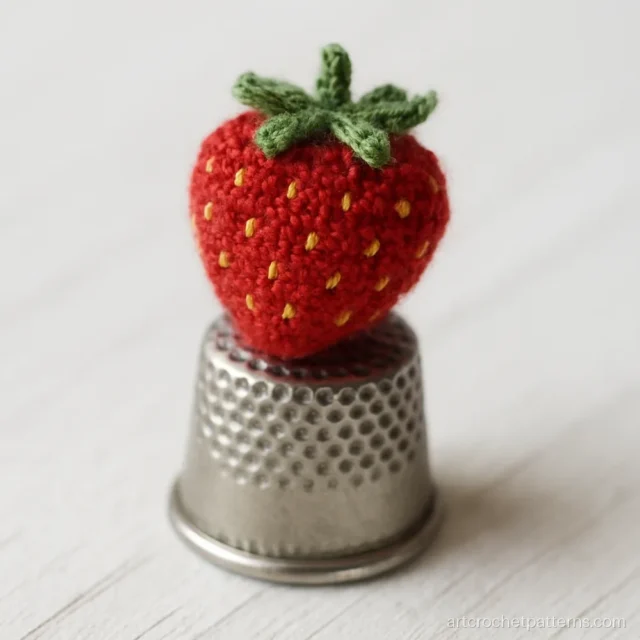 LevelIntermediateYarnSize 40 cotton threadHook0.75 mm steel
Pea sized strawberry
The pattern below makes this one. Seeds are single straight stitches of yellow sewing thread.
Maker note: Stuff with tiny tufts pushed in by tweezers before the hole gets too small.
 LevelAdvancedYarnSize 80 cotton threadHook0.5 mm steel
Inch tall jointed bear
Head, body and limbs are made separately and sewn with sewing thread. A classic first micro challenge.
Maker note: Embroider the eyes with black sewing thread; beads look clumsy at this scale.
 LevelIntermediateYarnSize 80 cotton threadHook0.6 mm steel
Stamp sized granny earrings
Three round grannies in size 80 thread come out about half an inch across and weigh almost nothing.
Maker note: Block the squares with a drop of water and pins so the corners stay square.
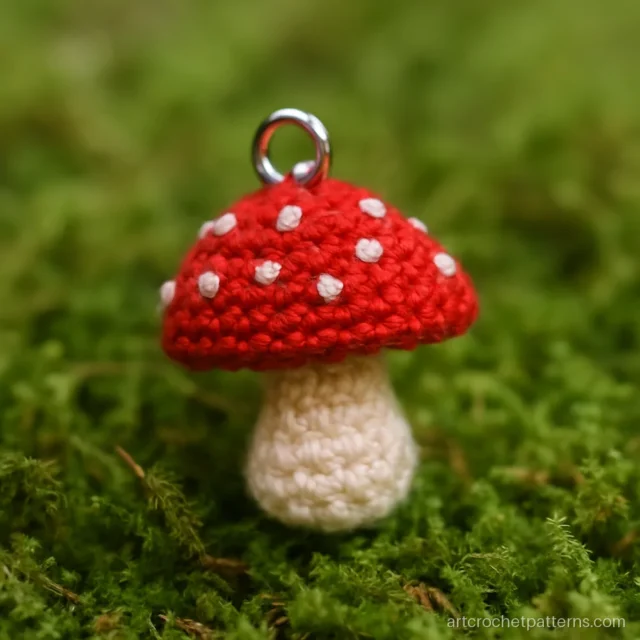 LevelIntermediateYarnSize 40 cotton threadHook0.75 mm steel
Toadstool charm with white spots
A cap and stem stitched together make a charm for a keyring or necklace.
Maker note: Stiffen the cap with a thin coat of diluted craft glue so the charm keeps its shape.
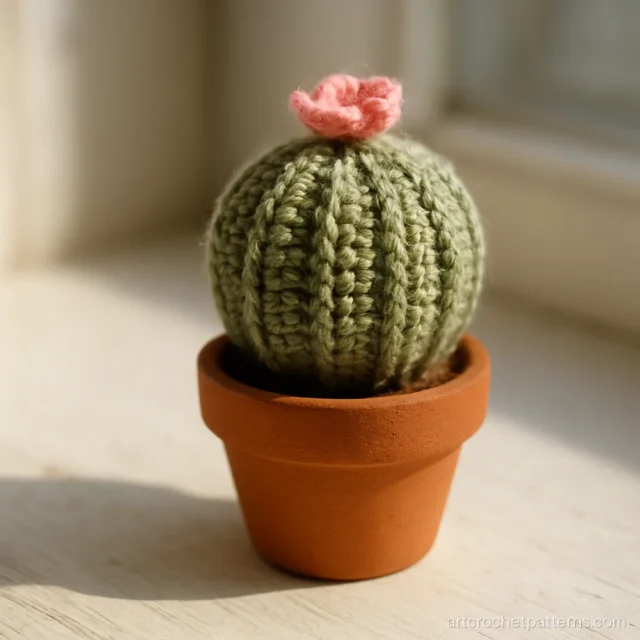 LevelEasyYarnFloss, 2 strandsHook0.9 mm steel
Cactus in a bottle cap pot
Two strands of floss give a slightly fuzzy, plant like texture. The pot is a painted bottle cap.
Maker note: Two strands of floss make a good stepping stone between yarn and true fine thread.
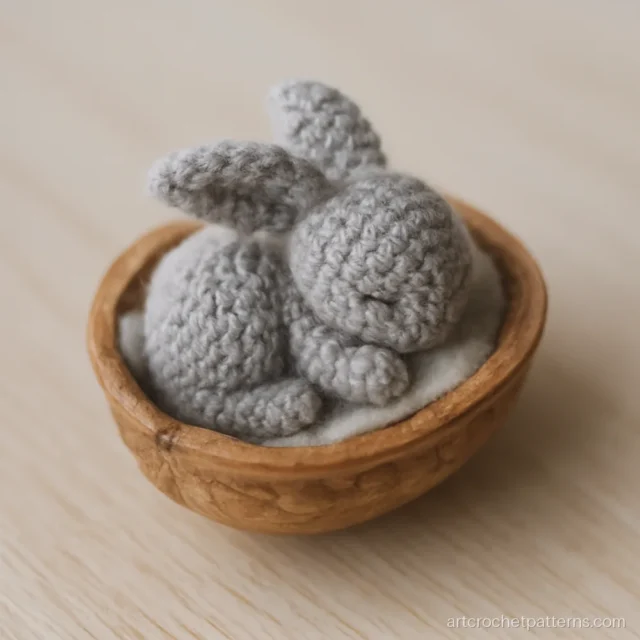 LevelAdvancedYarnSize 80 cotton threadHook0.5 mm steel
Gray bunny in a walnut shell
A curled bunny body with long ears tucked in a shell bed makes a sweet shelf piece.
Maker note: Work ears flat in rows, then fold and sew at the base so they lie back.
Micro crochet tools and materials
| Thread | Steel hook | Finished scale |
|---|---|---|
| Embroidery floss, 2 strands | 0.9 mm | Good first step, pieces about 3/4 in |
| Size 40 cotton thread | 0.75 mm | Charms and fruit around 1/2 in |
| Size 80 cotton thread | 0.5 to 0.6 mm | Inch tall animals with fine detail |
| Size 100 thread or sewing thread | 0.4 mm | Extreme miniatures for experienced makers |
Larger thread numbers mean finer thread. Steel hook numbers also run backward and vary between makers, so buy by the millimeter size. Beyond hook and thread, gather a magnifying lamp or reading glasses, a fine tapestry or beading needle, sharp embroidery scissors, tweezers for stuffing and a few tiny locking stitch markers or a scrap of contrast thread to mark rounds.
Free micro crochet strawberry pattern
Materials: size 40 cotton thread in red and green, a little yellow sewing thread, 0.75 mm steel hook, fiberfill, tweezers, fine needle. Size: about 1/2 inch tall. Go round and round in a spiral, never joining, and keep a scrap of contrast thread in the opening stitch of each lap. In UK patterns, the sc here would be written as dc.
- With red, Rnd 1: 4 sc in MR. (4)
- Rnd 2: (Sc, inc) x2. (6)
- Rnd 3: (Sc, inc) x3. (9)
- Rnd 4: (2 sc, inc) x3. (12)
- Rnd 5: (3 sc, inc) x3. (15)
- Rnds 6 and 7: Sc in each st around. (15)
- Rnd 8: (3 sc, dec) x3. (12)
- Rnd 9: (Sc, dec) x4. (8)
- Stuff firmly with small tufts.
- Rnd 10: Dec x4. (4)
- Fasten off, thread the tail through the front loops of the last 4 sts and pull closed.
- Leaves: with green, make a MR. *Ch 3, sl st in 2nd ch from hook, sl st in next ch, sl st in ring; rep from * 4 more times. Pull the ring closed. (5 leaves)
Assembly: sew the leaf star over the closed top with the green tails. With yellow sewing thread, make small straight stitches scattered over the berry for seeds. Bury every tail inside the stuffing before trimming.
How to start micro crochet without frustration
- Scale down in steps. Make a pattern in DK yarn first, then in 2 strands of floss, then in size 40 thread. Each step trains your eyes and fingers.
- Light from the side. A lamp angled across the work throws tiny shadows into each stitch so you can see where to insert the hook.
- Hold the work close. Pinch the piece right next to the stitch you are making. Holding it far away lets the thread slip.
- Count every round. At this size you cannot fix a mistake by feel. Mark the first stitch and count before you move on.
- Rest often. Look away at something across the room every 15 minutes and stretch your hands.
Micro crochet patterns: what to try first
Start with simple, round shapes: fruit, balls, mushrooms and small flowers. They use the same increase and decrease rounds as full size amigurumi patterns, just smaller. Next, try flat motifs like a tiny granny square, which need no stuffing. Animals with sewn limbs come last, since tiny parts are fiddly to attach.
Many full size patterns scale down well. The crochet mushroom and crochet earrings pages have shapes that convert easily. Pick designs with few color changes and simple faces.
Tiny trouble and how to solve it
| Trouble | Reason | Solution |
|---|---|---|
| Hook splits the thread | Thread too soft for the hook | Use mercerized cotton; it is smoother and firmer |
| Cannot see the stitches | Flat overhead light | Move the lamp low and to the side, add magnification |
| Hand cramps | Gripping a thin steel hook | Slide a foam grip or a pencil grip onto the handle |
| Fiberfill peeks out between stitches | Gaps from an oversized hook | Step the steel hook down one notch |
| Shape comes out lopsided | Lost count in a round | Count each round twice and use a contrast thread marker |
Safety and display
Display tiny work under a glass dome, inside a shadow box, or on a shelf away from dust. Charms for keyrings wear faster, so coat the surface lightly with diluted craft glue or choose a firm mercerized thread. To clean, dab with a damp cotton swab rather than washing.
Questions makers ask
What thread do I need for micro crochet?
Start with mercerized cotton thread in size 40, or 2 strands of embroidery floss. Move to size 80 or 100 thread once you are comfortable.
What size hook is used for micro crochet?
Steel hooks from about 0.4 to 0.9 mm. Match the hook to the thread so the fabric is tight and stuffing does not show.
Is micro crochet hard?
The stitches are the same as normal crochet, but seeing and handling them is harder. If you can make basic amigurumi, you can learn micro crochet with good light and patience.
How do I stuff something so small?
Pull off tiny tufts of fiberfill and push them in with tweezers or the blunt end of a hook. Stuff before the opening closes to a few stitches.
Can I follow regular amigurumi patterns with thread?
Yes. Most patterns work in thread; the piece just comes out smaller. Simple shapes with few parts convert best.
How do I add faces to micro pieces?
Embroider eyes and noses with one strand of black sewing thread or floss. Safety eyes and beads are too big at this scale.