
Safety eyes for crochet are plastic eyes with a ridged post and a locking washer, and this guide shows you which type and size to buy, where to put them and how to lock them so they stay put. They give amigurumi a clean, shiny look that is hard to match with yarn.
The name is a little misleading. "Safety" refers to the washer that locks on from inside, not to a toy being safe for babies. For anyone under 3, stitched eyes are the right choice, and we explain why near the end.
At a glance
What they are
Plastic eye, ridged post, locking washerCommon sizes
4 mm to 30 mmMost used size
8 to 10 mm for worsted toysWhen to fit
Before stuffing and closing the pieceNot for
Toys for babies and children under 3Also called
Toy eyes, craft eyes, plastic eyes
How safety eyes for crochet work
Each eye has three parts. The front is a dome of glossy plastic. Behind it sits a post, also called a shank, with a row of ridges along it. The third part is the washer, a flat disk with a hole that slides onto the post and grips the ridges so it cannot slide back off.
You push the post through the crochet fabric from the outside, slip the washer on from the inside, and press until it is snug against the fabric. Once locked, the washer is designed to stay there. That is why the eyes have to go in while the piece is still open and before it is fully stuffed. Most patterns tell you the rounds to place them on, for example "between Rnds 9 and 10, 7 stitches apart", as in our highland cow crochet pattern.
Types of safety eyes
- Solid black round. The classic. They suit almost any animal and are the easiest to find.
- Colored iris. A clear dome over a colored ring with a black pupil. Brown, blue, green and amber are common and look good on cats, owls and dolls.
- Glitter or sparkle. The colored part has glitter set in it. Fun for fantasy creatures like a crochet unicorn.
- Slit pupil. A tall, narrow pupil for cats, dragons and snakes.
- Oval. Taller than they are wide. They give a softer, cartoon style look.
- Safety noses. Triangle, oval or heart shaped noses lock on the same way, often in black or pink.
Washers come in plain plastic and, for some brands of eye, in metal. Metal washers grip hard and are almost impossible to remove, so test placement extra carefully with them.
In pictures
What the work should look like, with the yarn and hook used for each sample.
 LevelBeginnerYarnNone shownHookNone
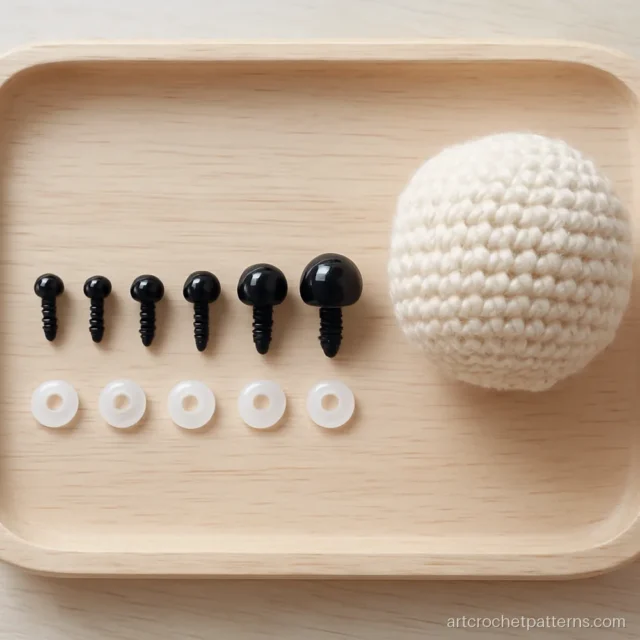
Safety eyes from 6 mm to 15 mm
A row of black safety eyes from 6 mm to 15 mm, each with its matching washer. Washers are sized to their post, so keep them in pairs.
Maker note: Store each size in its own small compartment with its washers. A 9 mm washer will not lock on a 10 mm post.
 LevelBeginnerYarnWorsted acrylicHook3.5 mm (E-4)
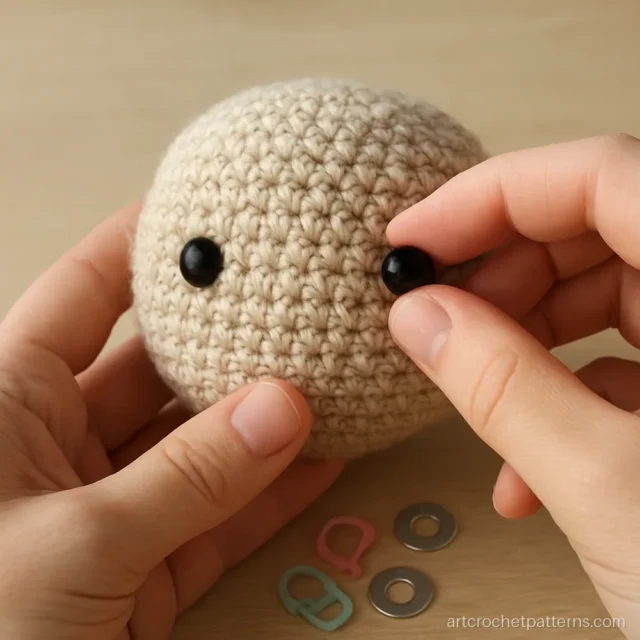
Testing eye placement before locking
Push the posts through the fabric without washers first, then turn the head and look. Moving an eye now takes seconds; moving it later is very hard.
Maker note: Mark each spot with a stitch marker or pin before pushing the posts in. Count stitches from the center front.
 LevelBeginnerYarnWorsted cottonHook3.5 mm (E-4)
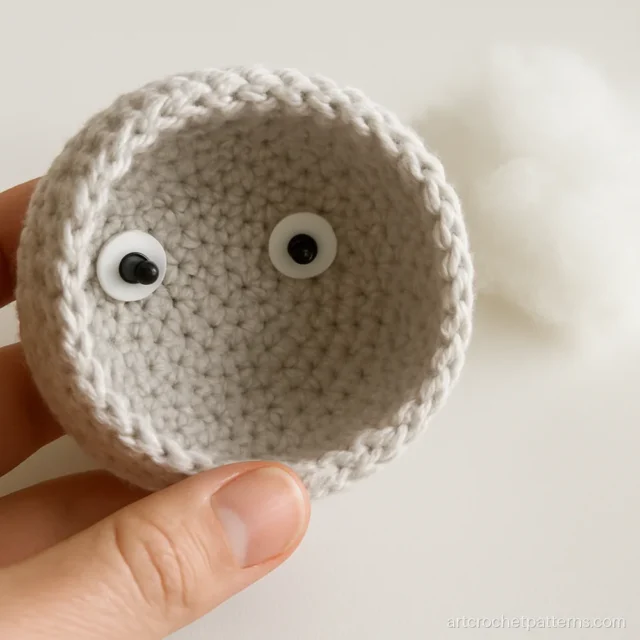
Locking the washer on the inside
Seen from inside, each washer sits flat against the fabric. Push until it is snug and will not slide back along the ridges.
Maker note: Press the washer down on a hard table with the eye face down on a folded towel. Even pressure locks it straight.
Choosing a size in mm
Eye size is the width of the dome in millimeters. Bigger eyes make a toy look younger and cuter. Smaller eyes look more lifelike. Use the table as a starting point and then try two sizes on the real piece before you choose.
| Toy size | Usual yarn | Eye size |
|---|---|---|
| Keychain, under 3 inches | DK or sport | 4 to 6 mm |
| Small, 3 to 5 inches | Worsted | 6 to 9 mm |
| Medium, 5 to 8 inches | Worsted | 9 to 12 mm |
| Large, 8 to 12 inches | Bulky or chenille | 12 to 16 mm |
| Jumbo, over 12 inches | Super bulky chenille | 18 to 30 mm |
Chenille and super bulky yarn leave big gaps between stitches. Pick a size where the washer is clearly wider than the gap, or the eye can pull through.
Placing the eyes step by step
- Finish the rounds past the eye line. Work a few rounds beyond where the eyes go so you can see the real shape of the head. Leave the piece open.
- Mark the spots. Find the center front, often right above the start of the round. Count out half the spacing on each side and drop a stitch marker into each spot.
- Push the posts through. Go between two stitches, not through the middle of one. The gap between stitches gives a neater hole and less strain on the yarn.
- Check before locking. Stuff the head loosely, look from the front and from the side, and move the eyes if they look off. Eyes set lower on the head look younger.
- Lock the washers. Take the stuffing out, slide each washer on and press it firmly home. It should sit flat against the inside of the fabric.
- Stuff and close. Fill the piece and finish the decrease rounds.
The washer: which way and how tight
Most plastic washers have one flat face and one face with a raised collar around the hole. The flat face goes toward the crochet fabric, and the collar points into the stuffing. Push until the washer is snug against the fabric; you will feel and often hear it click past the ridges.
The eye should not spin or wobble when you tug it from the front. If it does, push the washer a little further. Do not crush the fabric so hard that it puckers around the eye. A small washer tool helps for large sizes, or set the eye face down on a folded towel and press the washer with the end of an empty thread spool.
Common problems with safety eyes
| Problem | Cause | What to do |
|---|---|---|
| Eyes look uneven | The spiral jog shifts rounds | Count from the center front, not from the start of the round |
| Eye pulls through the fabric | Gap wider than the washer, common in chenille | Glue a small felt circle on the inside behind the washer |
| Eye spins | Washer not pushed far enough | Press it further along the ridges until snug |
| Washer will not go on | Washer from a different size | Match each washer to its own post size |
| Eye looks too big | Size chosen from the bag, not the toy | Test two sizes on the open piece first |
The under 3 rule and other eye options
Keep safety eyes, buttons and beads off anything you make for an infant or toddler younger than 3. Small hard parts can come loose with chewing and pulling, and they are a choking hazard. Use embroidered eyes instead. A few satin stitches in black yarn, or a small circle of single crochet sewn flat, look sweet and cannot come off. Our crochet eyes page shows several stitched styles.
Felt eyes glued in place are not a good swap for baby toys either, since glue can fail. For older kids and adults, safety eyes are fine. Check them for looseness every so often, and when you wash a toy, put it in a mesh bag so the plastic does not scratch. Find toys to use them on in our amigurumi patterns.
Questions makers ask
Which millimeter size suits a typical amigurumi?
For a typical 5 to 8 inch toy in worsted yarn, 9 to 12 mm works well. Go smaller for DK keychains and larger for chenille plush. Always try the eye on the open piece before you lock it.
Can you add safety eyes after stuffing?
Only while a hand still fits in through the opening. The washer has to go on from the inside, so fit the eyes while the piece is open, before the last decrease rounds.
Can a baby have a toy with plastic safety eyes?
No. Despite the name, they are not meant for toys going to anyone younger than 3. Stitched yarn eyes are the swap to make for that age group.
Which side of the washer faces the fabric?
On most plastic washers, the flat side faces the fabric and the raised collar faces inward. Push it on until it sits snug and the eye no longer wobbles.
How far apart should safety eyes be?
It depends on the toy, but 5 to 8 stitches apart is common on a head of 30 to 36 stitches. Wider spacing looks cuter and more baby like; closer spacing looks more alert.
Can I remove a safety eye?
It is hard by design. Heating the washer in very hot water can soften it enough to pry off, or you can cut the post from inside. Use a new washer afterward.