
This crochet ball pattern makes a smooth 2.5 inch sphere, and the chart below it shows how to scale the same idea to any size you need. A ball is the shape under almost every amigurumi head, so learning how to crochet a ball properly makes every toy after it easier.
You will also find six ball ideas, from a striped play ball to a set of juggling balls, plus the reasons balls come out flat or egg shaped and what to change.
At a glance
Skill level
BeginnerYarn
Worsted acrylic or cottonHook
3.5 mm (E-4)Time
About 1 hourFinished size
2.5 inches acrossYardage
About 25 yardsStitches used
MR, sc, inc, invisible dec
6 crochet ball pattern designs to make
Every design lists the skill level, yarn and hook, with a note from the maker.
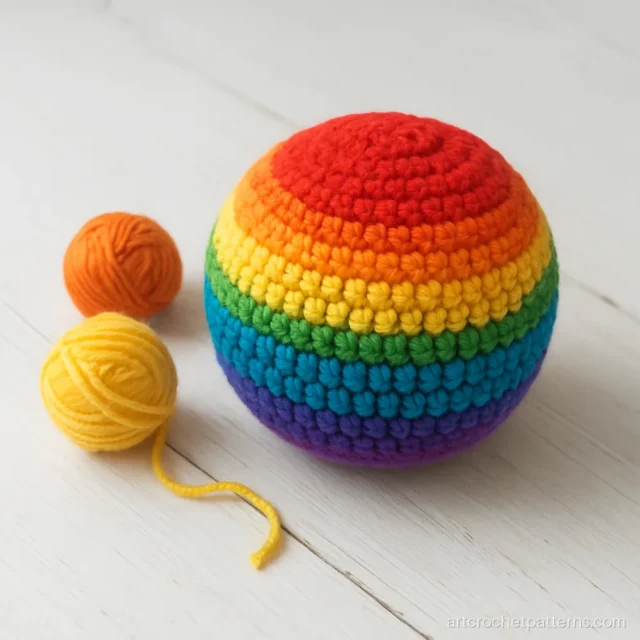 LevelEasyYarnWorsted acrylicHook3.5 mm (E-4)
Rainbow stripe play ball
One color for every two rounds gives neat bands. It is the pattern below scaled up to 48 stitches.
Maker note: Change color on the last pull through of the round before, and carry nothing. Cut and tie each color inside.
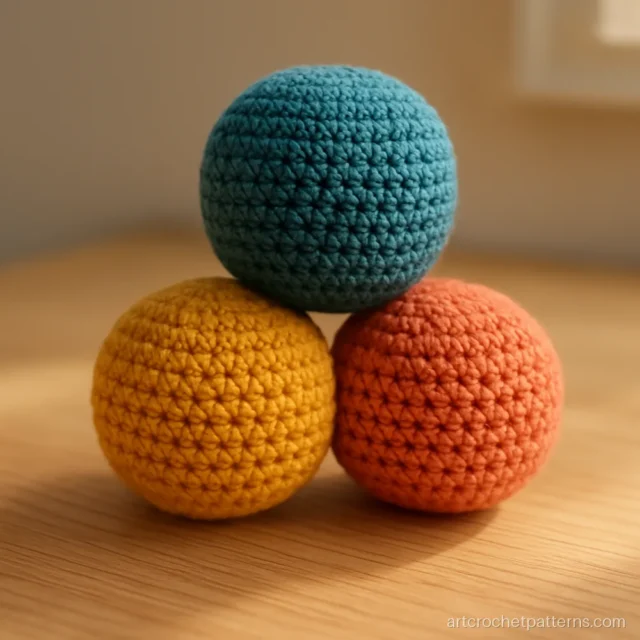 LevelEasyYarnWorsted cottonHook3.25 mm (D-3)
Cotton juggling ball set
Three balls filled with a bag of plastic pellets have a satisfying weight. Cotton holds its shape when caught again and again.
Maker note: Put pellets in a small sealed fabric pouch first, then add a little fiberfill around it so the ball keeps a round shape.
 LevelBeginnerYarnDK acrylic plus metallicHook3 mm
Bauble ornament ball
A small ball with a hanging loop and one metallic round becomes a tree ornament that never breaks.
Maker note: Hold metallic thread together with the main yarn for one round. On its own it is slippery and splits.
 LevelEasyYarnBulky acrylicHook6 mm (J-10)
Big pastel soft ball
Bulky acrylic on a J-10 hook gives a 7 inch ball for indoor games. The counts follow the 60 stitch row of the chart.
Maker note: Stuff in fist sized clumps and turn the ball as you fill it. Big balls go lumpy if you stuff from one side.
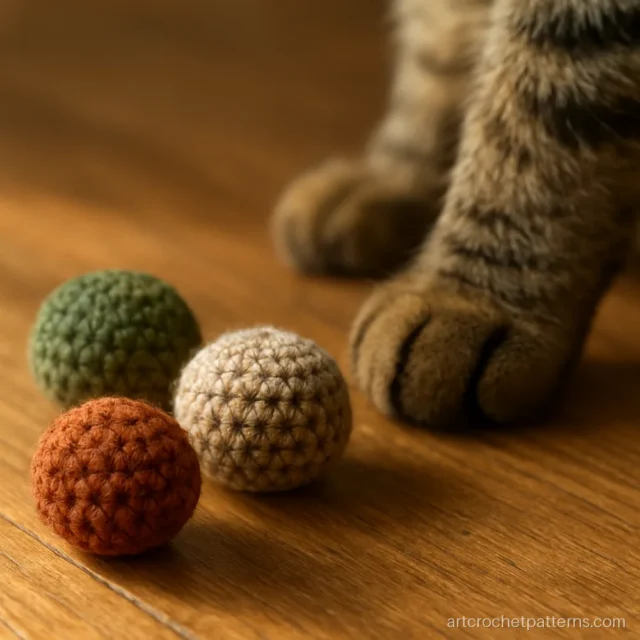 LevelBeginnerYarnWorsted wool tweedHook3.5 mm (E-4)
Mini catnip ball
Increase only through Rnd 3 and you get a ball about 1.5 inches wide. Wool with a pinch of dried catnip makes a toy cats bat across the floor.
Maker note: Put the catnip in the center of a wad of fiberfill so bits do not poke out between stitches.
 LevelIntermediateYarnWorsted woolHook4 mm (G-6)
Textured puff stitch ball
Puff stitches every few stitches on the even rounds add bumps that are easy to grip. It is a good next step after the plain sphere.
Maker note: Replace one sc with a puff on alternate even rounds and offset them so the bumps sit in a checker layout.
How to crochet a ball: the free 2.5 inch pattern
Gather: 25 yards of worsted acrylic or cotton, an E-4 or 3.5 mm crochet hook, a handful of fiberfill, one marker and a darning needle. Work in a spiral. The figure in brackets is your total after that round.
- Rnd 1: 6 sc in MR (6)
- Rnd 2: inc in each st (12)
- Rnd 3: (sc, inc) x6 (18)
- Rnd 4: (2 sc, inc) x6 (24)
- Rnd 5: (3 sc, inc) x6 (30)
- Rnd 6: (4 sc, inc) x6 (36)
- Rnds 7 to 12: sc in each st (36)
- Rnd 13: (4 sc, dec) x6 (30)
- Rnd 14: (3 sc, dec) x6 (24)
- Rnd 15: (2 sc, dec) x6 (18). Begin stuffing now, filling to the top.
- Rnd 16: (sc, dec) x6 (12). Top up the stuffing.
- Rnd 17: dec x6 (6). Fasten off with an 8 inch tail.
To close: put the tail on your needle, then lace it through just the front loops of the 6 remaining stitches, always entering from outside. Pull firmly and the hole shuts like a drawstring bag. Send the needle straight through to the far side, tug gently, and snip so the end slips inside.
Crochet ball pattern sizing chart for any sphere
The rule is simple: after the widest round, work about as many plain rounds as you needed to get there. A ball with 6 rounds of increases needs about 6 even rounds. After that, shrink it again in mirror image.
| Widest round | Even rounds | Diameter in worsted, 3.5 mm |
|---|---|---|
| 24 sts (Rnd 4) | 4 | About 1.75 inches |
| 36 sts (Rnd 6) | 6 | About 2.5 inches |
| 48 sts (Rnd 8) | 8 | About 3.5 inches |
| 60 sts (Rnd 10) | 10 | About 4.25 inches |
Your size will vary with tension, so treat these as a starting point. If your ball looks squashed, add one even round. If it looks tall, take one away.
Why the ball crochet pattern gets round
A flat circle adds 6 stitches every round forever. A ball adds 6 only until it reaches its equator, then stops adding. The plain rounds make the sides go straight up. Decreasing then curves the fabric back in, and the second half mirrors the first.
Where you place the increases matters too. If every round stacks its increases in the same spot, you get six faint corners and the ball looks like a hexagon. Shift the increase halfway along the repeat on alternate rounds. For example, Rnd 5 can be written as (sc, inc, 2 sc) x6 instead of (3 sc, inc) x6. The count is the same, 30, but the corners vanish.
Decreases should be invisible decreases worked through front loops, which leave no gaps for stuffing to peek through.
Stuffing, weight and stripes
- Fiberfill: light and squishy. Pull it apart into fluffy tufts before stuffing to avoid lumps.
- Pellets in a pouch: heavier, good for juggling or a weighted fidget ball. Always seal them in a sewn fabric bag, never loose.
- Wool roving or yarn scraps: firmer and denser. Wool also has a slight bounce.
- Stripes: pull the fresh color through on the closing stitch of the outgoing round. Read our guide to changing colors for the jog fix that makes the start of each stripe line up.
Lumpy, flat or pointed? Fixes for a crochet ball
| Shape issue | What caused it | Change next time |
|---|---|---|
| Egg shaped | Too many even rounds | Remove one or two plain rounds |
| Flat like a pebble | Too few even rounds or understuffed | Add an even round and stuff until firm |
| Hexagon corners | Increases stacked in a line | Offset the increase in alternate rounds |
| Pointed top | Tight magic ring pulled into a nub | Push the ring in from inside with the hook end |
| Lumps | Stuffing added in big balls | Tease fiberfill into thin wisps |
Things to make from one sphere
Once you have a round ball, you already have half of most toys. Add ears and it is the head of a crochet bear. Add a loop and it is a Christmas ornament. Make it small in wool with a pinch of catnip and you have one of the simplest crochet cat toys. A stack of three in shrinking sizes is a snowman, and two tiny balls with a long tail are a pair of cherries.
The amigurumi patterns section builds on this exact shape again and again.
Questions makers ask
How do I crochet a ball without a hole at the end?
Weave the long tail around the 6 final front loops and cinch it. The hole closes completely. A magic ring at the start does the same job at the other end.
Why does my crochet sphere look like an egg?
You worked too many rounds without increases or decreases. Take one or two even rounds out next time, or stuff more firmly so the sides push outward.
Is a crochet ball safe for a baby?
A plain ball with no eyes, bells or pellets, tightly stitched and firmly closed, is one of the safest crochet toys. Do not put rattles, bells or pellets in a ball meant for a baby, and check the seam for wear before each use.
Which fiber makes the best crochet ball?
Acrylic for soft play balls that go in the washer, cotton for firm balls that hold their shape, and wool for cat toys. Going down one hook size from the label keeps the fiberfill out of sight.
How do I make a bigger ball crochet pattern?
Keep adding 6 stitches per round until the ball is as wide as you want, then match those increase rounds with an equal run of plain ones before shrinking back down. The chart above shows four sizes.
Can I crochet a ball in rows?
Yes, some patterns make wedges in short rows and seam them, like an orange. It is slower and needs sewing. Working in the round is quicker and seamless, which is why this pattern uses it.