
A crochet cactus is a small amigurumi plant in a pot, and below are six designs to inspire you along with complete instructions for a saguaro style cactus with two arms. It sits on a desk or a windowsill, it never needs water, and it makes a kind gift for a friend who forgets their real plants.
The body is one long spiral tube of sc. Working the body in the back loop only gives you raised lines that look like cactus ribs. The pot starts as a flat circle, turns up at the edge, and gets a folded rim. If you have made one ball or one crochet mushroom, you already know every move here.
New to amigurumi? Start with the magic ring and the basics on the amigurumi patterns page, then come back.
At a glance
Skill level
BeginnerYarn
Worsted cotton or acrylicHook
3.5 mm (E-4)Stitches used
MR, sc, inc, dec, BLO, FLOSize
About 5 inches tall in its potTime
2 to 3 hours
6 crochet cactus designs to make
Every design lists the skill level, yarn and hook, with a note from the maker.
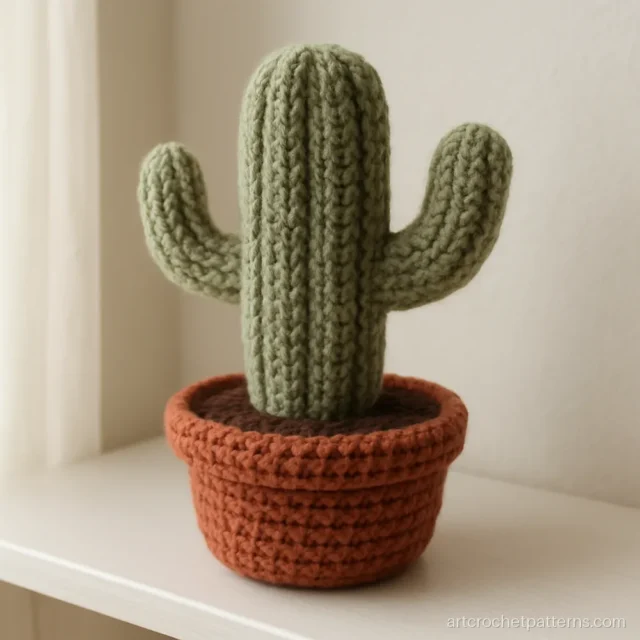 LevelBeginnerYarnWorsted cottonHook3.5 mm (E-4)
Two arm saguaro in a terracotta pot
The classic desert shape from the pattern below. The arms are short tubes sewn on at different heights so the plant looks natural.
Maker note: Pin both arms on before you sew. Set one higher than the other and tilt them up slightly.
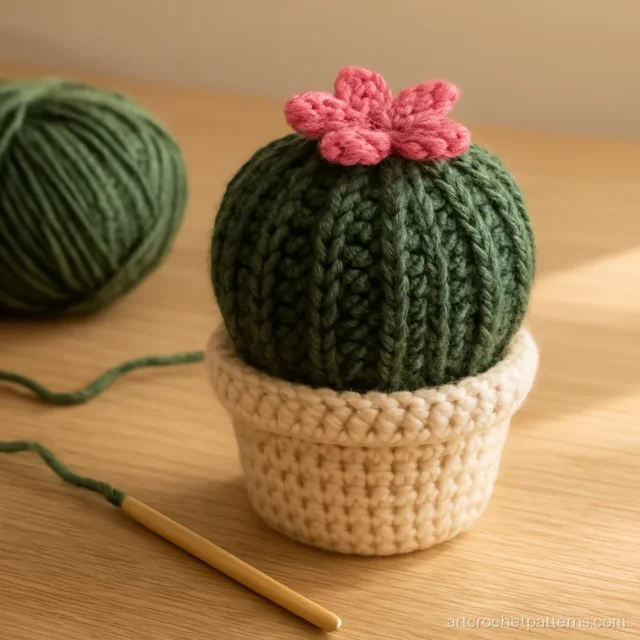 LevelBeginnerYarnWorsted acrylicHook3.5 mm (E-4)
Round barrel cactus with a pink bloom
A short ball of a cactus with a five petal flower. It uses less than half the yarn of the tall one and works up in an hour.
Maker note: Stop the body after Rnd 8 and close it like a ball. Sew the flower on dead center.
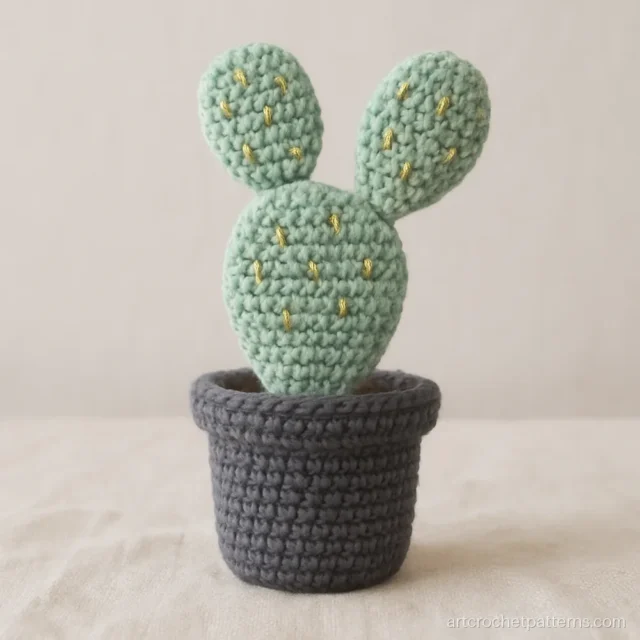 LevelEasyYarnWorsted cottonHook3.5 mm (E-4)
Prickly pear with flat paddles
Flat ovals stacked on each other make the paddle shape. Short yellow stitches on the surface stand in for spines.
Maker note: Stuff each paddle very lightly so it stays flat, then sew the paddles edge to edge.
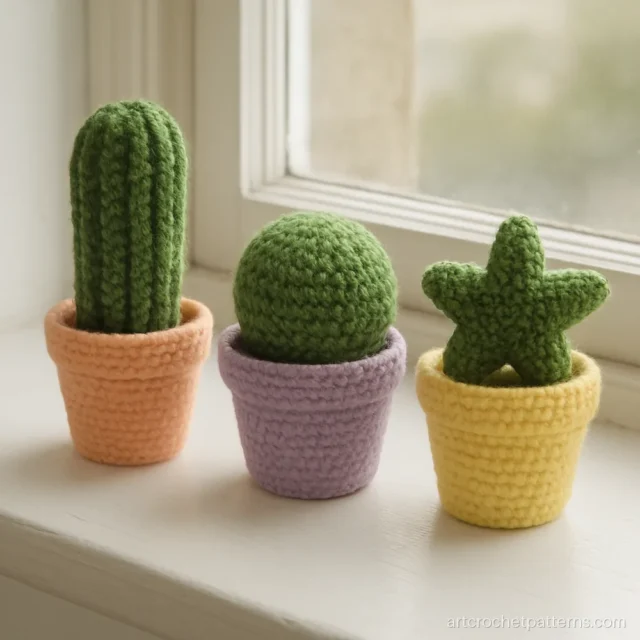 LevelBeginnerYarnDK acrylicHook3 mm
Pastel cactus trio for a windowsill
Three shapes in three pot colors: a tall tube, a ball and a tiny star. A good way to use small leftovers.
Maker note: With DK yarn, add one extra round to each part so the trio is not too tiny.
 LevelIntermediateYarnSport cottonHook2.75 mm (C-2)
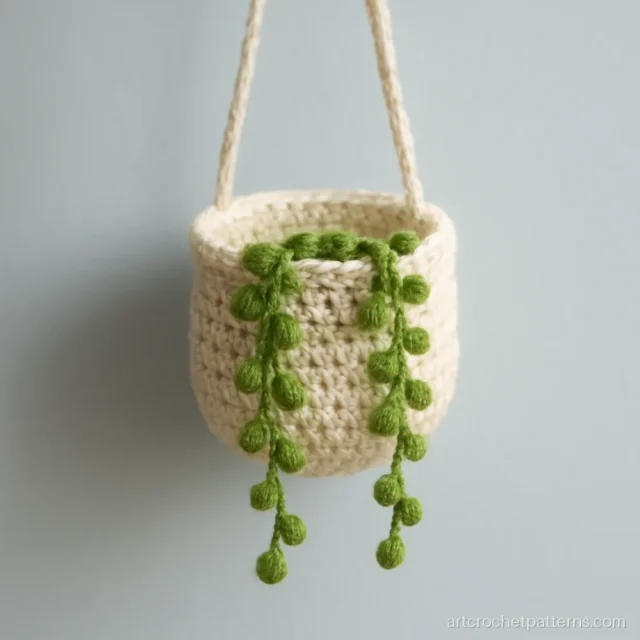
Hanging pot with trailing pearls
A soft cousin of the cactus: strings of little bobbles trail down past the pot edge. It looks best up high, where the strands can dangle freely.
Maker note: Make each strand a different length. Five strands of 8 to 14 inches looks full without tangling.
 LevelBeginnerYarnBulky acrylicHook5 mm (H-8)
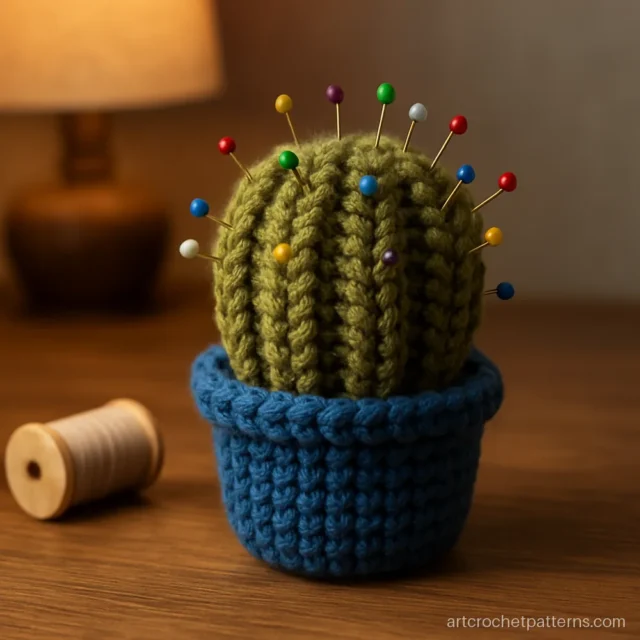
Chunky cactus pincushion
Firm stuffing and bulky yarn turn the cactus into a useful sewing tool. The pins become the spines.
Maker note: Stuff harder than you think. A soft body lets pins slide all the way in and get lost.
What you need for a crochet cactus
| Part | Yarn | Amount |
|---|---|---|
| Body and arms | Green worsted cotton or acrylic | About 40 yards |
| Pot | Terracotta, cream or any pot color | About 30 yards |
| Soil disc | Dark brown | About 8 yards |
| Flower (optional) | Pink, yellow or white | About 2 yards |
Gather polyester stuffing, the 3.5 mm hook, a single locking marker, a blunt yarn needle and a small zip bag of plastic pellets or clean aquarium gravel to weight the pot. Cotton gives the cleanest ribs. Acrylic feels gentler in the hand but blurs the ribs a bit. Go down a hook size from the label so no white fluff peeks out.
Free crochet cactus pattern: two arm saguaro
Finished size: about 5 inches tall from the pot base to the top of the cactus. Gauge is not critical, but your stitches should be tight. Rounds run in a continuous spiral with no joins, so clip a marker into each new round's opening sc. Stitch counts are in brackets.
Body (green)
- Rnd 1: 6 sc in MR (6)
- Rnd 2: inc in each st around (12)
- Rnd 3: (sc, inc) x6 (18)
- Rnd 4: (2 sc, inc) x6 (24)
- Rnds 5 to 18: working in BLO, sc in each st around (24)
- Fasten off with a 12 inch tail. Leave the bottom open.
Arms (make 2, green)
- Rnd 1: 6 sc in MR (6)
- Rnd 2: (sc, inc) x3 (9)
- Rnds 3 to 6: working in BLO, sc in each st around (9)
- Fasten off with a long tail. Stuff lightly.
Pot (terracotta)
- Rnd 1: 6 sc in MR (6)
- Rnd 2: inc in each st around (12)
- Rnd 3: (sc, inc) x6 (18)
- Rnd 4: (2 sc, inc) x6 (24)
- Rnd 5: (3 sc, inc) x6 (30)
- Rnd 6: working in BLO, sc in each st around (30)
- Rnds 7 to 12: sc in each st around (30)
- Rnd 13: working in FLO, (4 sc, inc) x6 (36)
- Rnds 14 to 15: sc in each st around (36)
- Sl st in next st and fasten off. Weave in the end.
Soil disc (brown)
- Rnds 1 to 5: work as pot Rnds 1 to 5 (30)
- Fasten off with a long tail.
Putting the cactus together
- Drop the bag of pellets into the pot. It keeps the plant from tipping when the arms make it top heavy.
- Stuff the body firmly, all the way into the top. Shape it with your fingers so the ribs run straight up.
- Center the open end of the body on the soil disc and whipstitch the last round of the body to the disc with the green tail. Add a little more stuffing before you close the gap.
- Sew one arm about Rnd 9 of the body and the other about Rnd 13 on the opposite side. Bend each arm up and tack its tip to the body with two small stitches.
- Push the soil disc into the pot so it sits level with Rnd 12, then whipstitch its edge to the inside wall all the way around.
- Fold the rim (Rnds 13 to 15) down over the outside of the pot. The FLO round makes a clean fold line.
For spines, embroider short straight stitches with a strand of white or pale yellow on the ribs. Our crochet flowers page has tiny blooms that sit well on top.
Cactus yarn and hook choices
| Cactus yarn | Hook range | How it turns out |
|---|---|---|
| Sport (2) | 2.75 or 3 mm | Keychain size, roughly 3.5 inches, with fine ribs |
| DK (3) | 3 or 3.25 mm | Near 4 inches, neat and firm |
| Worsted (4) | 3.5 or 4 mm | Our pattern size, close to 5 inches |
| Bulky (5) | 5 or 5.5 mm | Roughly 7 inches, a chunky shelf piece or pincushion |
Pick a green with some gray or blue in it. Sage, olive and dusty teal look like real desert plants. Bright kelly green reads as a toy.
Common crochet cactus problems
| What you see | Cause | Cactus fix |
|---|---|---|
| Ribs twist around the body | Spiral rounds lean as you go | That lean is normal. Work yarn under single crochet (wrap the yarn under the hook instead of over) for straighter columns, or keep the gentle twist. |
| Stuffing shows between stitches | Hook too big or loose hand | Drop one hook size and pull each sc snug. |
| Cactus falls over | Arms and body are heavier than the pot | Add more pellets and sew the soil disc in tightly. |
| Pot walls flare out | Rnd 6 was worked loosely | Work the BLO round with snug tension so the wall turns up at a sharp angle. |
| No ribs show | Worked through both loops | Check you are in the back loop for every body round. |
Gift and display ideas for a cactus crochet project
Make a row of three for a teacher's desk or a dorm shelf. Shrink one to sport weight and add a chain loop for a keychain. A Christmas version gets a red bloom and a tiny gold star, which pairs nicely with the ornaments on our Christmas crochet patterns page. If you enjoy soft plants that need no light, the crochet plants collection has leafy pots that sit well beside a cactus.
A cactus is a decor piece, not a baby toy. If you give it to a family with little ones, leave out the pellets, use no beads, and embroider all details so nothing can come loose.
Questions makers ask
Is a crochet cactus good for a beginner?
Yes. It uses single crochet, increases and back loop rounds, and the body is a plain tube with no shaping at the top. Most first timers finish one in an evening.
How do you make cactus ribs in crochet?
Work the body in the back loop only. The unworked front loops sit on the surface as raised lines that run up the body. Cotton shows them best.
What can I use to weight the pot?
Plastic poly pellets in a small zip bag work well. Clean, dry gravel or glass gems also work for a decor piece. Never put loose pellets straight into the pot, since they can leak through the stitches.
Can I make the cactus without a pot?
Yes. Close the bottom of the body with a decrease round, (2 sc, dec) x6 (18), then (sc, dec) x6 (12), then dec around (6), and it stands as a plush on its own.
How do I add spines?
Embroider tiny straight stitches over the ribs with white, cream or pale yellow yarn. Space them every two or three rounds and stagger them from rib to rib.
How long does a crochet cactus take?
The tall two arm version takes about 2 to 3 hours including sewing. A small barrel cactus with no arms takes about an hour.