
Crochet plants give you green on a dark shelf or a cold office desk, and here you get six potted designs plus a complete snake plant with its own pot. They never wilt, never drop leaves on the carpet and are safe around cats that chew real greenery.
Most crochet plant patterns use the same tools as amigurumi: tight single crochet worked in spirals, a stitch marker and a little stuffing. The pot is a cup shape, the soil is a flat circle, and the leaves are small tubes or flat shapes sewn into the soil. Once you can make a pot, you can fill it with almost any plant.
At a glance
Skill level
Beginner to intermediateYarn
Worsted cotton in greens, brown and terracottaHook
3.5 mm (E-4)Time
3 to 5 hours for the snake plantStitches used
MR, sc, inc, sc2tog, BLOSize
About 7 in tall with leaves
6 crochet plants designs to make
Every design lists the skill level, yarn and hook, with a note from the maker.
 LevelBeginnerYarnWorsted cottonHook3.5 mm (E-4)
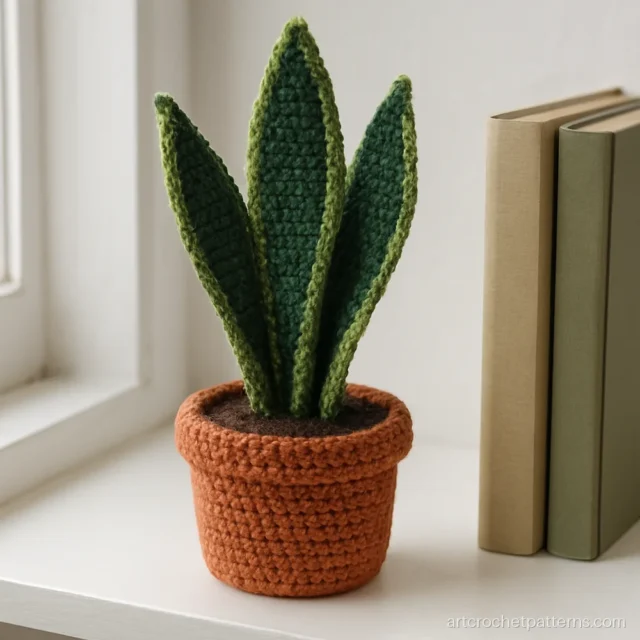
Snake plant in a terracotta pot
Three flat pointed blades stand up from a brown soil circle inside a cup shaped pot. Full steps for it appear below, and it makes a good first plant.
Maker note: Slide a chenille stem into each blade before you close it so the leaves stand straight and can be posed.
 LevelEasyYarnDK cottonHook3 mm
Succulent trio in tiny pots
Each rosette is a ring of petals worked into the front and back loops of a small circle. Three in a row fit a narrow windowsill.
Maker note: Use a slightly smaller hook for the petals than for the pots so the rosettes stay firm and cupped.
 LevelIntermediateYarnWorsted acrylicHook4 mm (G-6)
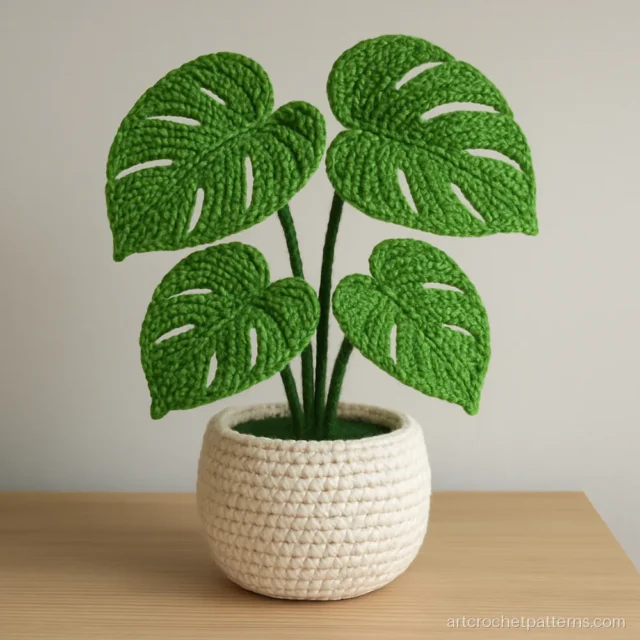
Monstera with split leaves
Flat leaves worked in rows of hdc and dc leave gaps that copy the splits of a real monstera. Floral wire stitched along the back holds each leaf open.
Maker note: Crochet over the wire with sc around the leaf edge instead of sewing it on later. It looks cleaner.
 LevelEasyYarnSport cottonHook2.75 mm (C-2)
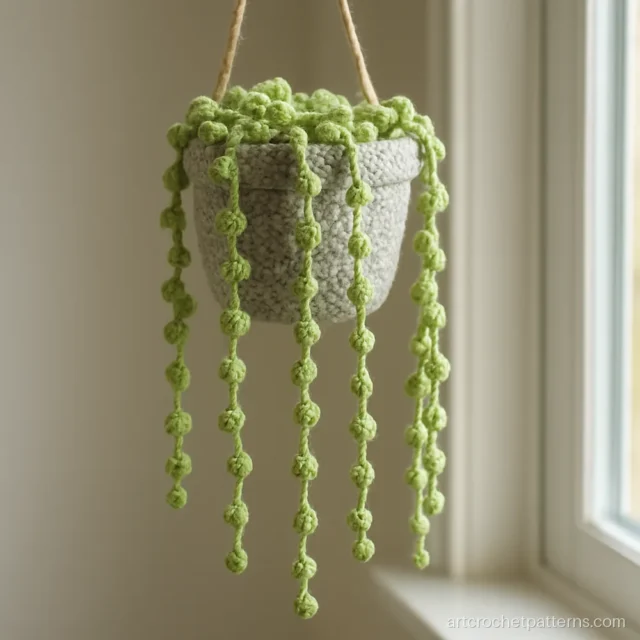
Trailing string of pearls
Long chains dotted with tiny bobbles spill over the rim of a small pot. Hang it from a hook or set it on a high shelf so the strands can fall.
Maker note: Space the bobbles every 3 chains and vary strand lengths from 6 to 14 inches for a natural look.
 LevelEasyYarnWorsted cottonHook3.5 mm (E-4)
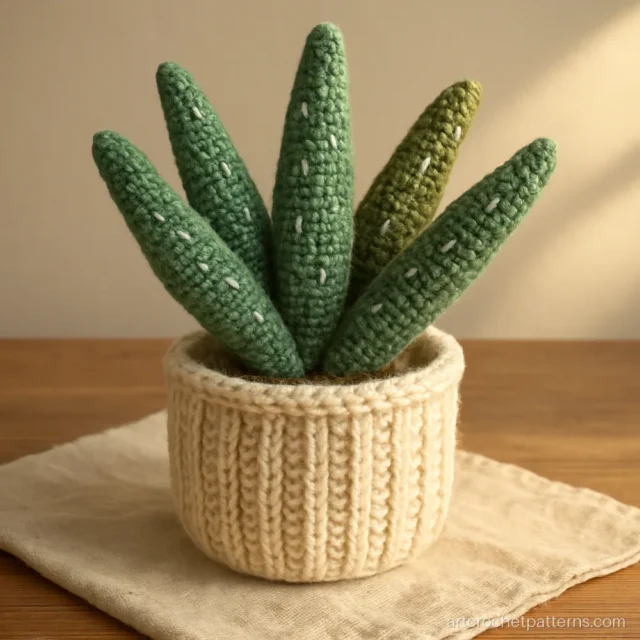
Spiky aloe in a cream planter
Aloe leaves are stuffed cones, wide at the base and pointed at the tip, sewn in a loose spiral so they fan out like the real plant.
Maker note: Embroider small white dashes along each leaf with a running stitch to copy the speckles of a real aloe.
 LevelIntermediateYarnDK acrylicHook3.5 mm (E-4)
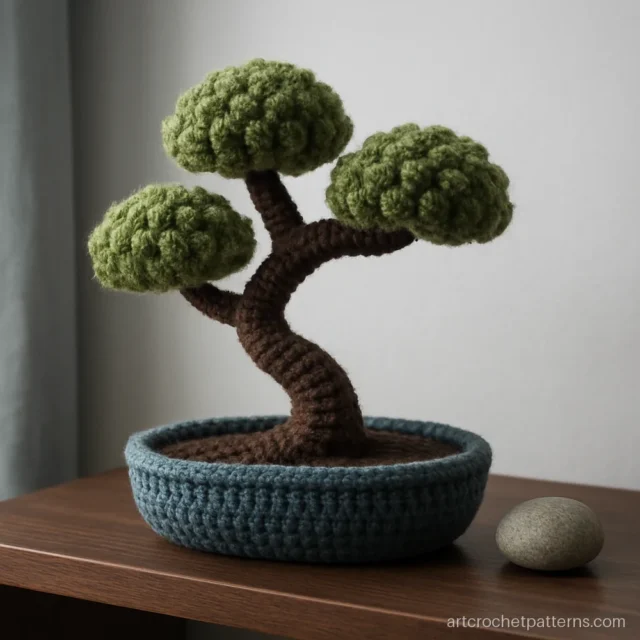
Little bonsai with leaf puffs
A wrapped wire trunk holds three cushion shaped clusters of puff stitches. The shallow oval pot is a stretched circle worked with extra increases at each end.
Maker note: Wrap the wire trunk in brown yarn first, then glue only the ends. Crochet covers the rest neatly.
Snake plant: a full crochet plant pattern
The finished plant is about 7 inches tall. The pot is 3 inches across at the rim. Every piece is worked in a continuous spiral, with the marker lifted into the newest first stitch as you go. Do not join rounds unless the pattern says so.
Materials: worsted (size 4) cotton in terracotta (about 60 yards), dark brown (15 yards), green (40 yards); an E-4 (3.5 mm) hook; stitch marker; fiberfill; a small zip bag of craft pellets or clean pebbles; 3 chenille stems; tapestry needle.
Gauge is not critical. Aim for tight stitches with no gaps.
Pot (terracotta)
- Rnd 1: 6 sc in MR. (6)
- Rnd 2: Inc in each st. (12)
- Rnd 3: (Sc, inc) 6 times. (18)
- Rnd 4: (2 sc, inc) 6 times. (24)
- Rnd 5: (3 sc, inc) 6 times. (30)
- Rnd 6: Working in BLO, sc in each st. (30)
- Rnds 7 to 8: Sc in each st. (30)
- Rnd 9: (4 sc, inc) 6 times. (36)
- Rnds 10 to 13: Sc in each st. (36)
- Rnd 14: (5 sc, inc) 6 times. (42)
- Rnds 15 to 16: Sc in each st. (42)
- Sl st in next st and fasten off. Fold Rnds 14 to 16 outward to form the rim.
Soil (brown)
- Rnds 1 to 5: Work as for the pot. (30)
- Rnd 6: (4 sc, inc) 6 times. (36)
- Fasten off, leaving a 16 inch tail.
Leaves (green, make 3)
- Rnd 1: 4 sc in MR. (4)
- Rnd 2: (Sc, inc) 2 times. (6)
- Rnd 3: (2 sc, inc) 2 times. (8)
- Rnd 4: (3 sc, inc) 2 times. (10)
- Rnds 5 to 24: Sc in each st. (10) For the short leaf, stop after Rnd 18.
- Fold a chenille stem in half, push it in with the bent end at the tip, and flatten the leaf. Sc across the opening through both layers. (5) Fasten off with a tail.
Assembly: set the pellet bag in the base of the pot and add fiberfill up to Rnd 13. Poke the wire ends of each leaf through the center of the soil circle, twist them together underneath and tuck them into the stuffing. Sew the leaf bases to the soil. Sew the soil edge to Rnd 13 on the inside of the pot all the way around.
Yarn and hook choices
Cotton gives crisp, matte leaves that look closer to real foliage than shiny acrylic. Acrylic is softer and fine for plants that will be handled.
| Yarn | Hook | What you get |
|---|---|---|
| Sport cotton | 2.5 to 3 mm | Small, detailed plants for a desk |
| DK cotton | 3 to 3.5 mm | Succulents and mini pots |
| Worsted cotton | E-4 or G-6 | Shelf size plants like the snake plant |
| Bulky acrylic | 5 to 6 mm | Big floor plants, very quick |
Go down a size or two from the hook printed on the ball band. Gaps between stitches let the white stuffing show and spoil the look.
Making a crochet plant look real
- Weight the pot. Pellets or pebbles in a sealed bag stop a tall plant from tipping.
- Use two greens. Change to a lighter shade for the last 2 rounds of a leaf, or embroider a stripe up the middle.
- Vary heights. Real plants never grow every leaf the same length.
- Angle the leaves. Sew outer leaves leaning out and the center leaf straight up.
- Close holes neatly. The invisible decrease keeps shaped leaves smooth.
A wire inside the leaves is fine for decor, but keep wired plants away from babies and pets that chew.
Other plants to put in the same pot
The pot and soil pattern above works for almost anything. Keep the soil at 36 stitches and change what grows from it.
- Succulent: a small sc circle with rounds of petals worked in the front loops, then the back loops.
- Cactus: a tall stuffed tube with ribs worked in BLO. See the crochet cactus patterns for full shapes.
- Tulips or daisies: wire stems with flower heads from the crochet flowers page.
- Trailing plants: chain strands with small leaves sewn on every inch, hung in a crochet plant hanger.
Fixing common plant problems
| Trouble | Reason | What to do |
|---|---|---|
| Pot sides bulge | Too much stuffing | Fill loosely and let the weights do the work |
| Leaves flop over | No wire or soft yarn | Add a chenille stem or use cotton |
| Base does not sit flat | Skipped the BLO round | Work Rnd 6 in back loops for a sharp edge |
| Rounds lean to one side | Normal spiral drift | Steam lightly and shape with your fingers |
Dusting and care
Crochet plants gather dust like any shelf item. Every few weeks, shake them gently or use a hair dryer on a cool setting. To clean, sponge the leaves with cool soapy water and let the plant dry upright. Do not put a wired plant in the washing machine, because the wire can bend and poke through the stitches. Sunlight fades greens over time, so a bright spot out of direct sun keeps colors fresh.
Questions makers ask
Are crochet plants good for beginners?
Yes. The snake plant asks for only three skills: a magic ring, single crochet worked in a spiral, and simple increases. The magic ring guide shows the start.
What yarn is best for a crochet plant?
Worsted cotton is the favorite. It holds shape, has a matte look like real leaves and comes in many greens. Acrylic works too and is softer.
How do I make crochet plant leaves stand up?
Put a chenille stem or floral wire inside the leaf, or crochet over wire along the edge. Stiff cotton and a small hook also help leaves hold themselves up.
How long does one crochet plant take?
The snake plant takes about 3 to 5 hours. Tiny succulents take under an hour each. A monstera or bonsai with many leaves can take a weekend.
Are crochet plants safe with pets?
They are safer than many real houseplants that are toxic to cats and dogs. Still, keep any piece with wire or pellets out of reach of pets that chew fabric.
Can I make a crochet plant without stuffing?
Yes. Flat leaves like the monstera need no stuffing. The pot can hold a small piece of foam cut to fit instead of fiberfill.