
This crochet leaf pattern is worked all the way around a short chain: up one side in stitches that grow from short to tall and back again, a chain at the tip, then the mirror image down the other side. It takes ten minutes, uses about three yards of yarn and finishes with a slip stitch stem.
Leaves are the quiet part of every flower project. A rose without leaves looks unfinished, and a bunch of stems with no greenery looks bare and stiff. Below you get the free leaf pattern with counts, a chart for making leaves longer or wider, six designs from autumn maple tones to an ivy garland, and the small fixes that keep leaves flat.
At a glance
Skill level
BeginnerYarn
Worsted (size 4) cotton or acrylic, about 3 ydHook
4 mm (G-6)Size
About 2.5 in long plus stemTime
10 minutesStitches used
ch, sl st, sc, hdc, dc, tr
6 crochet leaf pattern designs to make
Every design lists the skill level, yarn and hook, with a note from the maker.
 LevelBeginnerYarnWorsted cottonHook4 mm (G-6)
Sage green pointed leaf
The free pattern below in sage cotton. The tall treble stitches in the middle give the leaf its width, and the ch 2 at the tip makes a clean point.
Maker note: Work the second side into the bottom loops of the chain, the ones left after side one.
 LevelBeginnerYarnWorsted acrylicHook4 mm (G-6)
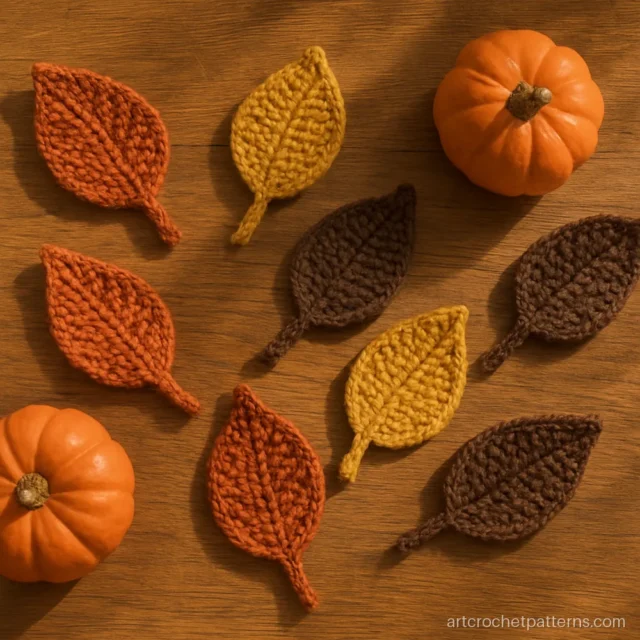
Autumn leaves in rust and mustard
Eight leaves in fall colors for a table scatter. Use them loose, string them as a garland, or sew them around a wreath form.
Maker note: Make some leaves one round of sc bigger than others. Mixed sizes look far more natural.
 LevelEasyYarnDK cottonHook3.5 mm (E-4)
Ivy leaf garland
Small leaves joined every 3 inches along a long chain vine, alternating two greens. Drape it over a mirror or a shelf edge.
Maker note: Make the leaves first, then crochet the vine and join each leaf with a sl st as you pass.
 LevelEasyYarnWorsted cottonHook4 mm (G-6)
Veined leaf applique
A lighter green vein worked in surface slip stitch up the middle. It turns a plain leaf into a detailed applique for a pillow or bag.
Maker note: Work the vein before you sew the leaf down; you need room behind it for the yarn.
 LevelBeginnerYarnWorsted cottonHook3.5 mm (E-4)
Long tulip leaf blade
A long chain with mostly double crochet makes a narrow blade for tulips and daffodils. It wraps around a wire stem neatly.
Maker note: Keep the treble section short and the dc sections long for a blade instead of an oval.
 LevelEasyYarnSize 10 cotton threadHook1.65 mm steel
Leaf bookmark in thread
Two thread leaves at the end of a slim chain. Thin enough to close inside a book without leaving a mark.
Maker note: Starch the leaves so they stay flat between pages.
Free crochet leaf pattern with stem
You will work along the top loops of the chain first, turn the corner at the tip and come back along the bottom loops, so the chain ends up in the middle of the leaf as its center line.
- Yarn: about 3 yards of worsted (size 4) cotton or acrylic
- Hook: 4 mm (G-6)
- Notions: tapestry needle
- Finished size: about 2.5 inches long and 1.25 inches wide, plus a 1 inch stem
- Ch 11.
- Side 1: sc in 2nd ch from hook, hdc in next ch, dc in next 2 ch, tr in next 2 ch, dc in next 2 ch, hdc in next ch, then (sc, ch 2, sc) all in the last ch for the tip (11 sts and a ch-2 tip)
- Side 2: rotate the work and continue along the bottom loops of the chain. Hdc in next ch, dc in next 2 ch, tr in next 2 ch, dc in next 2 ch, hdc in next ch, sc in last ch (20 sts)
- Join with sl st to the first sc.
- Stem: ch 6, sl st in 2nd ch from hook and in each of the next 4 ch (5 sl st). Sl st into the base of the leaf.
- Fasten off and weave in the ends.
Side 1 and side 2 mirror each other: sc, hdc, 2 dc, 2 tr, 2 dc, hdc, sc. That symmetry is what gives the oval shape. The (sc, ch 2, sc) at the tip shares one chain and makes the point.
How to crochet a leaf: the chain corner
The part beginners worry about is the turn at the tip. After the (sc, ch 2, sc), turn the leaf so the chain lies along the top. A line of lone loops now runs beneath your side 1 stitches. Those are the bottom loops. Insert the hook under one loop for each stitch on side 2, working back toward the start.
If you find the single loops hard to see, work over the starting tail as you go. It fills the gap and makes the center line slightly raised, like a midrib. The crochet chain lesson shows which loops are which.
Bigger, longer and rounder crochet leaves
Every change starts with the chain. Keep the stitches mirrored on both sides and the leaf stays symmetrical.
| Leaf shape | Chain | Stitches each side | Use it for |
|---|---|---|---|
| Small round | Ch 8 | sc, hdc, 3 dc, hdc, then the tip | Daisies, hair clips |
| Classic oval | Ch 11 | sc, hdc, 2 dc, 2 tr, 2 dc, hdc, then the tip | Roses, appliques |
| Long blade | Ch 21 | sc, 2 hdc, 6 dc, 2 tr, 6 dc, 2 hdc, then the tip | Tulips, lilies |
| Wide leaf | Ch 11, then a sc round | Classic, then sc around with 3 sc at the tip | Pillows, wreaths |
Count before you work: the stitches before the tip, plus the one chain that holds the tip, must equal the chain minus one. For the classic leaf that is 9 plus 1, or 10.
Leaf mistakes and simple repairs
| Problem leaf | Reason | Repair |
|---|---|---|
| Curls into a tube | Chain too tight compared to the stitches | Make the 11 chains one hook size up |
| Lopsided | Sides not mirrored | Check each side against the stitch list before joining |
| No point at the tip | Ch 2 skipped | Put (sc, ch 2, sc) into the last chain |
| Stem flops | Loose slip stitches | Work the stem tightly, or sc instead of sl st |
| Holes along the middle | Stitches worked between chains | Work into a loop of each chain, never the gaps |
Ways to use crochet leaves
- Two leaves under each crochet rose for a brooch or applique.
- Long blades wrapped round wire stems in a crochet flower bouquet.
- A fall garland of leaves in rust, gold and brown; see crochet garland for joining and hanging.
- Leaves on a plant pot or a stuffed crochet plant.
- A ring of leaves around a crochet sunflower for a wall hanging.
Surface slip stitch makes a quick vein: hold a contrast yarn behind the leaf, poke the hook through from the right side, draw the contrast up, and slip stitch along the center line. More motifs to pair with leaves are on the crochet flowers page.
Questions makers ask
How do you crochet a leaf for beginners?
Chain 11 and work up one side with stitches that go from short to tall and back, then put (sc, ch 2, sc) in the last chain for the tip. Mirror those stitches back along the chain's underside and join.
Which fiber gives crisp crochet leaves?
Cotton gives the crispest leaves and a sharp tip. Acrylic is fine for garlands and toys. Pick two or three greens so a bunch of leaves looks natural.
Why won't my crochet leaf lie flat?
Chain loosely, keep both sides mirrored, and block the leaf by pinning it damp to a towel until dry. A tight chain is the usual reason a leaf curls.
Can I add a leaf to a flower without sewing?
Yes. Join the leaf yarn to the back of the flower with a slip stitch, chain 11 and work the leaf from there. It is attached as you go.
How do I make a free crochet leaf pattern bigger?
Swap in heavier yarn with a matching larger hook, or start with a longer chain and add stitches in the middle section. One extra outline of sc, with 3 sc at the tip, widens it too.