
A crochet cardigan is the garment most makers want to try first, and the easiest way in is a cardigan built from five plain rectangles. This page gives you that pattern in five sizes, six other cardigan styles to try next, and the fit and layout notes you need to make any of them come out wearable.
A rectangle cardigan has no shaping at all: one back panel, two front panels and two sleeves, each one a flat panel of hdc rows, joined with a needle at the end. It drapes in a relaxed, slightly boxy way with dropped shoulders. If you can make a straight blanket with even edges, you can make this.
Looking for a pullover instead? The crochet sweater page covers sweater patterns with closed fronts. This page stays with open front styles.
At a glance
Skill level
Easy (confident beginner)Yarn
Worsted (size 4) wool blend or acrylicHook
5.5 mm (I-9)Gauge
14 hdc and 10 rows = 4 inSizes
S, M, L, XL, 2XTime
20 to 35 hoursStitches used
ch, hdc, sc
6 crochet cardigan designs to make
Every design lists the skill level, yarn and hook, with a note from the maker.
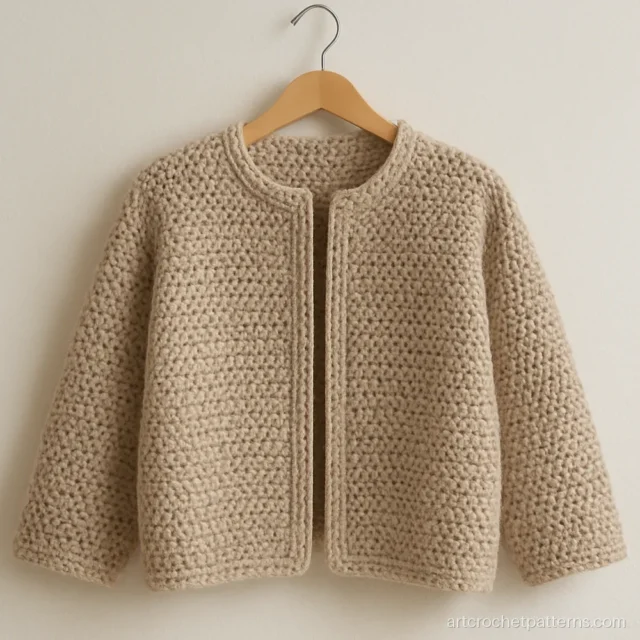 LevelEasyYarnWorsted wool blendHook5.5 mm (I-9)
Oatmeal rectangle cardigan
Five rectangles, a sc front band and dropped shoulders. This relaxed everyday layer is the written crochet cardigan pattern on this page.
Maker note: Make all five pieces before blocking any of them, then block them together so they match in length.
 LevelIntermediateYarnWorsted acrylicHook5 mm (H-8)
Patchwork granny square cardigan
Squares in clashing brights, joined in cream, built on the same back, fronts and sleeves layout. The full method is on the granny square cardigan page.
Maker note: Plan the squares on paper first. Count how many fit across the back at your size before you make any.
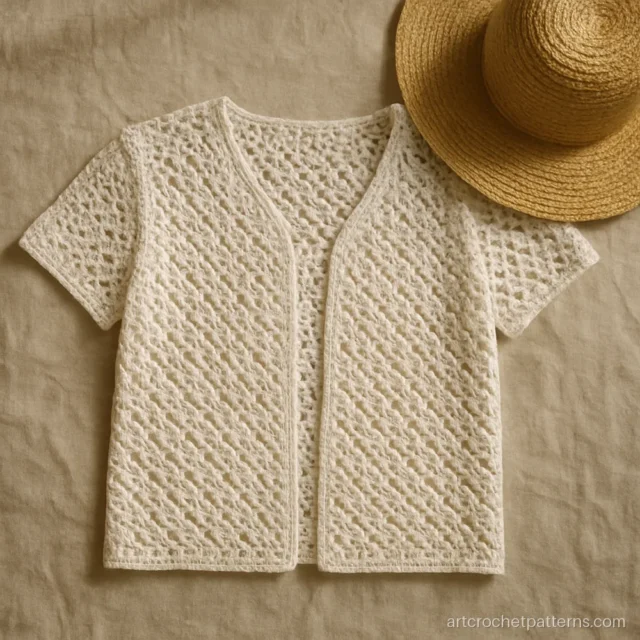 LevelEasyYarnDK cottonHook4.5 mm (7)
White short sleeve summer cardigan
A crochet short sleeve cardigan in light cotton with an open V stitch. Throw it over a sundress in summer evenings.
Maker note: Cotton lace lengthens with wear, so stop the body about an inch before your target.
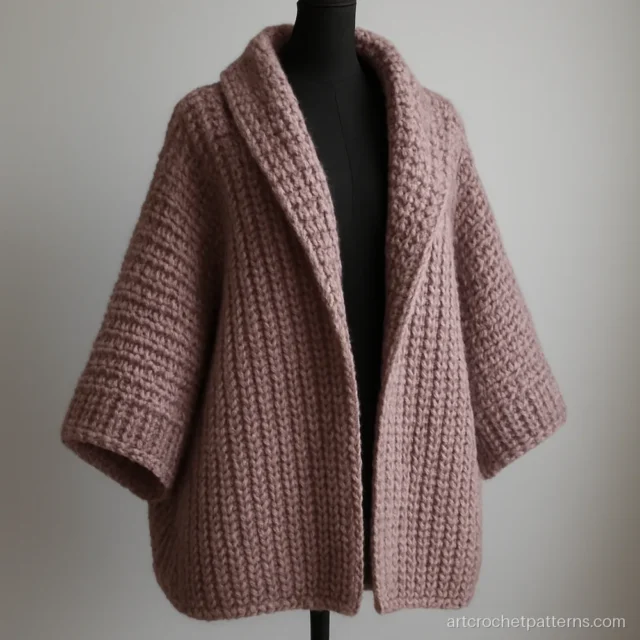 LevelBeginnerYarnBulky acrylic blendHook8 mm (L-11)
Mauve cocoon cardigan
A single large panel, folded with its short edges stitched partway, gives wide sleeves. The middle opening falls into a soft shawl collar.
Maker note: The cocoon fits most sizes. Measure wrist to wrist across your back for the rectangle length.
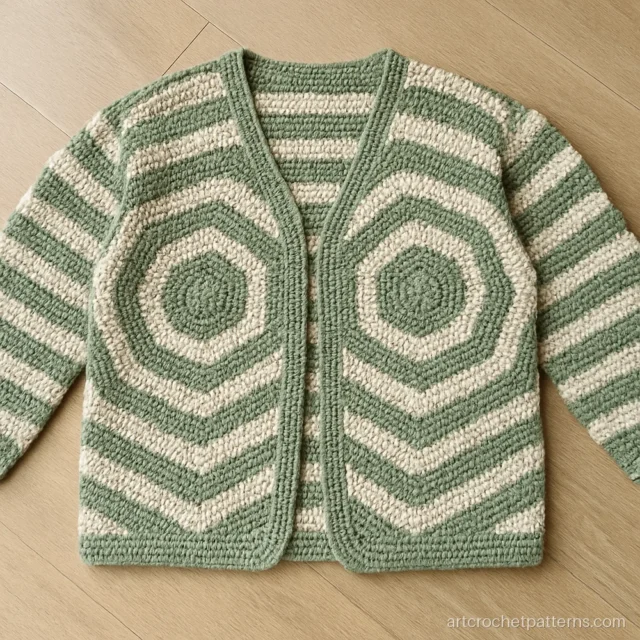 LevelIntermediateYarnWorsted wool blendHook5.5 mm (I-9)
Sage and cream hexagon cardigan
Two big hexagons folded in half become the fronts, back and sleeves at once. Laid flat, you can see how the shape works.
Maker note: Keep adding rounds until one hexagon, point to point, spans from the middle of your back out to your wrist.
 LevelAdvancedYarnDK cotton blendHook4 mm (G-6)
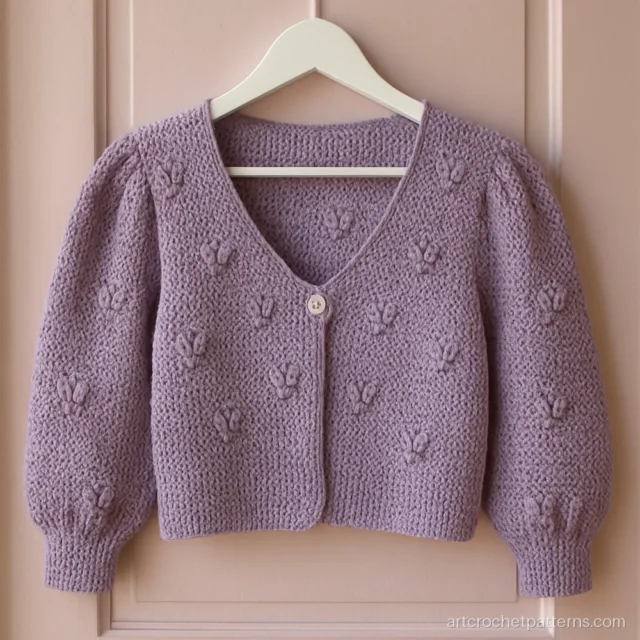
Cropped lilac butterfly cardigan
Butterfly motifs worked in clusters across a cropped body, with gathered puff sleeves. A playful spring layer for jeans.
Maker note: Make one butterfly as a swatch. Its width tells you how many will fit across the front at your size.
Easy crochet cardigan pattern: five rectangles
Choose your size by finished bust. This cardigan is meant to be roomy, with about 4 to 6 inches more than your actual bust measurement. Inside the pattern, the smallest size comes first and the others follow in brackets: S (M, L, XL, 2X).
| Size | To fit bust | Finished bust | Body length | Sleeve length | Yarn |
|---|---|---|---|---|---|
| S | 32 to 34 in | 38 in | 22 in | 17 in | 1,100 yd |
| M | 36 to 38 in | 42 in | 23 in | 17 in | 1,250 yd |
| L | 40 to 42 in | 46 in | 24 in | 16.5 in | 1,350 yd |
| XL | 44 to 46 in | 50 in | 25 in | 16 in | 1,450 yd |
| 2X | 48 to 50 in | 54 in | 26 in | 15.5 in | 1,600 yd |
Sleeves look short on paper because the dropped shoulder adds a few inches to the arm. Materials: the yardage from the table in a medium weight yarn, a 5.5 mm crochet hook, which is US I-9, locking markers and a blunt needle.
Gauge: a blocked swatch shows 14 stitches across and 10 rows up in a 4 inch square.
- Note: the ch 2 at the start of each row is a turning chain and does not count. Work the first hdc into the first stitch.
- Back: Ch 68 (76, 82, 90, 96). Row 1: Hdc in 3rd ch from hook and in each ch across, turn. (66 (74, 80, 88, 94) hdc)
- Back Row 2: Ch 2, hdc in each st across, turn. (66 (74, 80, 88, 94) hdc) Rep Row 2 until you have 55 (58, 60, 62, 65) rows in all. Fasten off.
- Fronts (make 2): Ch 35 (39, 42, 46, 49). Work Row 1 as for the back. (33 (37, 40, 44, 47) hdc) Rep Row 2 until the front has the same number of rows as the back. Fasten off.
- Sleeves (make 2): Ch 58 (62, 65, 68, 72). Work Row 1 as for the back. (56 (60, 63, 66, 70) hdc) Rep Row 2 until you have 42 (42, 41, 40, 39) rows. Fasten off.
- Shoulders: lay the back flat and place the fronts on top, edges matching at the outer sides. Sew the top edges together from each outer edge inward for 6 (6.5, 7, 7.5, 8) inches. The unsewn middle forms the neck.
- Sleeves: fold each sleeve in half across its last row and mark the center. Pin that mark to a shoulder seam and sew the sleeve top to the body. The sleeve covers 8 (8.5, 9, 9.5, 10) inches down the front and back.
- Side and sleeve seams: sew each sleeve underarm seam, then continue down the side of the body to the hem.
- Front band: join yarn at the lower right front corner. Row 1: Ch 1, sc evenly up the right front, around the back neck and down the left front, working 3 sc for every 2 row ends and 1 sc in each st across the back neck. Turn. Rows 2 and 3: Ch 1, sc in each sc, turn. Fasten off.
Mattress stitch hides seams almost completely, and the mattress stitch lesson covers it. Run each tail inside a seam allowance before the final blocking.
Crochet cardigan layout: how the pieces fit
Before you learn how to crochet a cardigan of any style, it helps to see the layout. Picture it flat on a table:
- Rectangle cardigan: the back is one wide rectangle. Each front is half as wide and sits on top of it. The two sleeves are wide rectangles sewn sideways onto the shoulder line, like a capital T. This is the pattern above.
- Cocoon cardigan: one big rectangle, doubled over lengthwise. Each short end gets sewn a few inches in to form sleeves. The opening between the seams wraps your back and falls into a collar at the front.
- Hexagon cardigan: two large hexagons, each folded so that one side becomes a sleeve, joined up the back. See the hexagon cardigan crochet pattern.
- Granny square cardigan: squares joined into the same T shape as the rectangle version. The granny square cardigan page has a square count chart.
- Top down raglan: started at the neckline and grown downward, with increases on four diagonal lines. Seamless, and easier to try on as you go, but harder for a first garment.
Getting the size right
Over a thin shirt, take your chest measurement at its widest point with a flexible tape. Then add ease, the extra room the cardigan has beyond your body.
| Fit | Ease added to bust | Look |
|---|---|---|
| Close | 0 to 2 in | Neat, sits near the body; fronts meet |
| Classic | 3 to 6 in | Easy to layer over a shirt; the pattern above |
| Oversized | 8 to 12 in | Slouchy, dropped shoulders slide down the arm |
Compare with a cardigan you already own. Lay it flat and measure across the back from side seam to side seam, then double it. That number is the finished bust you like to wear. Gauge matters a lot in garments: if your swatch has 15 stitches instead of 14 over 4 inches, a size M comes out almost 3 inches smaller.
Yarn and hook for crochet cardigans
| Season | Yarn | Hook | Notes |
|---|---|---|---|
| Winter | Worsted wool or wool blend | 5 to 6 mm | Warm, springy, blocks into crisp pieces |
| All year | Worsted acrylic | 5 to 6 mm | Easy care, light, sold in every color |
| Summer | DK cotton or cotton and linen | 4 to 4.5 mm | Cool and breathable; can stretch in length |
| Cozy layer | Bulky acrylic blend | 8 to 9 mm | Fast, thick; best for cocoon styles |
Garments drape better with a slightly larger hook than you would use for a blanket in the same yarn. A stiff fabric makes a cardigan stand away from the body like a box. For a white crochet cardigan, choose a smooth cotton; it shows every stitch, so keep tension even.
Cardigan styles to try next
- Crochet short sleeve cardigan: use the rectangle pattern, but work only 10 to 14 rows for each sleeve. In DK cotton it becomes a crochet summer cardigan.
- Crochet cocoon cardigan: one rectangle about as long as your wrist to wrist span and 30 to 36 inches wide. Very forgiving on fit.
- Crochet patchwork cardigan: mixed granny squares, solid squares and stripes in a T layout.
- Butterfly cardigan: lace or cluster butterflies worked into the fabric or appliquéd onto a plain body. The crochet butterfly page has motifs.
- Long line cardigan: add 8 to 10 inches to the body length of the rectangle pattern and side slits at the hem.
- Crochet cardigan sweater with buttons: add 2 more rows to the front band and make ch 2 buttonholes on the right front.
Explore more wearables in the crochet clothes section, or a lighter layer on crochet shrug.
Fit problems and fixes
| Problem | Likely reason | What to do |
|---|---|---|
| Whole cardigan too small | Gauge tighter than 14 sts per 4 in | Swatch again on a J-10 |
| Fronts gape and flip out | Band too tight or too loose | Rework the band with fewer or more sc, then block |
| Grows longer after wearing | Heavy cotton or loose gauge | Make body shorter and dry flat |
| Sleeves too long | Dropped shoulder not counted | Measure from neck center to wrist and subtract half the back width |
| Pieces different lengths | Row counts differ | Count rows, not inches, on matching pieces |
Blocking and caring for the finished piece
Before seaming, wet block each panel to the widths and lengths your size calls for. Pieces that match in size make seams far easier. Wash the finished cardigan by following the yarn label. Wool and cotton cardigans should dry flat, never on a hanger, because the wet weight pulls the shoulders out of shape. Store folded in a drawer. A cardigan on a hanger slowly grows bumps at the shoulders. For the full method, see blocking crochet.
Questions makers ask
How do you crochet a cardigan as a beginner?
Start with rectangles. Make a back, two fronts half as wide, and two sleeves, all in plain rows. Sew the shoulders, add the sleeves, seam the sides, and work a sc band around the front. The pattern above walks through each step.
Is a crochet cardigan hard to make?
A rectangle cardigan is easy if you can keep straight edges and count rows. Fitted cardigans with shaping, buttonholes or lace are harder. The main skills are gauge and seaming.
How much yarn will my crochet cardigan use?
For the worsted rectangle cardigan, about 1,100 yards for size S up to 1,600 yards for 2X. Lace and bulky styles vary, so check the pattern and buy one extra ball.
Crochet cardigan or crochet sweater: how are they different?
A cardigan opens down the front, often with a band or buttons. A sweater is a pullover with a closed front. Our crochet sweater page covers pullovers.
Which yarn suits a crochet summer cardigan?
A DK cotton or cotton and linen blend with an open stitch. It breathes and feels cool. Cotton does lengthen slightly as you wear it.
Is a crochet cardigan a quick make?
The rectangle cardigan takes about 20 hours in size S and up to 35 hours in 2X, including seaming. Chunky cocoon styles can be done in a weekend.
Can I make the rectangle cardigan with short sleeves?
Yes. Work each sleeve for 10 to 14 rows instead of the full count. Everything else stays the same.