
Your first crochet sweater can be built from four flat rectangles, two for the body and two for the arms, joined with straight seams and finished with ribbing. That is the easy pullover written out below, sized from S to 2X, after six original designs to spark ideas.
Drop shoulder sweaters like this one skip all armhole shaping. The sleeve simply meets the body a little below the shoulder bone, which gives the relaxed look you see on many store bought knits. Once you have made one, raglan and fitted styles feel far less mysterious. For how sweaters fit into the wider family of garments, start at the crochet clothes hub.
At a glance
Skill level
EasyYarn
Worsted wool blend or acrylicHook
5.5 mm (I-9)Stitches used
hdc, FPdc, BPdc, scSizes
S, M, L, XL, 2XTime
20 to 35 hours
6 crochet sweater designs to make
Every design lists the skill level, yarn and hook, with a note from the maker.
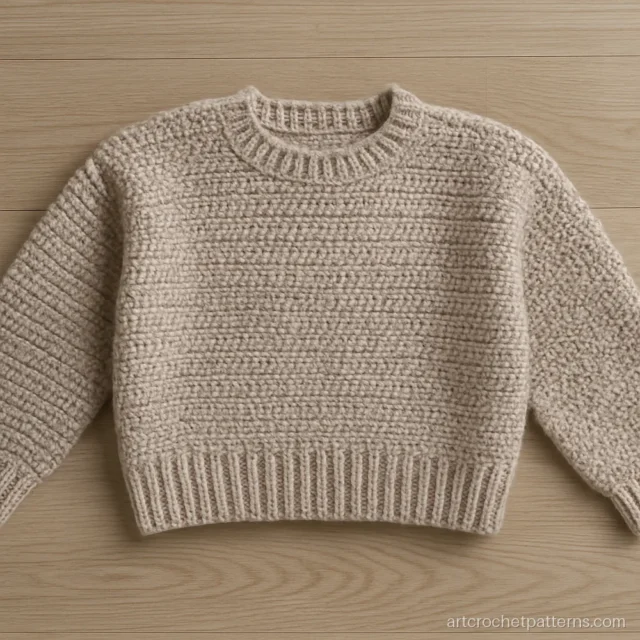 LevelEasyYarnWorsted wool mix, oatmealHook5.5 mm (I-9)
Oatmeal drop shoulder pullover
The rectangle pullover from this page in an oatmeal wool blend. Plain half double crochet shows off a tweedy yarn well.
Maker note: Steam each piece to the same size before seaming. Rectangles that match make a sweater that hangs straight.
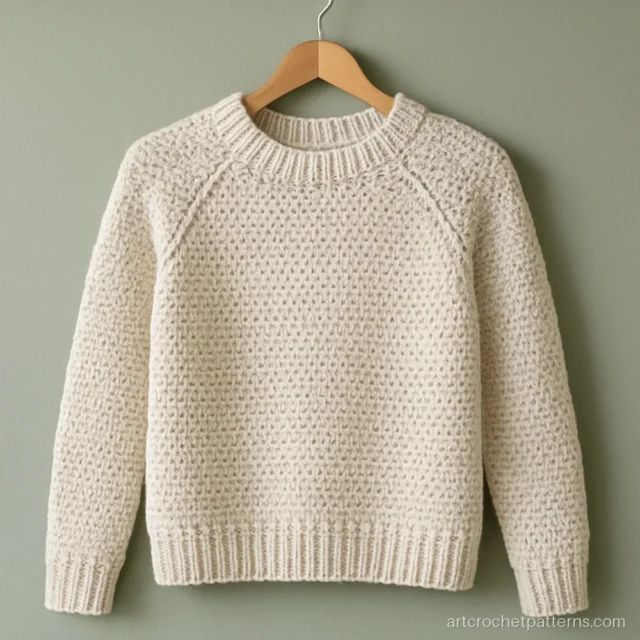 LevelIntermediateYarnWorsted acrylic, whiteHook5 mm (H-8)
White raglan crew neck
A white crochet sweater worked top down as a raglan, so fitting checks happen while the yoke grows. The diagonal increase lines run from neck to underarm.
Maker note: Place a marker at each of the four raglan lines and move it up every round. It saves a lot of counting.
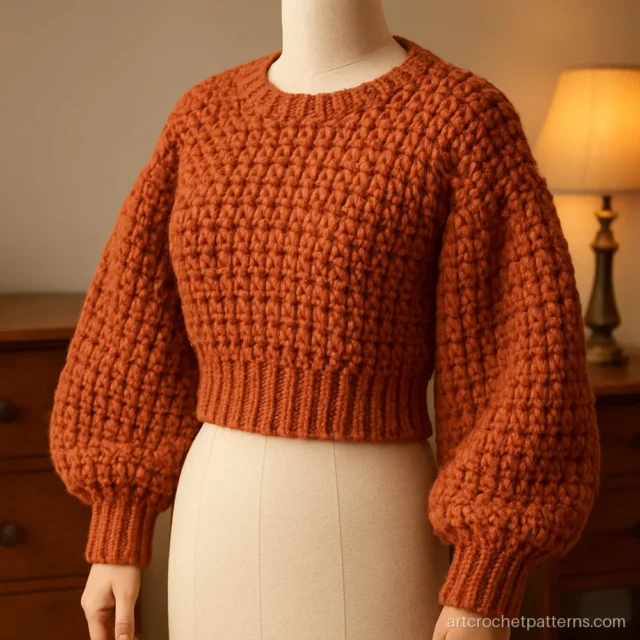 LevelEasyYarnBulky acrylic wool, rustHook8 mm (L-11)
Rust chunky cropped sweater
A crochet cropped sweater in bulky yarn with gathered sleeves. Bulky weight means fewer rows and a quick finish.
Maker note: Cropped sweaters still need full length sleeves. Do not shorten the sleeves with the body.
 LevelIntermediateYarnWorsted wool, charcoalHook5 mm (H-8)
Charcoal crew for him
A crochet mens sweater in moss stitch with a classic crew neck. The tight texture looks like a knit from a few steps away.
Maker note: Many men like a roomy fit and longer sleeves. Measure an old favorite sweater and copy it.
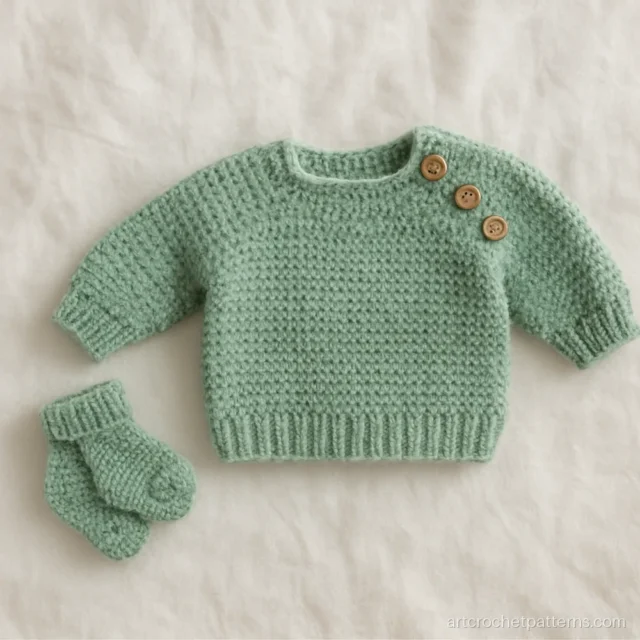 LevelEasyYarnDK acrylic, mintHook4 mm (G-6)
Mint baby sweater
A crochet baby sweater with buttons on one shoulder so it goes over a baby's head easily.
Maker note: Sew buttons with strong thread and check them each wash. Trim every strand end short: nothing over 7 inches should dangle on baby wear.
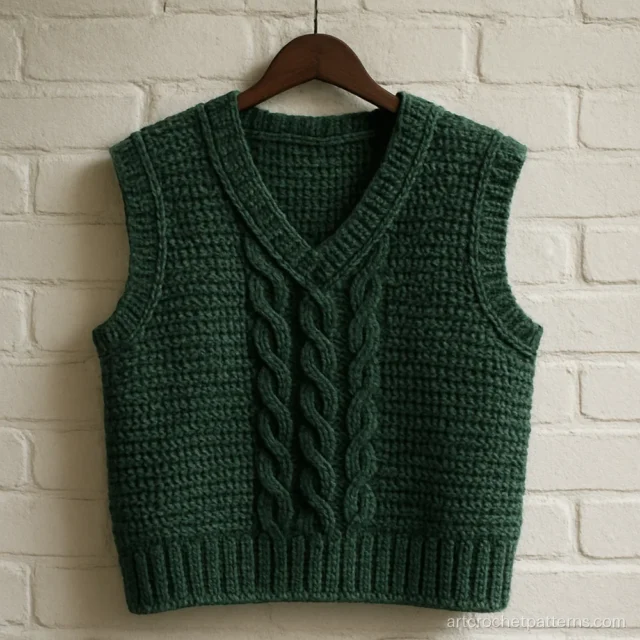 LevelIntermediateYarnWorsted wool blend, forestHook5 mm (H-8)
Forest green sweater vest
A crochet sweater vest with a V neck and front post cables up the center. It layers over a collared shirt.
Maker note: Post stitch cables pull the fabric in. Swatch the cable panel separately and add stitches if it narrows.
Simple crochet sweater pattern: the four rectangle pullover
Everything here is a flat rectangle in half double crochet. The ribbing is added at the end, in rounds, so you never have to work rib in rows. The neck is a boat neck: the top edges of the front and back are simply left open between the shoulder seams. Sizes are written S (M, L, XL, 2X), and chest measurements for each one sit in the fit section below.
What to gather
- Worsted wool blend or soft acrylic, roughly 1,100 (1,250, 1,400, 1,550, 1,700) yards
- Hook in 5.5 mm (I-9) or the size that gets gauge
- Locking markers, a yarn needle and a steam iron or spray bottle
Gauge
Your gauge swatch should hold thirteen hdc in width and ten rows in height over 4 inches. Ch 2 begins every row and is never counted, so your first hdc goes into the very first stitch.
Front and back (make 2)
- Ch 64 (70, 77, 83, 90).
- Row 1: Hdc in 3rd ch from hook and in each ch across. Turn. (62, 68, 75, 81, 88)
- Row 2: Ch 2 (does not count), hdc in each st across. Turn. (62, 68, 75, 81, 88)
- Rows 3 to 52 (55, 57, 60, 62): Rep Row 2. Fasten off. (62, 68, 75, 81, 88)
Sleeves (make 2)
- Ch 54 (57, 60, 64, 67).
- Row 1: Hdc in 3rd ch from hook and in each ch across. Turn. (52, 55, 58, 62, 65)
- Rows 2 to 40 (41, 42, 42, 44): Ch 2 (does not count), hdc in each st across. Turn. Fasten off. (52, 55, 58, 62, 65)
Putting it together
- Block all four pieces. Front and back should be about 19 (21, 23, 25, 27) inches wide.
- Shoulders: with right sides facing, sew 16 (18, 20, 21, 23) stitches in from each outer corner of the top edge. The middle stays open as the boat neck.
- Fold each sleeve in half across its last row and mark the center. Pin that mark to a shoulder seam and sew the last row of the sleeve to the side edges of the front and back.
- Sew each sleeve seam and side seam in one line, from cuff to underarm to hem.
- Cuffs: join yarn at the sleeve seam. Rnd 1: ch 2 (does not count), work 30 (32, 34, 36, 38) hdc evenly around the cuff edge, sl st to first hdc. Rnds 2 to 4: ch 2, *FPdc around next st, BPdc around next st; rep from * around, sl st to first st.
- Hem: work the same rib, with Rnd 1 having 116 (128, 140, 152, 164) hdc.
- Neck: one round of sc, about 1 sc per stitch, keeps the edge from rolling.
How to crochet a sweater that fits: measure, then pick
Wrap a soft tape around the chest at its widest, with one finger slipped under it. Add ease: 2 inches for a close fit, about 6 for this drop shoulder look, and 8 or more for oversized. Pick the size whose finished chest is nearest your total.
| Size | Chest (in) | Finished chest (in) | Body length before rib (in) |
|---|---|---|---|
| S | 32 to 34 | 38 | 21 |
| M | 36 to 38 | 42 | 22 |
| L | 40 to 42 | 46 | 23 |
| XL | 44 to 46 | 50 | 24 |
| 2X | 48 to 50 | 54 | 25 |
For a crochet cropped sweater, stop the body 5 to 6 inches early. For longer arms, add rows to the sleeves; every 5 rows adds about 2 inches.
Yarn and hook for crochet sweaters
Crochet makes a thicker fabric than knitting at the same yarn weight, so lighter yarn often gives the better sweater. Worsted is the easiest to learn on. DK makes a smoother, less bulky drape if you have the patience for more rows.
| Yarn | Hook | The sweater you get |
|---|---|---|
| DK wool or blend | 4.5 mm | Light, drapes well, more hours |
| Worsted, part wool | 5.5 mm (I-9) | Warm, even, the pattern above |
| Worsted acrylic | 5.5 mm | Machine washable, a little less springy |
| Bulky | 8 mm | Very warm and quick, heavy on the shoulders |
Wool blocks into shape and springs back at the cuffs. Acrylic is easy care, but it does not block much, so the swatch has to be right before you start.
Sweater styles to try next
- Raglan: worked top down in one piece with four increase lines. A crochet raglan sweater fits the shoulders better than a drop shoulder.
- Hexagon sweater: two big granny hexagons folded into a body with sleeves. Our hexagon cardigan page shows the folding.
- Cardigan: the same rectangles with the front split in two. A crochet cardigan pattern free to follow is on the crochet cardigan page.
- Crochet sweater vest: skip the sleeves and add ribbed armholes; see crochet vest designs.
- Crochet tank: for summer, the sleeveless rib on our crochet tank top page.
- Hoodie: add a hood rectangle folded and seamed at the top, shown on the crochet hoodie page.
A sweater scarf crochet pattern, a long scarf with pockets or sleeves at the ends, is closer to a wrap; the crochet scarf page covers the basic shapes.
Where sweaters go wrong
| Trouble | Usually because | What helps |
|---|---|---|
| Sweater is much bigger than planned | Gauge swatch was too small or not washed | Make a 6 inch swatch and wash it like the sweater |
| Sleeves too tight at the top | Sleeve width under twice the armhole depth | Add stitches to the sleeve chain, 3 per inch |
| Fabric feels stiff and boardy | Hook size runs small for that yarn | Move up 0.5 mm and make a fresh swatch |
| Neck slides off one shoulder | Boat neck too wide | Sew the shoulder seams 3 stitches longer |
| Ribbing flares | Too many stitches in Rnd 1 | Use the counts given; the hem round is about 90 percent of the body edge |
Washing a handmade sweater
Check the yarn label. Wool usually wants a hand wash in cool water with a wool wash, a gentle squeeze in a towel, and a flat dry. Acrylic usually tolerates a cool, delicate machine cycle. Dry every sweater flat, whatever the fiber, and fold it for storage. A cedar block in the drawer keeps moths away from wool.
Questions makers ask
Is a crochet sweater hard for a beginner?
Not this one. If you can work even rows of half double crochet and count to the end of a row, you can make it. The only new skills are seaming and post stitches for the rib.
How much worsted does one crochet sweater eat up?
The pullover here uses about 1,100 to 1,700 yards of worsted across sizes. Lacy stitches use less, dense stitches like moss or post stitch texture use more.
Can I make this as a crochet mens sweater?
Yes. The sizing is unisex. Most men want a longer body and sleeves, so add 5 rows to each piece that needs it for every 2 extra inches.
Is there an easy crochet baby sweater pattern?
The same four rectangles work at tiny sizes in DK yarn. For a baby sweater crochet pattern with proper sizes, see our baby crochet patterns page.
Why is my crochet sweater so heavy?
Crochet uses more yarn per square inch than knitting. Choose a lighter yarn, a hook one size up, or an airier stitch like V stitch or mesh.
How do I crochet a sweater with sleeves that taper?
Start the sleeve at the cuff with fewer stitches and add 1 hdc at each end every 4th row until it reaches the full width. Seam it the same way.