
A crochet vest gives you the cozy look of a sweater without sleeves, which means less yarn, fewer hours and no sleeve seams to fight with. On this page are six vest designs and a complete V neck sweater vest pattern in four sizes.
The pattern is two panels in half double crochet with a ribbed hem. The front splits at the armholes and each side is shaped with one decrease every other row, so the V comes out the same in every size. It layers over a shirt in autumn and over a tee in spring.
At a glance
Skill level
Easy to intermediateYarn
Worsted wool blend or acrylicHook
5.5 mm (I-9)Stitches used
Hdc, hdc2tog, FPdc, BPdc, scSize
Chest 34 to 48 inTime
12 to 18 hours
6 crochet vest designs to make
Every design lists the skill level, yarn and hook, with a note from the maker.
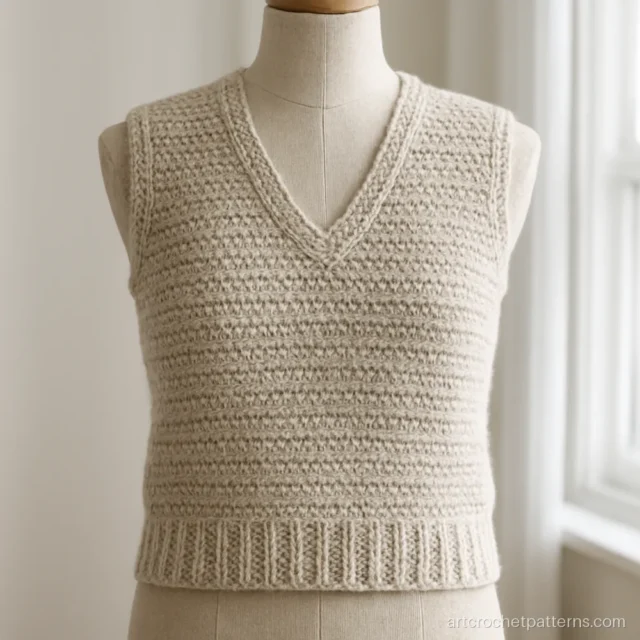 LevelEasyYarnWorsted wool blendHook5.5 mm (I-9)
V neck sweater vest in oatmeal
The written pattern. Plain half double crochet rows with post stitch ribbing at the hem.
Maker note: Count the V decreases with a tally on paper. Both front sides must end on the same row.
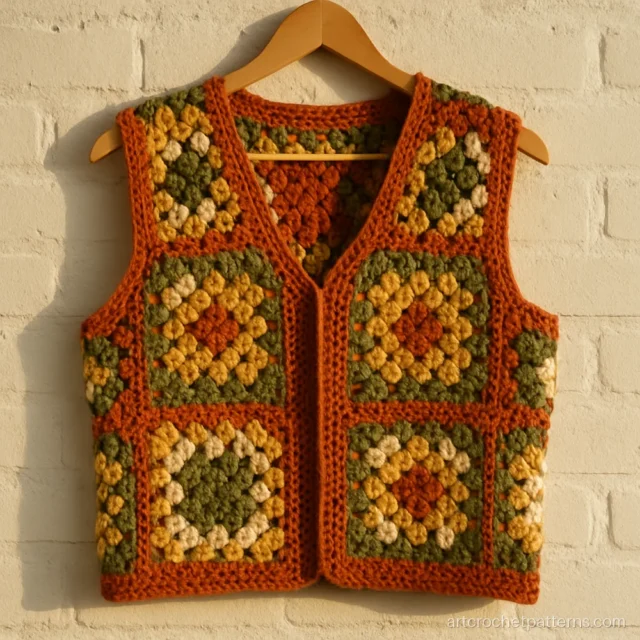 LevelEasyYarnWorsted acrylicHook5 mm (H-8)
Patchwork granny square vest
Twenty squares in four earthy shades, joined into a boxy vest. A good way to use up stash yarn.
Maker note: Arrange the twenty motifs in vest shape first and photograph the layout to judge where each color falls.
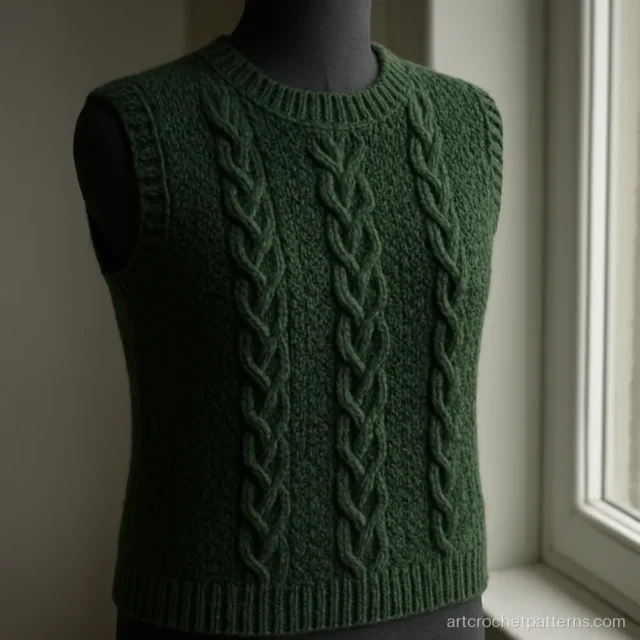 LevelAdvancedYarnAran woolHook5.5 mm (I-9)
Cabled crew neck vest in forest green
Three cable panels down the front, made with crossed front post treble stitches. A classic look.
Maker note: Cables draw the fabric narrower; widen any cabled panel by roughly a tenth.
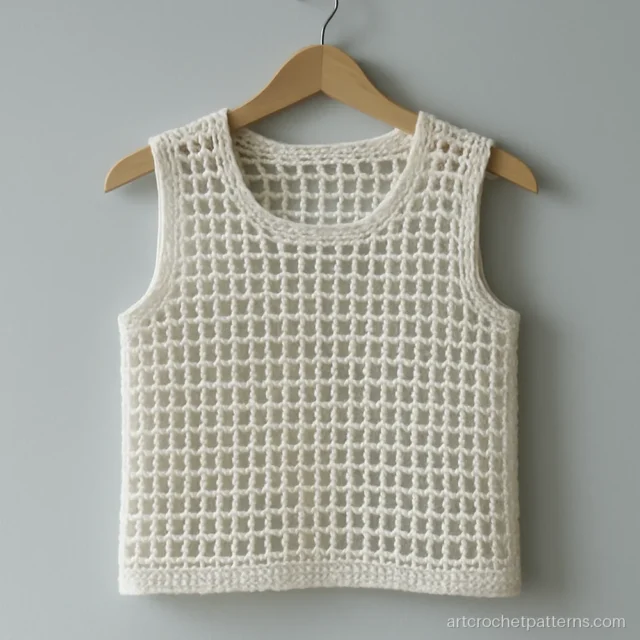 LevelEasyYarnDK cottonHook4.5 mm (7)
White mesh layering vest
An open mesh vest in cotton that layers over a tee or a slip dress in warm weather.
Maker note: Mesh grows lengthwise when worn. Block it a little shorter than you want it to finish.
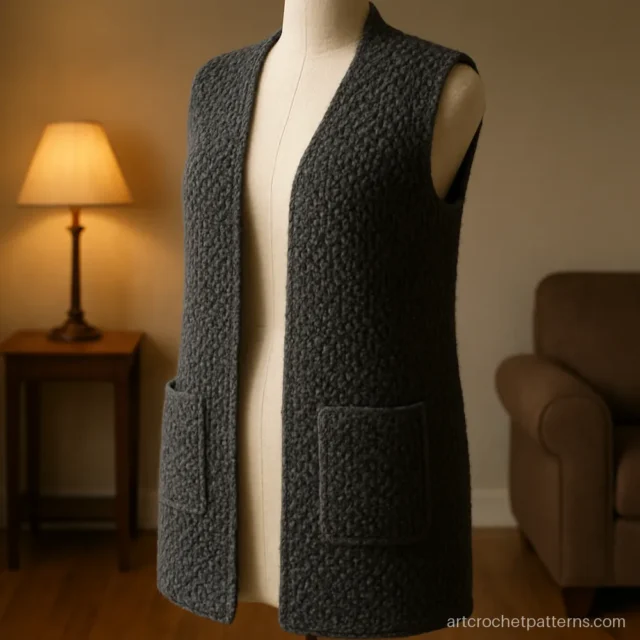 LevelIntermediateYarnWorsted acrylicHook5.5 mm (I-9)
Long open front vest
A hip length vest with no buttons and two patch pockets. Worked in moss stitch for a soft, woven look.
Maker note: Sew the pockets on before seaming the sides so you can lay the front perfectly flat.
 LevelEasyYarnWorsted acrylicHook5.5 mm (I-9)
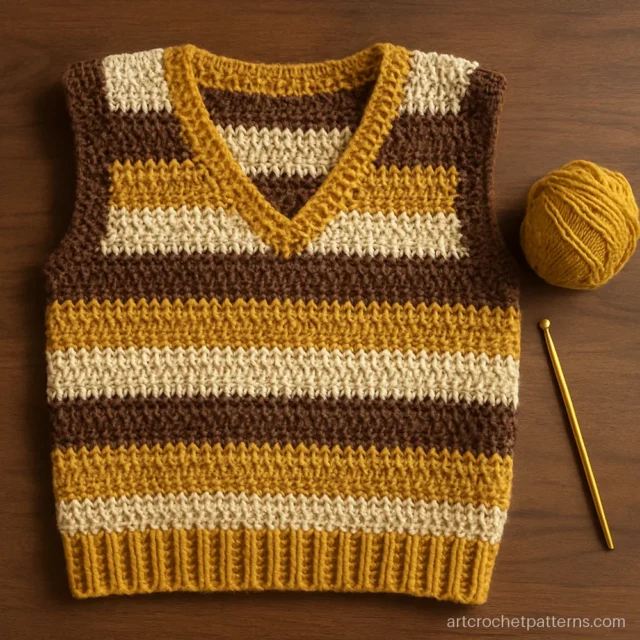
Retro striped vest
The V neck pattern in two row stripes of three colors. Carry the yarns up the side seam.
Maker note: Two row stripes let you carry each color up the side, which means far fewer ends to weave in.
How a crochet vest is built
Nearly every vest comes down to two flat panels, seamed where they meet over the shoulders and along each side. The shaping happens in three places:
- Hem. A band of ribbing that pulls in slightly so the vest sits on the hips instead of flaring.
- Armholes. A few stitches skipped at each side, then a small number of decrease rows to curve the opening.
- Neck. A straight back neck, and on the front either a scooped crew or a V made by decreasing at the center.
Once you have made one vest, you can change the stitch, the neck or the length freely. The same panels with sleeves become a crochet sweater, and an open front version leans toward a crochet cardigan.
Free crochet vest pattern: V neck sweater vest
Written for size M (chest 38 to 40 inches). US terms. The ch 2 at the beginning of hdc and rib rows is not counted. Finished chest is about 40 inches with 0 to 2 inches of ease.
Materials: 650 to 750 yards of worsted yarn for size M, a 5.5 millimeter hook (US letter I-9), markers, a blunt seaming needle.
Gauge: 4 inches holds 14 hdc across and 10 hdc rows up.
- Back. Ch 72. Row 1: hdc in 3rd ch from hook and in each ch across, turn (70).
- Rows 2 to 4: ch 2, *FPdc around next st, BPdc around next st; rep from * across, turn (70). On rows 3 and 4, work FPdc around posts that stand out toward you and BPdc around posts that sink away, so the ribs line up.
- Rows 5 to 34: ch 2, hdc in each st across, turn (70).
- Armholes. Row 35: ch 1, sl st in next 5 sts, ch 2, hdc in next 60 sts, turn, leaving the last 5 sts unworked (60).
- Row 36: ch 2, hdc2tog, hdc in each st to last 2 sts, hdc2tog, turn (58).
- Rows 37 and 38: rep Row 36 (56, then 54).
- Rows 39 to 55: ch 2, hdc in each st across, turn (54). Fasten off.
- Front. Work Rows 1 to 35 as for the back (60).
- Left side of V. Row 36: ch 2, hdc2tog, hdc in next 26 sts, hdc2tog, turn, leaving the other 30 sts unworked (28).
- Row 37: ch 2, hdc2tog, hdc in next 24 sts, hdc2tog, turn (26).
- Row 38: ch 2, hdc2tog, hdc in next 22 sts, hdc2tog, turn (24).
- Row 39 (starts at neck edge): ch 2, hdc2tog, hdc in each st across, turn (23).
- Row 40: ch 2, hdc in each st across, turn (23).
- Rows 41 to 54: rep Rows 39 and 40 seven more times (16).
- Row 55: ch 2, hdc in each st across (16). Fasten off.
- Right side of V. With the same side facing as Row 36 of the left side, join yarn in the first unworked st at the center. Row 36: ch 2, hdc2tog, hdc in next 26 sts, hdc2tog, turn (28).
- Rows 37 and 38: work as for the left side (26, then 24).
- Row 39 (starts at armhole edge): ch 2, hdc in each st to last 2 sts, hdc2tog, turn (23).
- Row 40: ch 2, hdc in each st across, turn (23).
- Rows 41 to 54: rep Rows 39 and 40 seven more times (16).
- Row 55: ch 2, hdc in each st across (16). Fasten off.
Assembly: place front and back with right sides together. Sew the 16 shoulder stitches of each front side to the outer 16 stitches of the back. The 22 middle stitches of the back form the back neck. Sew the side seams from the top of the ribbing to the armhole.
Edging: start at a shoulder seam and single crochet twice around the neckline, using sc3tog at the point of the V on each round. Work 2 rounds of sc around each armhole.
Crochet vest sizes
Every size uses the same V shaping: three combined decrease rows, then eight single decreases at the neck edge. Only the stitch counts change.
| Size | Chest (in) | Ch | Row 1 | After armholes | Each shoulder |
|---|---|---|---|---|---|
| S | 34 to 36 | 66 | 64 | 48 | 13 |
| M | 38 to 40 | 72 | 70 | 54 | 16 |
| L | 42 to 44 | 78 | 76 | 60 | 19 |
| XL | 46 to 48 | 86 | 84 | 68 | 23 |
For the front of each size, split the stitches left after Row 35 in half. Each half loses 6 stitches in Rows 36 to 38 and 8 more along the neck, which lands on the shoulder count above. The back neck is 22 stitches in all sizes. For a longer vest, add rows between Rows 5 and 34.
Yarn and hook for vests
| Yarn | Hook | The vest you get |
|---|---|---|
| DK wool or acrylic | G-6 or size 7 | Thin enough to wear under a jacket; needs more rows |
| Worsted wool blend | I-9 as written | Warm and soft with good stitch definition |
| Worsted acrylic | I-9 | Easy care, a little less drape |
| Aran wool | I-9 or J-10 | Thick and cozy; best for cables |
| DK cotton | Size 7 | Cool for spring layering; heavier when wet |
Wool mixed with a little synthetic fiber keeps its shape and resists pilling under arms. Hand dyed and high yardage wool skeins cost more but give a richer color.
Common vest fitting problems
| What happens | Why | Change |
|---|---|---|
| Armholes gape at the sides | Armhole too deep for your frame | Work 2 fewer rows after Row 38 on back and front |
| V is too deep or too shallow | Neck decreases spaced for an average torso | Start the split 2 rows higher for a shallower V |
| Ribbing flares | Post stitches too loose | Drop to an H-8 for the three rib rows |
| Shoulders slip off | Shoulder seam too narrow | Sew the seams 2 stitches wider toward the neck |
Ways to style and change your vest
- Crew neck: instead of the V, work the front like the back to Row 49, then leave the center 22 sts unworked and finish each shoulder separately.
- Cropped: stop the body at Row 24 for a short vest over high waisted trousers or a crochet skirt.
- Granny squares: make 4 inch squares and join them into panels the same size as the written ones.
- Button front: split the front up the middle from Row 5 and add a button band.
For more wearable patterns see the crochet clothes section.
Questions makers ask
Is a crochet vest a good first garment?
Yes. It has no sleeves and only light shaping, so you practice gauge, decreasing and seaming on a project that is quicker than a sweater. Make a gauge swatch first; a vest that is 2 stitches off over 4 inches ends up 5 inches or more too big or too small around.
What yardage does this crochet vest pattern take?
Plan on 550 yards of worsted in the smallest size, rising to around 900 in the XL, in half double crochet. Textured stitches like puffs or cables can use a third more.
What do I wear under a crochet vest?
A collared shirt for a classic look, a plain tee for casual days, or a fitted long sleeve top in cold months. Mesh vests layer over tank tops and slip dresses.
How do I stop my vest from stretching?
Use a wool blend rather than pure cotton, work at the gauge given, and store the vest folded. Hanging a vest pulls the shoulders and makes it longer.
Can I add pockets to a crochet vest?
Yes. Crochet two squares of about 5 by 5 inches in the same stitch and sew them to the front before you seam the sides. Place their top edges about 3 inches above the ribbing so your hands reach them easily.
Can a crochet sweater vest go in the washing machine?
Only if the label allows it. Superwash wool and acrylic tolerate a gentle cycle in cool water. Afterward, spread the vest on a towel, ease it back to the measurements in the size table and leave it until fully dry.