
Crochet curtains filter daylight into soft patterns on the floor, so here are six panel ideas plus a complete mesh cafe curtain you can start tonight. A cafe panel covers only the lower half of a window, so it stays small enough for a first home project.
Most curtain patterns are open work: mesh, filet, shells or lace. Open stitches use less yarn, dry faster after washing and hang lighter on the rod. Most makers pick cotton, since a cotton panel keeps its length over months on the rod, while acrylic tends to sag.
If you have made a scarf or a crochet table runner, you already have the skills. The pattern below uses only chains, double crochet and half double crochet.
At a glance
Skill level
Easy to advancedYarn
DK or sport cotton, or size 10 threadHook
4 mm (G-6) for the cafe panelTime
12 to 20 hours per panelStitches used
ch, dc, hdc, scGood for
Kitchens, bathrooms, doorways
6 crochet curtains designs to make
Every design lists the skill level, yarn and hook, with a note from the maker.
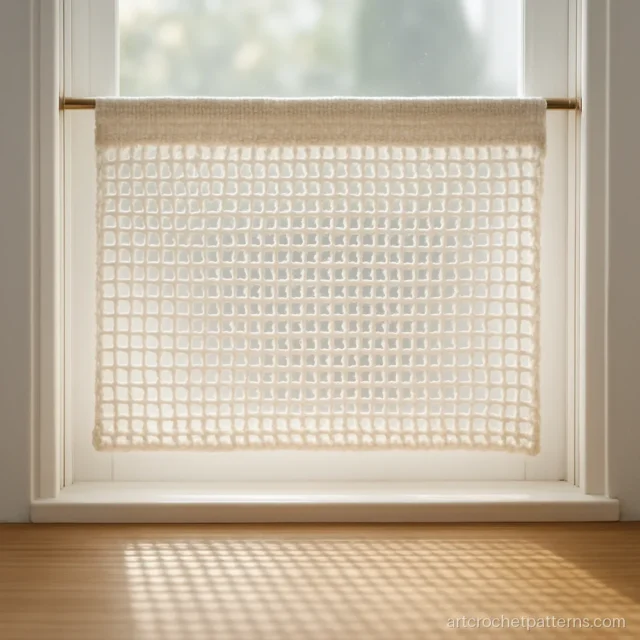 LevelEasyYarnDK cottonHook4 mm (G-6)
White mesh cafe curtain with rod pocket
A grid of double crochet and single chains, finished with a solid band that folds into a rod pocket. The full instructions for it follow further down.
Maker note: For the first ten rows, count ch-1 spaces as each row finishes. One lost space makes the edge slant.
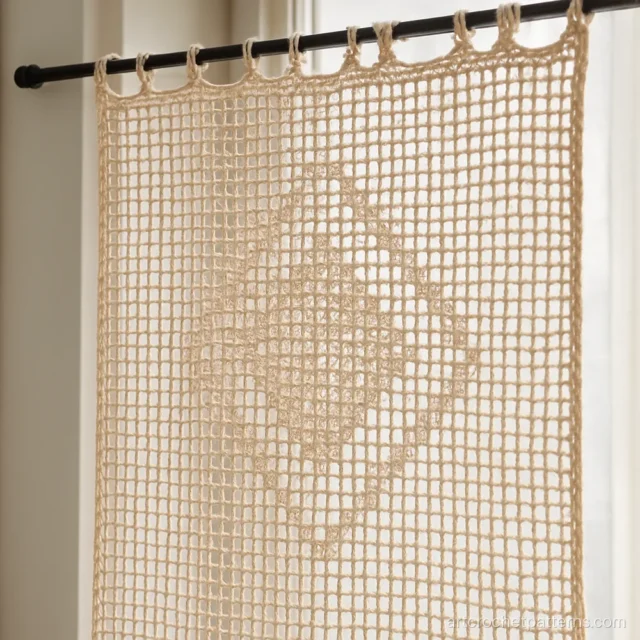 LevelIntermediateYarnSize 10 cotton threadHook1.75 mm steel
Ecru filet panel with diamond motif
Filet crochet draws a picture with filled and open squares. Thread gives crisp blocks, and a diamond is an easy first chart because it is symmetrical.
Maker note: Mark every tenth row of the chart with a sticky note so you never lose your place.
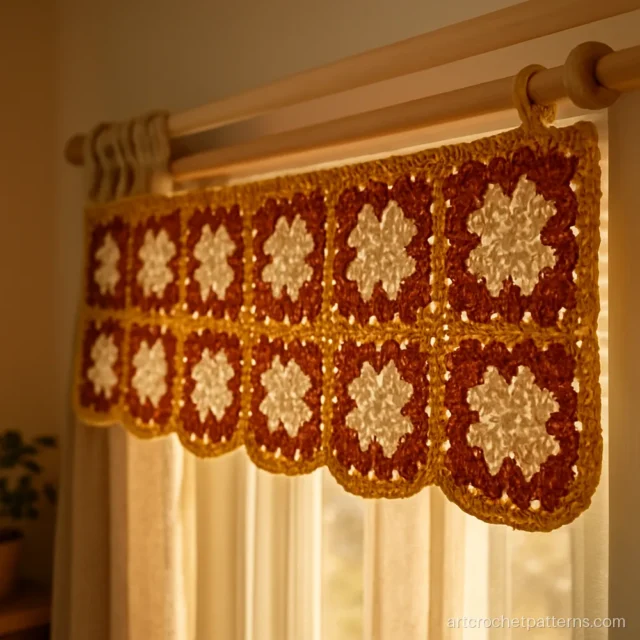 LevelBeginnerYarnWorsted acrylicHook5 mm (H-8)
Granny square valance in warm colors
A single strip of joined granny squares hangs across the top of a window as a short valance. Use leftover worsted in two or three warm shades.
Maker note: Join the squares with a flat slip stitch seam so the strip hangs straight instead of rippling.
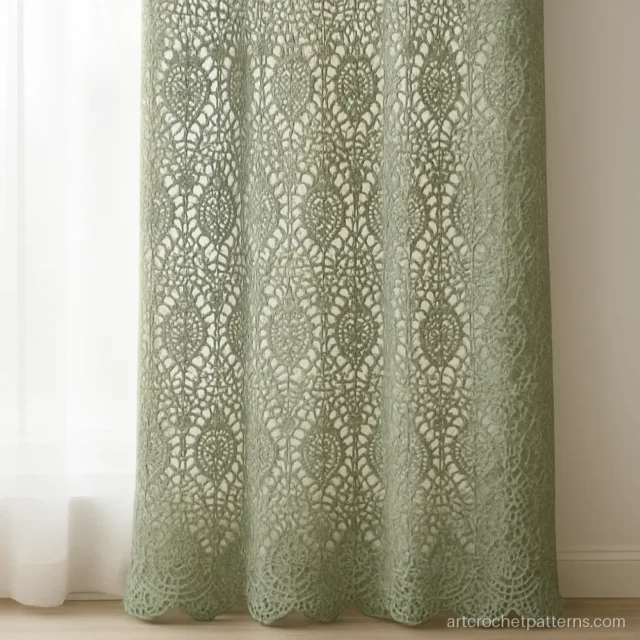 LevelAdvancedYarnSport cottonHook3.25 mm (D-3)
Sage pineapple lace long panel
Pineapple lace stacks fans of chain loops into pointed shapes. This floor length panel takes patience but blocks into an heirloom piece for a living room.
Maker note: Block the panel wet on a clean floor with rust proof pins so every pineapple opens to the same size.
 LevelBeginnerYarnBulky cotton blendHook6 mm (J-10)
Doorway curtain of crochet cords
Long chains backed with slip stitches hang from a dowel to screen a pantry or closet doorway. The wooden beads add weight so the cords hang straight.
Maker note: Make every cord a little longer than you need. Cotton cords shrink slightly after the first wash.
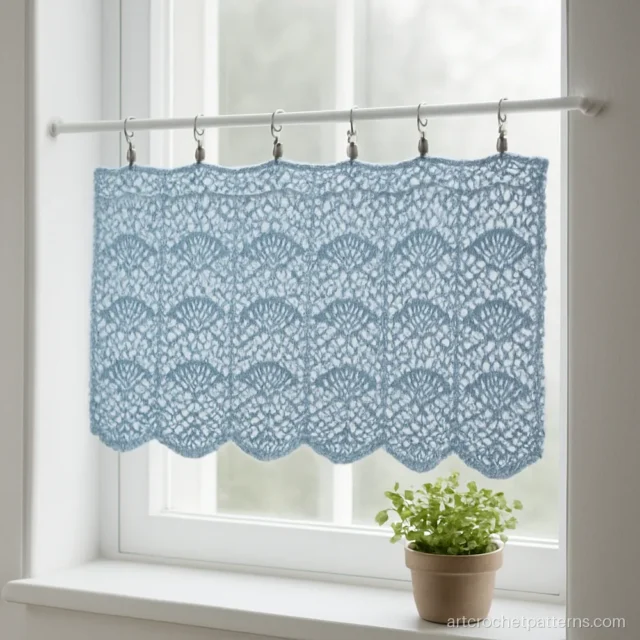 LevelEasyYarnDK cottonHook4.5 mm (7)
Pale blue shell stitch tier curtain
Fans made of 5 dc each give a denser fabric with more privacy than mesh while still letting light through between the fans.
Maker note: Shell rows need a chain multiple of 6 plus 1. Count twice before you start row 1.
Free crochet curtain pattern: mesh cafe panel
This panel is 30 inches wide and about 26 inches long, including a 1.5 inch rod pocket. It fits the lower half of a standard 30 to 36 inch kitchen window. To change the width, add or remove 2 chains for each mesh space.
Materials: about 450 yards (410 m) of DK (size 3) cotton, a 4 mm (G-6) hook, a tapestry needle, and a cafe rod.
Gauge: 9 mesh spaces and 8 rows = 4 inches in the mesh pattern. In this pattern the beginning ch 3 or ch 4 counts as a double crochet.
- Ch 137.
- Row 1: Dc in 5th ch from hook (skipped chs count as dc and ch-1 sp), *ch 1, sk next ch, dc in next ch; rep from * across, turn. (67 ch-1 sps)
- Row 2: Ch 4 (counts as dc and ch 1), sk first ch-1 sp, dc in next dc, *ch 1, sk next ch-1 sp, dc in next dc; rep from * across, working the last dc in the 3rd ch of the beg chs, turn. (67 ch-1 sps)
- Rows 3 to 48: Rep Row 2. (67 ch-1 sps)
- Row 49: Ch 2 (does not count), hdc in each dc and in each ch-1 sp across, turn. (135 hdc)
- Rows 50 to 56: Ch 2, hdc in each hdc across, turn. (135 hdc)
- Fasten off, leaving a tail of 40 inches for sewing.
Finishing: fold the hdc band in half toward the back so the last row meets Row 49. Whip stitch the edge down through the back loops, leaving both short ends open. Slide the rod through. Join yarn at a bottom corner and work 1 row of sc along the hem, putting 1 sc in each dc and 1 sc in each ch-1 sp, for a neat finished edge. Weave in ends along a solid row, then block.
Measuring the window before you chain
Measure the rod, not the glass. For a flat panel like the cafe curtain, make the width equal to the rod length. For a gathered look, make it 1.5 times the rod. For length, run the tape from the top of the rod down to your chosen hem line.
| Curtain style | Width | Typical length |
|---|---|---|
| Cafe or tier | Rod length, flat | Half the window, 24 to 30 in |
| Valance | Rod length to 1.5 times | 10 to 16 in |
| Sill length panel | Half the rod per panel | Rod to sill, often 36 to 63 in |
| Floor length panel | Half the rod per panel | 84 or 95 in |
| Doorway cords | Door width | Door height minus 2 in |
Crochet lace grows longer as it hangs, especially in heavy cotton. Stop a floor panel about 1 inch short and hang it for a week before adding a final edging.
Yarn and hook for crochet curtain patterns
Choose cotton or a cotton and linen blend. These fibers take sunlight better than acrylic, which can fade and turn shiny. Mercerized cotton adds gloss and sharp stitch outlines, both helpful in lace.
| Yarn weight | Hook | Result |
|---|---|---|
| Size 10 thread | Steel hook near 1.5 mm | Fine traditional lace, slow to make |
| Fingering cotton | C-2 or D-3 | Light, airy panels with detail |
| Sport or DK cotton | 3.5 mm to 4.5 mm | The best balance of speed and drape |
| Worsted cotton | 5 to 5.5 mm | Heavy, cottage style, fast to work |
Thread panels can take weeks. A DK panel the size of the pattern above takes a few relaxed evenings.
Picking a stitch for light and privacy
The stitch decides how much the room shows from outside. Open mesh stitch hides almost nothing but softens the view. Filet crochet lets you fill squares where you want cover, so a band of solid blocks at eye level adds privacy. Shell stitch and V stitch sit in the middle. Solid stitches like single crochet are too heavy for a window and block most of the light.
- Most light: mesh, open lace, pineapple lace.
- Some privacy: filet with a pattern, shells, granny clusters.
- Most privacy: line the panel with a plain cotton sheer behind the crochet.
Hanging options
A rod pocket is simple and hides the rod. Tabs show off the rod and slide more easily: work 2 inch wide strips of sc, fold each into a loop and sew it to the top edge every 4 to 5 inches. Clip rings need no sewing at all and let you take the panel down for washing in seconds. Clip into a solid row, never into a mesh space, or the clip will pull the lace out of shape.
When a curtain panel goes wrong
| What you notice | Cause | Remedy |
|---|---|---|
| Panel is narrower at the top | Spaces dropped at row ends | End each row in the 3rd ch of the beg chs |
| Hem flares or ruffles | Too many sc in the edging | Work 1 sc per stitch and space, no more |
| Curtain stretched longer | Weight of wet or heavy cotton | Dry flat, and hang a week before final edging |
| Lace looks crumpled | Not blocked | Wet block and pin square, see blocking crochet |
Washing and sun care
Cotton curtains can soak in a cool hand wash or machine washed inside a zipped mesh bag on the delicate setting, and lay them flat on a towel to dry. Never hang a wet lace panel; the water weight drags it longer. Direct sun slowly fades bright colors, so pale and natural shades age best on a south window. Take panels down twice a year to shake out dust. For more home pieces, browse the blankets and home section.
Questions makers ask
Are crochet curtains hard to make?
A mesh cafe curtain is an easy project once you can make a double crochet. The work is repetitive rows. Filet and pineapple lace panels are harder because you follow a chart or long repeats.
Which yarn works best for crochet curtains?
Cotton or a cotton blend in sport or DK weight. It holds its length better than acrylic, takes sun well and washes easily. Use size 10 thread only if you want fine traditional lace and have time to spare.
How many yards go into one crochet curtain?
The 30 by 26 inch mesh panel above uses about 450 yards of DK cotton. A solid stitch would need nearly twice as much. For long panels, buy all the yarn from one dye lot at the start.
Will a crochet curtain stretch over time?
Some stretch is normal, mostly in length. Cotton stretches less than acrylic, and open mesh stretches less than tall lace stitches. Dry panels flat and let them hang for a week before you finish the hem.
Can I use a granny square pattern for curtains?
Yes. Granny squares make cheerful valances and cafe panels. Join them flat and use a lighter yarn so the panel is not too heavy. The granny square pattern page shows the basic square.
Do crochet curtains give privacy?
Open mesh gives very little. Filet with filled blocks, shell stitch or a sheer liner behind the panel all give more cover while keeping the handmade look.