
A crochet ear warmer covers the part of your head that actually hurts in the wind, and it leaves a ponytail or a bun free. The band on this page is worked flat in moss stitch, which gives a dense, woven look that blocks wind better than open lace.
Moss stitch needs nothing beyond sc and a ch 1, so it suits anyone who has made a scarf or two. Beyond the full pattern, you get six designs, a size chart, and a way to turn the same stitch into a neck warmer.
At a glance
Skill level
BeginnerYarn
Worsted (4) wool blend, about 90 yardsHook
5 mm (H-8)Time
2 to 3 hoursStitches used
ch, sc, ch-1 spaces (moss stitch)Finished size
4.25 by 19 inches before seamingAlso called
Winter headband, ear band
6 crochet ear warmer designs to make
Every design lists the skill level, yarn and hook, with a note from the maker.
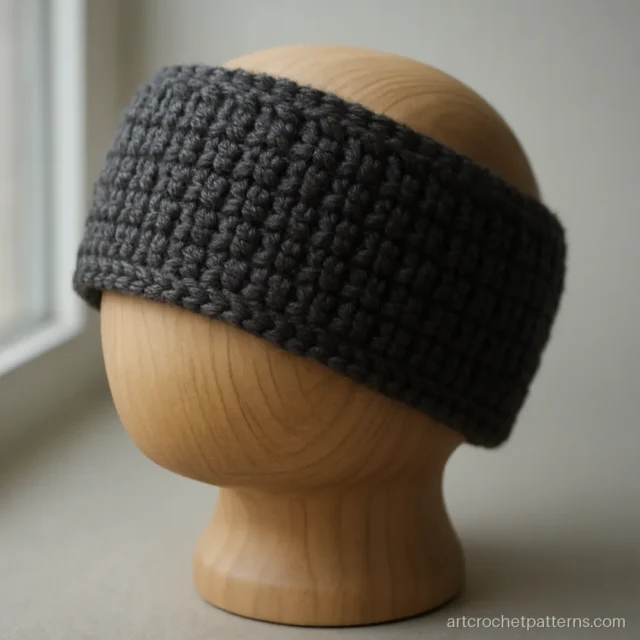 LevelBeginnerYarnWorsted (4) wool blendHook5 mm (H-8)
Charcoal moss stitch ear warmer
The band from the written pattern. A round of single crochet along both long edges keeps the woven fabric from curling.
Maker note: Count to 17 on each row while you settle in. Moss stitch hides a lost stitch until the band slants.
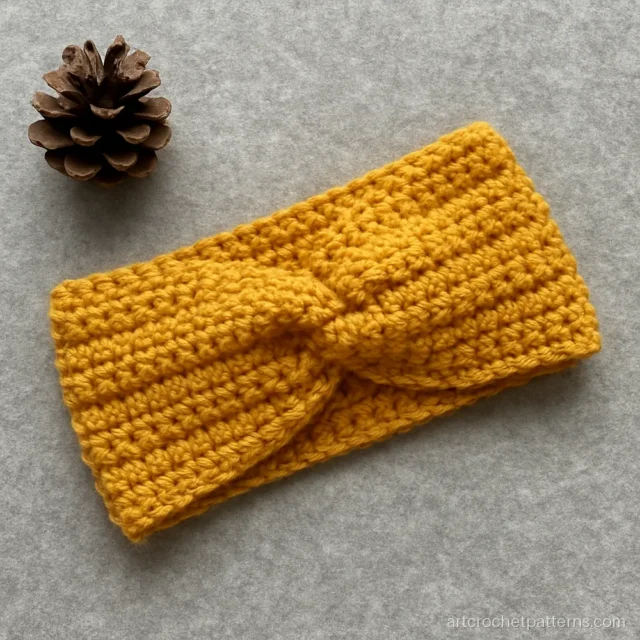 LevelEasyYarnWorsted (4) acrylicHook5 mm (H-8)
Twist front winter headband
Fold each short end in half, hook the folds through each other, then seam. The twist gives a cozy double layer right over the forehead.
Maker note: Make this one an inch longer than plain bands. The twist uses up length.
 LevelBeginnerYarnBulky (5) woolHook6.5 mm (K-10.5)
Chunky ribbed ear band
Sideways rows of back loop sc make tall ribs that stretch over a hat brim. Bulky yarn finishes this band in one evening.
Maker note: Work about 64 rows of 12 stitches. Ribs stretch a lot, so measure the band slightly pulled.
 LevelEasyYarnWorsted (4) woolHook5 mm (H-8)
Fleece lined ear warmer
A strip of fleece hand sewn inside turns any band into a cold weather piece. It also covers the wrong side, so yarn ends never touch the skin.
Maker note: Cut the fleece a quarter inch narrower than the band so it does not peek out at the edges.
 LevelEasyYarnWorsted (4) wool blendHook5 mm (H-8)
Button neck warmer
The same moss stitch, made wider and longer, wraps the neck and closes with buttons. The chain 1 spaces work as buttonholes, so no extra rows are needed.
Maker note: Pick buttons that just squeeze through a ch-1 space. Too small and they pop open in the wind.
 LevelEasyYarnWorsted (4) acrylicHook5 mm (H-8)
Kids ear warmer with little ears
Two small triangles sewn on top add a playful touch. Each triangle narrows by an sc2tog at its two edges on every row, down to a single point stitch.
Maker note: Sew the little ears through both layers of the band and knot the tails inside so small fingers cannot pull them loose.
Free crochet ear warmer pattern in moss stitch
The band is a long rectangle. You seam the short ends, then add an edge of single crochet around each opening. Moss stitch is also called linen stitch, and the moss stitch lesson shows it in slow motion if the rows below feel unclear.
Materials: 90 yards worsted wool blend, 5 mm (H-8) hook, yarn needle. Gauge: 16 sts and 18 rows = 4 inches in moss stitch. Size: adult, fits heads 21 to 22.5 inches.
- Foundation: ch 18.
- Row 1: sc in 2nd ch from hook, *ch 1, sk 1 ch, sc in next ch; rep from * to end, turn (9 sc, 8 ch-1 sps = 17 sts)
- Row 2: ch 1 (does not count), sc in first sc, sc in next ch-1 sp, *ch 1, sk next sc, sc in next ch-1 sp; rep from * to last sc, sc in last sc, turn (17 sts)
- Row 3: ch 1 (does not count), sc in first sc, *ch 1, sk next sc, sc in next ch-1 sp; rep from * to last 2 sts, ch 1, sk next sc, sc in last sc, turn (17 sts)
- Rows 4 to 86: repeat Rows 2 and 3, ending with a Row 2. The band should measure about 19 inches.
- Seam: fold the band so the short ends meet. Whip stitch them together through both loops. Do not fasten off.
- Edge round: ch 1, work 1 sc in the end of each row around one long edge, join with sl st to first sc. Fasten off. Join yarn at the seam on the other edge and repeat.
The finished band should feel snug, not tight. It will stretch about an inch with wear, which is why it is cut a little shorter than your head.
Ear warmer crochet pattern sizes
For other sizes, alter the row count and nothing else. The 17 stitch width suits teens and adults; drop to 13 stitches (ch 14) for small kids so the band does not cover the eyes.
| Size | Head | Band length | Width in sts |
|---|---|---|---|
| Toddler | 18 to 20 in | 16 in | 13 |
| Child | 19 to 20 in | 17 in | 13 |
| Teen, small adult | 20 to 21 in | 18 in | 17 |
| Most adults | 21 to 22.5 in | 19 in | 17 |
| Large adult | 22.5 to 24 in | 20.5 in | 17 |
Run a soft tape just above the eyebrows and across the upper ears for the real number. Our hat size chart has measuring tips that apply here too.
Yarn for a crochet winter headband
| Yarn | Hook | What the band feels like |
|---|---|---|
| DK (3) merino | 4.5 mm | Thin enough for a bike helmet |
| Worsted (4) wool mix | 5 mm | Warm and firm; the pattern above |
| Bulky (5) wool | 6.5 mm | Thick and quick for snow days |
Wool keeps ears warm even when snow melts on it. If the wearer finds wool itchy on the forehead, a superwash merino or a soft acrylic is kinder. Avoid cotton for winter; it holds cold moisture.
Making a crochet neck warmer from the same stitch
A crochet neck warmer is just a wider, longer band that buttons instead of seaming. Chain 32 for 31 stitches, which is about 7.5 inches wide. Work moss stitch rows until the piece wraps your neck with a 3 inch overlap, around 24 inches for most adults.
Skip the seam. Instead, sew three buttons along one short end. Opposite them, the gaps in the final moss row already act as buttonholes. Work the single crochet edge around all four sides to finish. For a looser loop that goes over the head, see the crochet cowl instead.
Mistakes that spoil an ear band
| What you see | Reason | Repair |
|---|---|---|
| Band slants or narrows | Skipping the final sc on a row | Count to 17 each time; the final sc tucks into the side |
| Holes look large | Chain 1 worked too loose | Pull each ch 1 down to the same height as the sc beside it |
| Seam makes a ridge | Seaming through the front loops only | Whip stitch through both loops, then steam it flat |
| Band slips up off the ears | Too long for the head | Rip back 4 rows at a time until it grips |
Questions makers ask
Can a first year crocheter manage this crochet ear warmer pattern?
Easily. There are just two rows to repeat, and both use single crochet and chain 1. The hardest part is keeping count at the row ends, and a marker clipped into each row's final sc solves that.
How long should a crochet ear warmer headband be?
Aim for a band that comes up roughly 2.5 inches short of the head so it grips. An adult with a 22 inch head needs a band of about 19 inches. A springy ribbed band can be up to 4 inches under.
Can I wear an ear warmer under a hood or helmet?
Swapping to DK yarn and a smaller hook slims the band down. Moss stitch lies flat with no bumps, so it is comfortable under a bike or ski helmet. Check that the helmet still fits snugly with the band on.
What is the difference between an ear warmer and a headband?
An ear warmer is wider, usually 3.5 to 5 inches, and is meant to cover the ears for warmth. A crochet headband is often narrower and mainly holds hair back.
How much yarn do ear warmers take?
An adult moss stitch band uses about 90 yards of worsted, and a kids size about 55. That means one standard skein makes two adult bands, or one band plus a matching pair of small mittens.
Why does my band ripple instead of lying flat?
The foundation chain is often tighter than the rows. Chain loosely, or chain using the next hook up and work Row 1 with your usual one. A firm block with steam also relaxes a ripple.